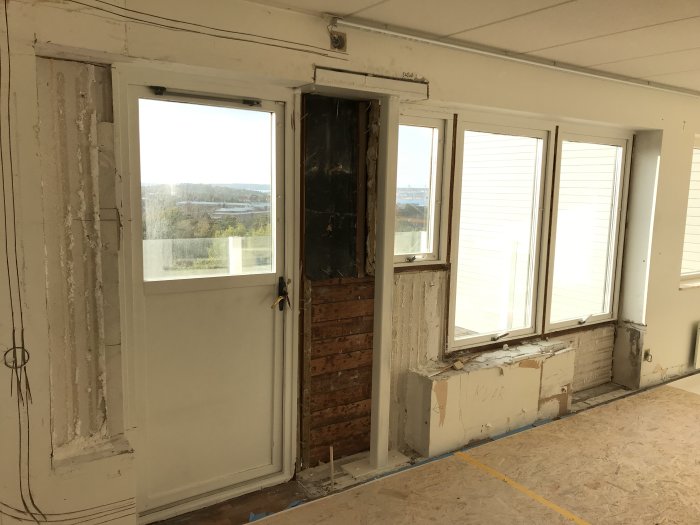
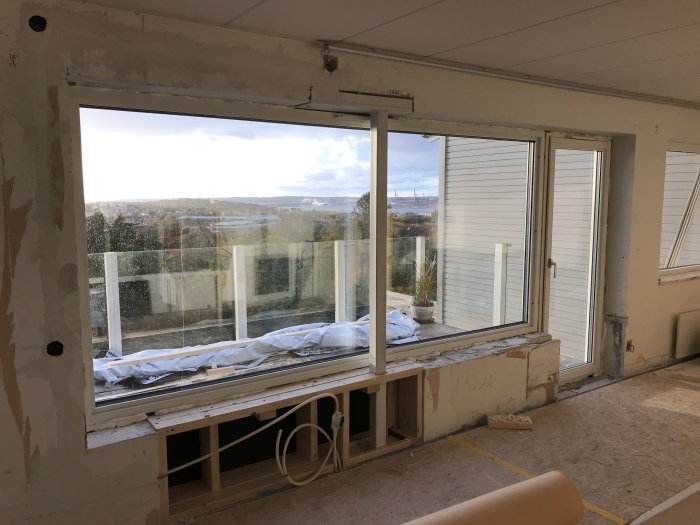
We are planning to install larger window sections in our house built in 1980 using aerated concrete. At the same time, we want to move the door to the balcony. See the image below.
Current Situation
Renovation Plans
Red indicates the new window sections and the location of the new balcony door. Green shows the space between the current window section and the current balcony door that we want to remove. For obvious reasons, we are somewhat concerned about the load-bearing capacity. I have obtained the relation drawings from the city planning office, but we can't make sense of how to interpret them.
Does anyone wise here on the forum know how to interpret the documents? - see below.
Our considerations are:
Is it possible to remove the green section without reinforcing above the new window section/balcony door?
Could the fact that the vertical load to the right of the new large window section descends above the window on the lower floor cause problems?
Of course, we intend to consult with a structural engineer with these plans, but I would like to have some insight into the matter first.
upper floor wall
explanation upper floor
lower floor wall
I would like to say that my experience with aerated concrete is limited and dates back a long time. But I can read drawings...
Zzamen said:
Is it possible to remove the green part without reinforcing above the new window section/balcony door?
No, two separate load-bearing beams rest on the green part.
Zzamen said:
Can the fact that the vertical load to the right of the new large window section goes down above the window on the lower floor cause problems?
No, not if the load is unchanged. It is evident from the drawing that there is a beam above the windows on the ground floor, which is dimensioned for 22 kN/meter.
I feel some hesitation about this project. It can have quite significant consequences that need to be thoroughly checked first.
That the beam is dimensioned to 22kN/m is probably much due to the balcony. But some force definitely goes down on the left side of the balcony today which instead has to be absorbed by the beam. Which it may (not) handle? ...
Much more information is required to form an opinion.
Is it a large window or three smaller ones? Between the windows, maybe you can have a stud to distribute the load from the roof?
The fact that the beam is dimensioned to 22kN/m is likely due to the balcony. But some force definitely goes today down on the left side of the balcony, which instead has to be absorbed by the beam. Which it might (not) handle? ...
It requires much more information to be able to form an opinion.
Is it a large window or three smaller ones? Between the windows, perhaps you can have a stud to distribute the load from the roof?
Our hope was to install a large window section to take advantage of the view without it being obstructed by studs. We have a neighbor with a similar house. They made this workaround by removing the pillar to the left of the window and instead made one large window section in that direction. They then attached an L-beam in the span and vertical beams in the corners down to the floor.
Can you deduce from the explanation what material the beams above the windows are made of? I find it hard to interpret the explanations in the documents.
I am quite sure that LB stands for a reinforced lightweight concrete beam. Since there are two such beams, one 3300 mm long and the other 1500 mm long, resting on the green pillar element, you would need a 4800 mm long beam to replace these. I don't think beams that long are manufactured. You could of course consider other materials, steel, wood, or concrete, but it's not without issues considering the weight differences. Glulam is probably the most realistic.
But couldn't you afford a rule between the patio door and the glass section? Then the span of the beam would be slightly less.
mmm well, sure you could, but the frame on both the door and window would be too wide for me per se. But of course - if it drastically changes the dimensioning conditions, it might have to be done. We've contacted a structural engineer now. Let's see what he says.
An update in this thread. I had a constructor calculate the solution, and with an IPE 240 on top along with VKR 80x80x5 on the sides and finally a plate like PLST 150x200x15 as protection against the floor structure, this should be possible. Then we must account for a 5 mm sag if snow cannon Allan comes.
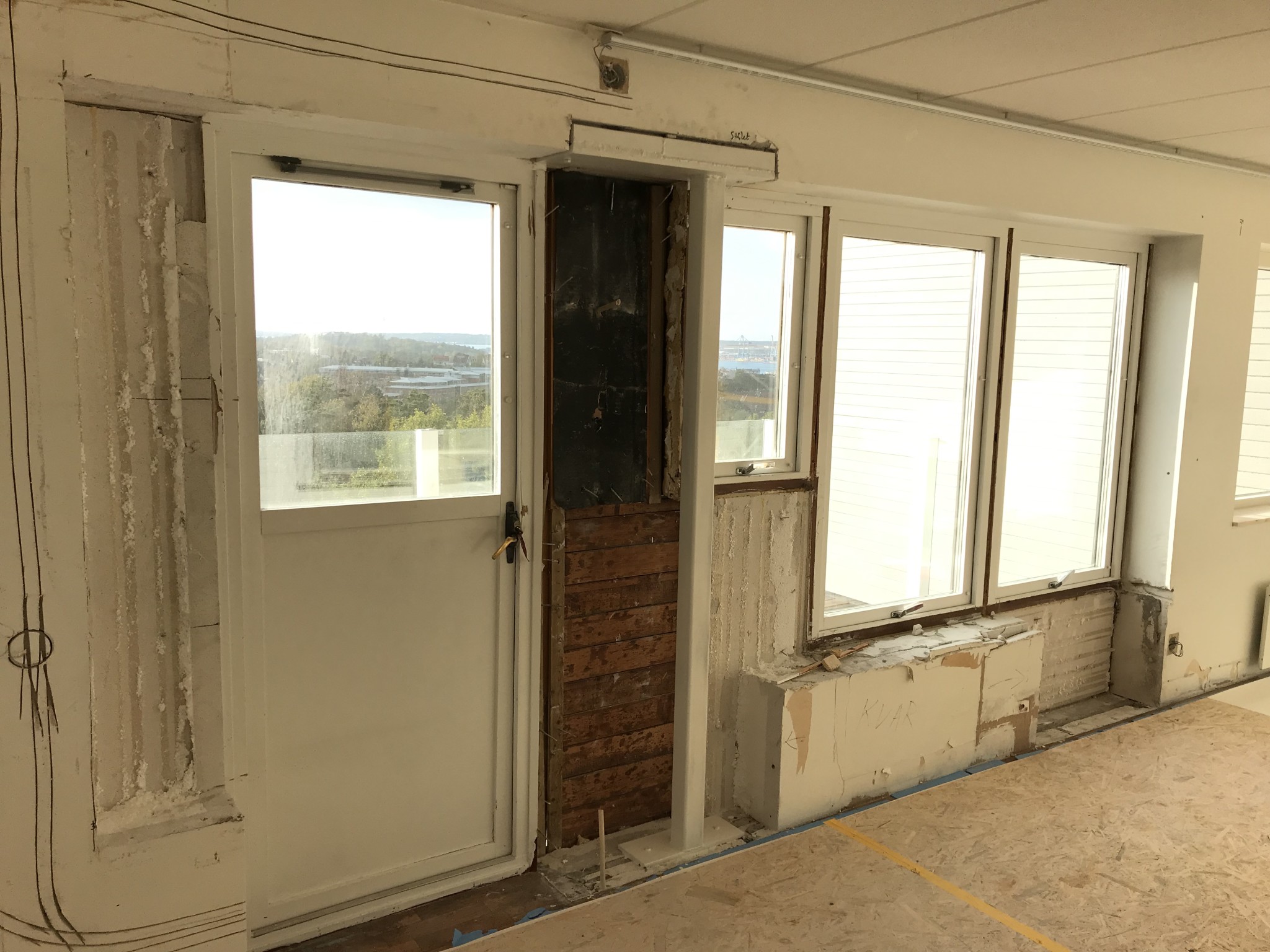
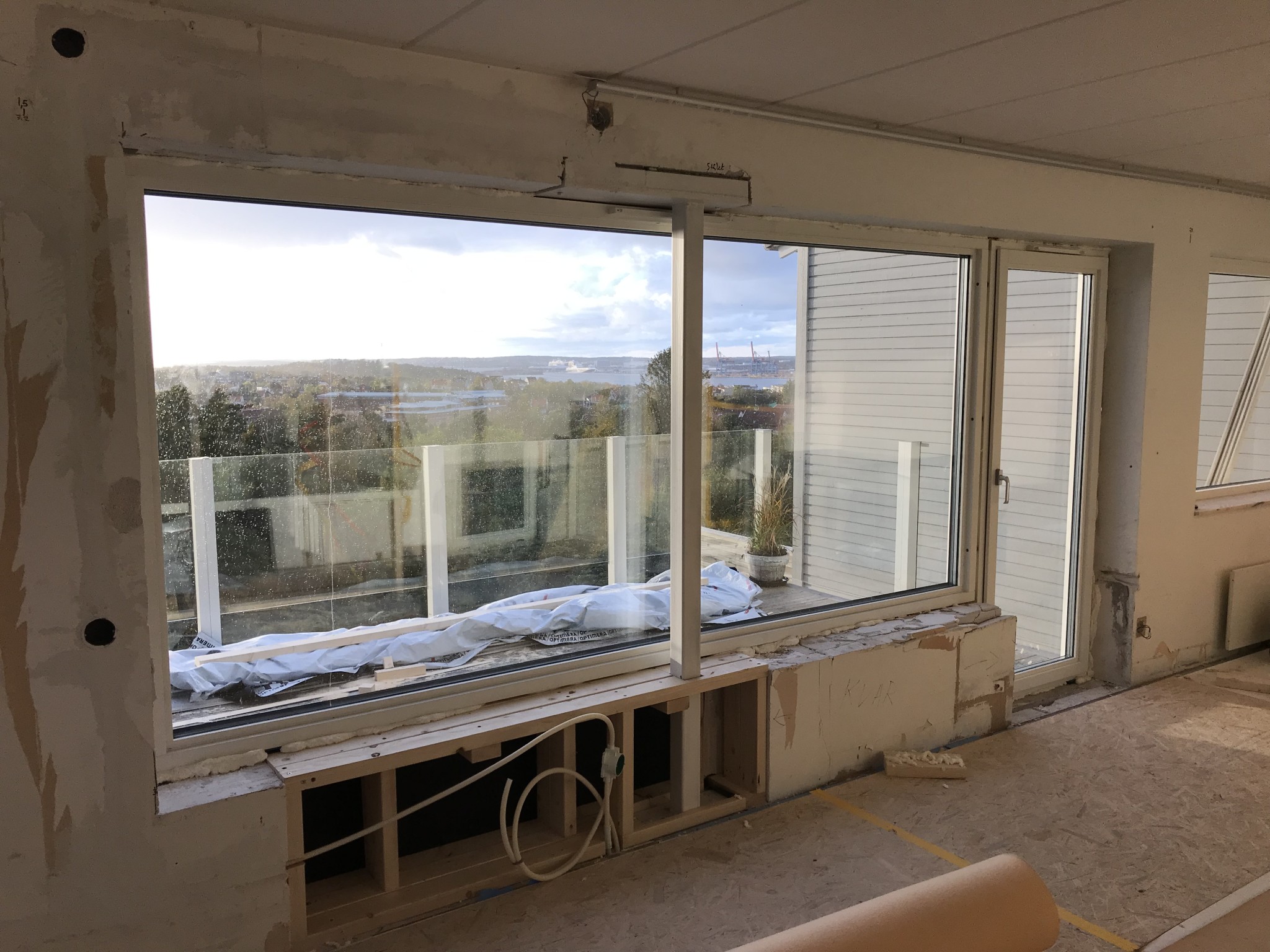
Thought I'd wrap up my own topic with a "this is how it turned out" picture. After much deliberation, we decided last fall to go ahead and open up for larger windows and move the patio door. We got estimates to entirely alter the opening with beams around the opening and floor joists. However, it was way too expensive, so the solution was a steel post that sits in the middle, inside the window. This post takes all the weight from the two lightweight concrete beams that supported the old opening. A compromise we have no problem living with—in fact, almost the opposite. The post prevents an aquarium-like feeling that might otherwise occur.
Steel installed, and all the lightweight concrete wall that isn't to be kept removed. Only the outer paneling and the remaining old windows separate us from the elements.
New window and patio door installed. The wall under the window that needed to be rebuilt was framed up instead of using lightweight concrete blocks.
Final result.
Click here to reply
Vi vill skicka notiser för ämnen du bevakar och händelser som berör dig.