
27,731 views ·
7 replies
28k views
7 replies
Is lime plaster the only option for an old basement?
Working on the bathroom construction in the basement and continuing an old question (http://www.byggahus.se/forum/byggma...lken-puts-faerg-som-anvaents-i-kaellaren.html) in this thread as the topic has shifted somewhat.
Previously, I was wondering what paint was used and if I could plaster over it, but now it turns out that most of the plaster and loose paint have been torn down instead, so now I am going to plaster the walls and am considering what type of plaster to use. As I am new to "stone houses," I have read a bit on the forum and the internet but haven't gotten much wiser than not being able to plaster with "harder" plaster than the existing wall can handle.
I have two walls that need fixing.
1. The outer wall has clearly been repaired (plastered and painted) in one spot but not another. The room was previously two storage spaces, and I have torn and moved the wall between them to make a larger room. In the attached picture, the left part is clearly newer, probably cement or KC because it is very hard. The right side is also more or less cleaned of paint and plaster, but here is a much thinner plaster. You can see in the debris that there are two layers; the bottom one might be lime, as the foundation of the house was probably laid around 1918, as you can see I am on the foundation wall which seems to consist of mortar and stone. I want to plaster and paint this wall.
2. Two interior walls are cleaned down to the brick, and the brick and mortar in the joints feel very weak. One brick wall, a short side with a door, will be plastered and painted. The larger brick wall I will just fill the worst holes in and then attach a moisture-resistant board here to tile; it seems like the easiest and quickest way to get a tile-ready surface.
Now the question is, is there a type of plaster I can go for here, especially for the outer wall?
Previously, I was wondering what paint was used and if I could plaster over it, but now it turns out that most of the plaster and loose paint have been torn down instead, so now I am going to plaster the walls and am considering what type of plaster to use. As I am new to "stone houses," I have read a bit on the forum and the internet but haven't gotten much wiser than not being able to plaster with "harder" plaster than the existing wall can handle.
I have two walls that need fixing.
1. The outer wall has clearly been repaired (plastered and painted) in one spot but not another. The room was previously two storage spaces, and I have torn and moved the wall between them to make a larger room. In the attached picture, the left part is clearly newer, probably cement or KC because it is very hard. The right side is also more or less cleaned of paint and plaster, but here is a much thinner plaster. You can see in the debris that there are two layers; the bottom one might be lime, as the foundation of the house was probably laid around 1918, as you can see I am on the foundation wall which seems to consist of mortar and stone. I want to plaster and paint this wall.
2. Two interior walls are cleaned down to the brick, and the brick and mortar in the joints feel very weak. One brick wall, a short side with a door, will be plastered and painted. The larger brick wall I will just fill the worst holes in and then attach a moisture-resistant board here to tile; it seems like the easiest and quickest way to get a tile-ready surface.
Now the question is, is there a type of plaster I can go for here, especially for the outer wall?
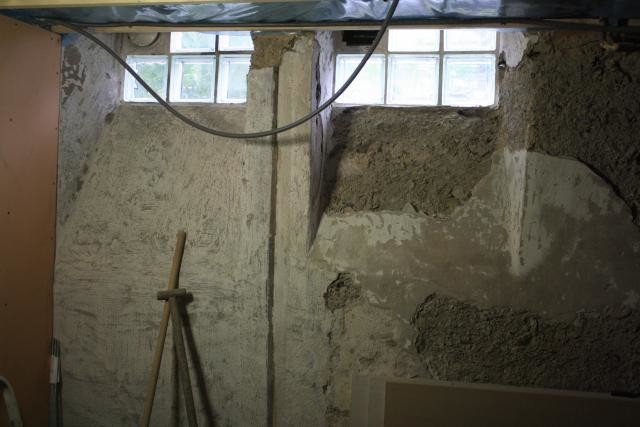
So you can't apply a harder mortar than what you have behind it. If you have a bare brick wall, B mortar will work. However, if you're repairing the wall in the picture (which I just saw)  make sure not to use a harder mortar than what's underneath. In old basements, it's not uncommon for it to be plastered with regular lime mortar (i.e., no cement in the mortar), and you shouldn't repair that surface with a mortar that contains cement. Alternatively, you can completely clear the wall of old plaster and apply new mortar.
So you have traditional lime mortar, then comes rendering mortar C (contains a little cement), rendering mortar B (a bit more cement), and cement mortar A (a lot of cement).
make sure not to use a harder mortar than what's underneath. In old basements, it's not uncommon for it to be plastered with regular lime mortar (i.e., no cement in the mortar), and you shouldn't repair that surface with a mortar that contains cement. Alternatively, you can completely clear the wall of old plaster and apply new mortar. So you have traditional lime mortar, then comes rendering mortar C (contains a little cement), rendering mortar B (a bit more cement), and cement mortar A (a lot of cement).
Thanks for the help. Based on the recommendation at the building store, I'm going with C mortar just to be safe. The wall that needs repairing is plastered with at least two different types of plaster, one that was easy to knock down and one that can't be removed without extreme force; I guess it was lime and cement-based respectively. Likewise, the joints in the brick wall are quite weak, so he recommended a slightly milder plaster. So, I just have to hope that what remains now is cement or some sort of kc variant, and we'll see in a while if it falls down again....
Hi MMR,MMR said:Thanks for the help. After a recommendation at the hardware store, I'm going with C mortar just to be safe. The wall that needs repair is plastered with at least two different types of plaster, one that was easy to knock down and one that can't be removed without extreme force. I guess it was lime versus cement-based. Also, the joints in the brick wall are quite weak, so he recommended a slightly milder plaster. So I'll just have to hope that what stays on now is cement or some KC variant, and we'll see if it falls down again in a while....
A little curious about how it went for you with your wall?
Standing with a house from 1924 that has plastered basement walls that are peeling. It feels very porous, but I don't want to knock everything down, just fix what's worst.
I have skimmed through the forum, but my case isn't really covered here.
My basement has lime plaster from '58 that has been painted with plastic paint. The paint has flaked off and a previous owner tried to blow it away with a pressure washer with moderate success.
The result now is that I can scrape off the plaster with my fingertip, both on the walls and ceiling.
A company I talked to thought it was enough to remove the paint and reinforce the plaster on the walls. However, we have no ROT left, so it seems I might have to put in the leather.
What is the easiest and best thing to do as a layman?
1) Reinforce the plaster myself
2) Knock down the plaster and re-plaster
3) Other suggestions
(in the ceiling, which is also plastered, I plan to put gypsum boards against wooden beams (above ground) that I attach to the concrete behind the plaster)
My basement has lime plaster from '58 that has been painted with plastic paint. The paint has flaked off and a previous owner tried to blow it away with a pressure washer with moderate success.
The result now is that I can scrape off the plaster with my fingertip, both on the walls and ceiling.
A company I talked to thought it was enough to remove the paint and reinforce the plaster on the walls. However, we have no ROT left, so it seems I might have to put in the leather.
What is the easiest and best thing to do as a layman?
1) Reinforce the plaster myself
2) Knock down the plaster and re-plaster
3) Other suggestions
(in the ceiling, which is also plastered, I plan to put gypsum boards against wooden beams (above ground) that I attach to the concrete behind the plaster)
Click here to reply
Similar threads
-
Uppräkning offert på faktura, vad gäller?
Priser, Kalkyler, Fastighetsskatt m m. -
Hur byta ut gammal gallerventil mot ny?
Byggnadsvård -
Någon som vet var man kan köpa en Rost (galler) till en Combi-Therm?
Övrigt husrelaterat -
Vad gäller för antal anslutningar på ett vanligt vägguttag
El -
Uppskov, gäller det endast nyköp av ersättningsbostad?
Priser, Kalkyler, Fastighetsskatt m m.