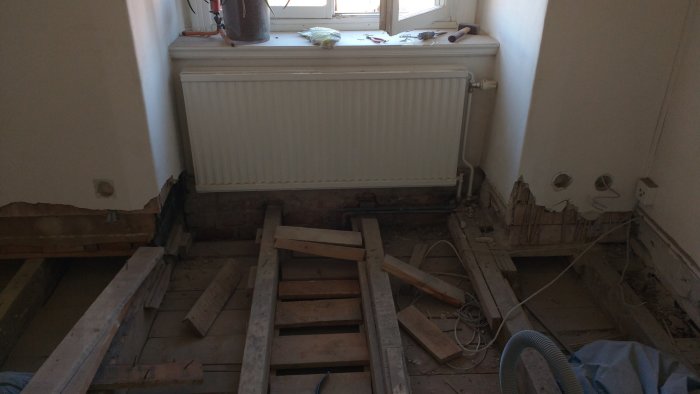
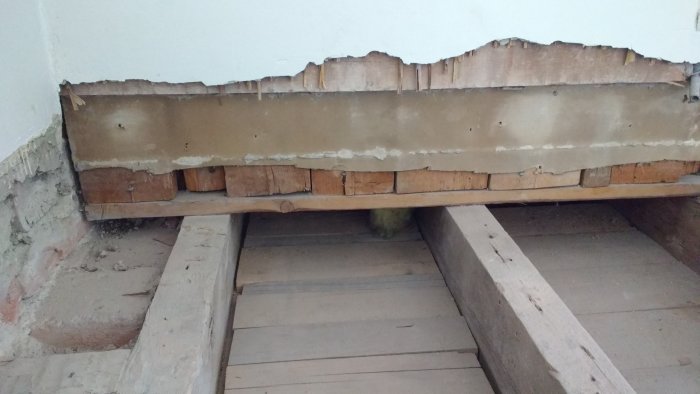
In the apartment I live in on the top floor, I've just been granted permission to level the floor joists. At the same time, I want to try to fix any deficiencies (the floor became 11 degrees cold in certain spots last winter).
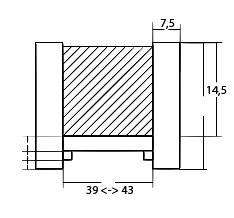
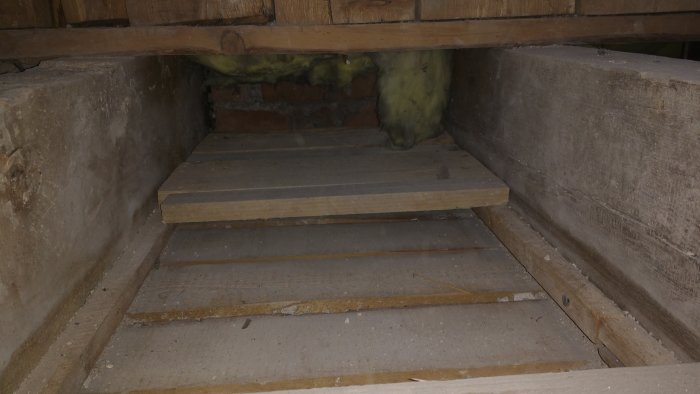
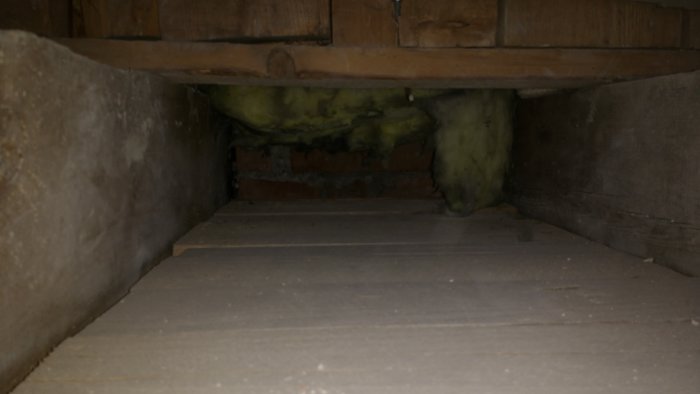
The joists are spaced about 50 cm apart, with a variation of about 3-4 cm. Then it has a blind bottom/cross bottom to support the 14.5 cm thick insulation of brick, clay, and mortar. The wind barrier on the walls stops about 10 cm before the floor begins, so the wind blows in, especially in the corner.
And since the blind bottom has an air gap of a couple of cm up to the ceiling joists, there's a good chance for the cold air to blow "freely."
One side is brick, and the other is part of the metal roof, so where there is a metal roof, there are double boards with wind barrier in between, which do not go all the way down to the floor.
So to the questions:
- Should I take the opportunity to ensure there is a wind barrier all the way down to the floor?
- Why is there an air gap, is it because people are paranoid about moisture?
- Shouldn't you be able to fill the air gap with something that insulates light sound which the heavy layer doesn't handle?
- Should I persuade the association to replace the old heavy insulation with something else that should be great for handling impact sound and more?
i.e., under the beam, the neighbor's roof joist is attached.
The strange thing is that the wind barrier on the walls stops a few decimeters before the floor, and last winter we had 11 degrees on parts of the floor. Several neighbors apparently have the same problem. But on the other hand, the joist goes all the way to the brick without a wind barrier...
The wind doesn't blow much through either brick or metal, but it doesn't hurt to seal. They rarely did things unnecessarily, so the air gap definitely has a purpose; it might be to prevent your insulation from falling to the neighbor's, but I would leave the gap.
I would probably align the beams, buy diffusion-open paper and place it in each floor beam compartment, then fill the compartments with rock wool. If you want to be excessive, you can put a paper on top of the insulation before laying the floor and let the paper go up slightly on the wall.
Thank you, some people think that the old sand brick chip mixture is good against impact sound. But you're voting for stenul? How does it work in a house that "breathes"?
Yes, if you have drafts in the floor and want to insulate, then definitely insulation. The insulation breathes; it's the plastic outside the insulation that is usually used to prevent moisture migration. If you want to eliminate footstep noise, you might consider placing a couple of layers of gypsum at the bottom, as gypsum dampens sound well. You don't need the insulation to extend more than a meter (or 60-80 cm) in from the wall, if you want to put your old mixture back there.
Clay was previously used to seal, for example, the subfloor, i.e., equivalent to windproofing paper, but rodent-proof.
It is likely cracks in the brick wall and/or gaps in the fiberglass that you see peeking down from the attic space that allow cold air to come in.
So, just as leby says, lay windproofing paper at the bottom of the subfloor and fill it with glass or rock wool (it insulates best). It is enough to do this from the inner edge of your walls outward, or if there are uninsulated exterior walls, then about 50 cm in. The rest of the compartments can be filled back with the old massive and sound-dampening filling. However, don't forget the windproofing paper here as well. Make sure to overlap and seal (tape) the windproofing paper on the walls too. Also, caulk all gaps, joints, pipe throughputs, etc., where there might be drafts. Even very small ones. When the wind blows, microscopic cracks/gaps are enough to make it very cold. It would be a shame to discover next winter that it was only 95% sealed when walls, floors, moldings, paint, and wallpaper are back in place...
A couple/double gypsum board pieces under the wool for soundproofing is not a bad idea. I recommend caulking around all edges to ensure soundproofing. With wooden moldings around, it will probably be even quieter (including caulking). The smallest air gap and sound sneaks through.
You can replace the boards with OSB if you want. It's not so damp that it can affect gypsum, you don't need to worry about that. Tape, anything intended to stick for a long time. There is special tape intended for taping canvas seams in hardware stores, which is cheap and good.
EPS would probably work too but messy and a bit more expensive... Then you never know which holes it might run into, maybe ends up with the neighbor.....
Vi vill skicka notiser för ämnen du bevakar och händelser som berör dig.