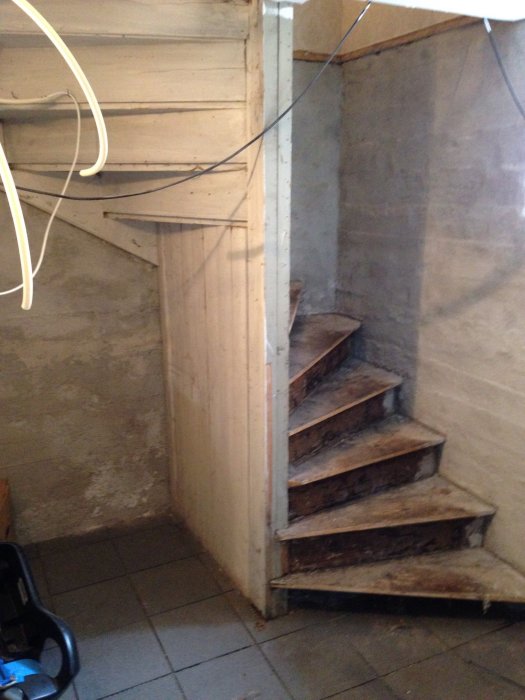
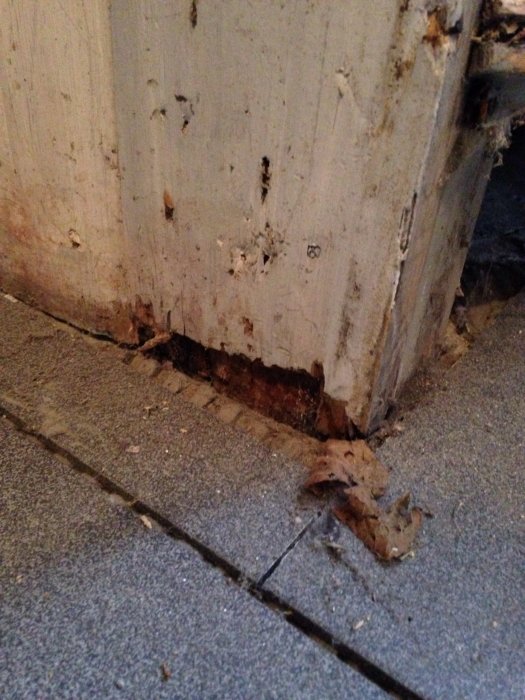
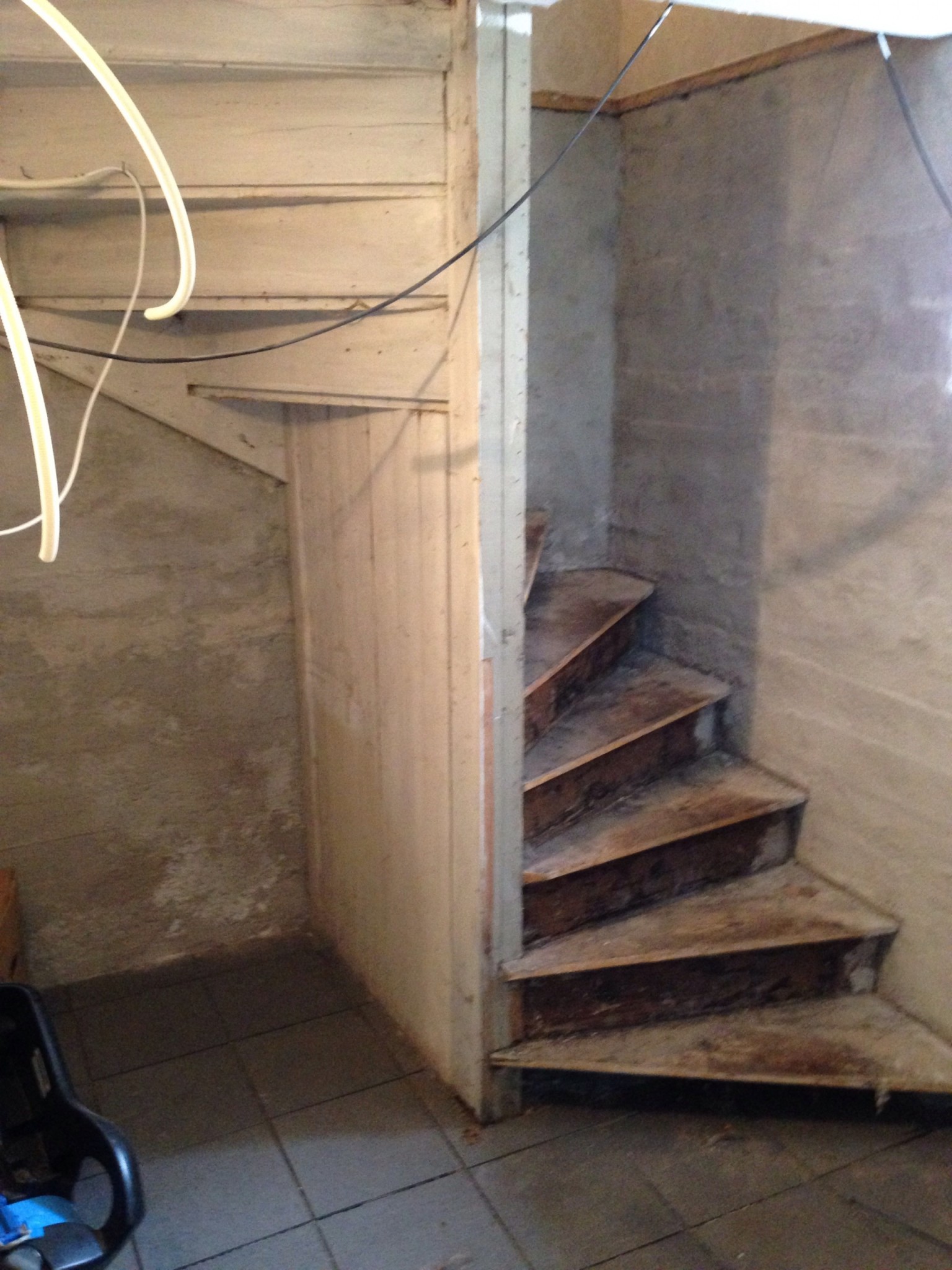
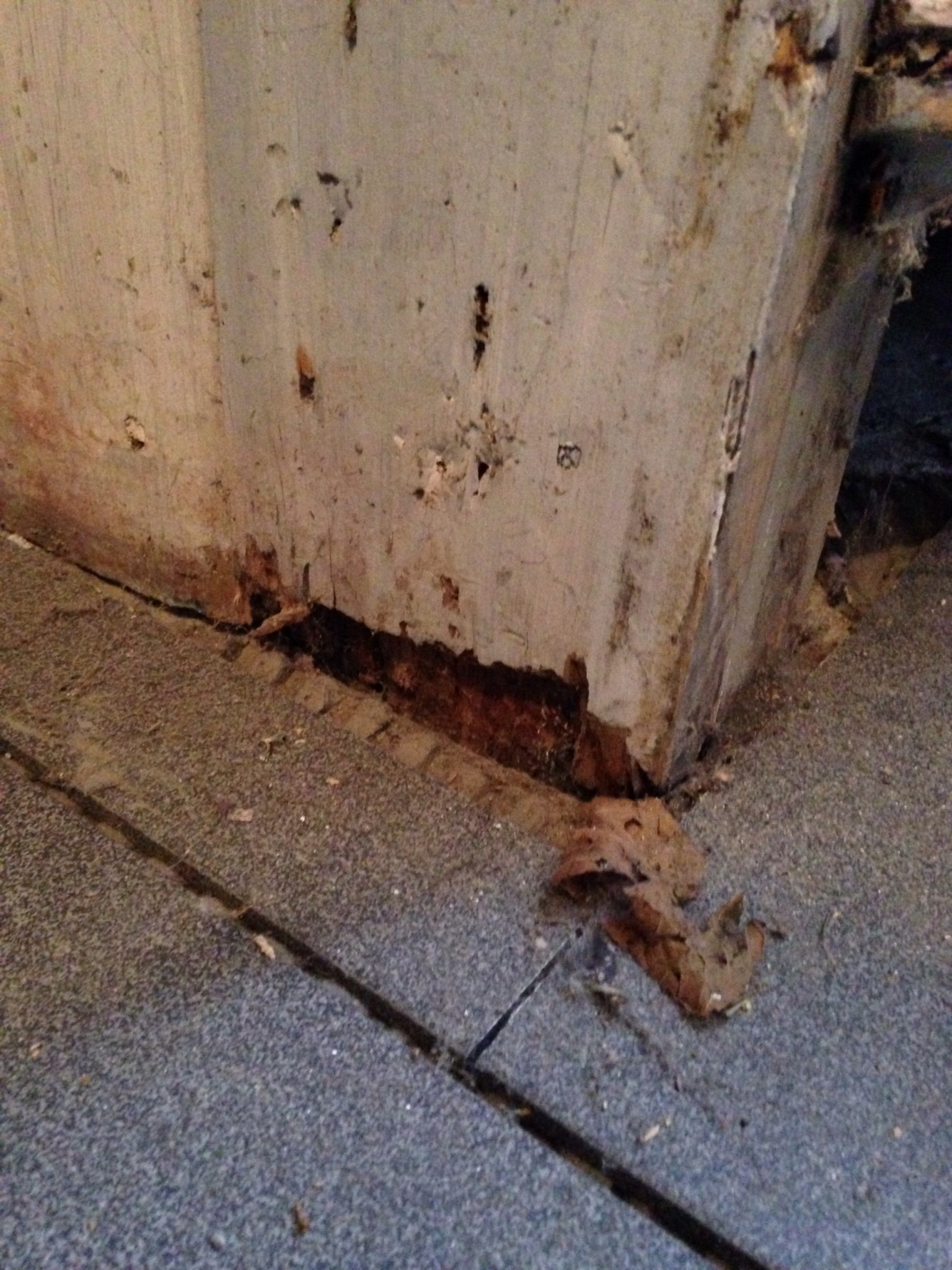
The staircase in my house is attached to a post that runs from the second floor all the way down to the basement. The floor has been cast around the post, which has naturally led to it rotting at the bottom. Otherwise, the basement is dry, and I haven't seen any damage on the parts that are directly against the basement wall.
The post is not completely rotten yet. But it would be best to fix it now since I'm going to be working there anyway. So I would appreciate some help with how to practically go about it.
How do I support the post while I repair it?
What's the best way to repair it?
How should I make a new "foot"?
Is the plank wall under the stairs part of the load-bearing structure?
I would have mounted a temporary post or two beside the post, and if possible avoided using the stairs during the repair time.
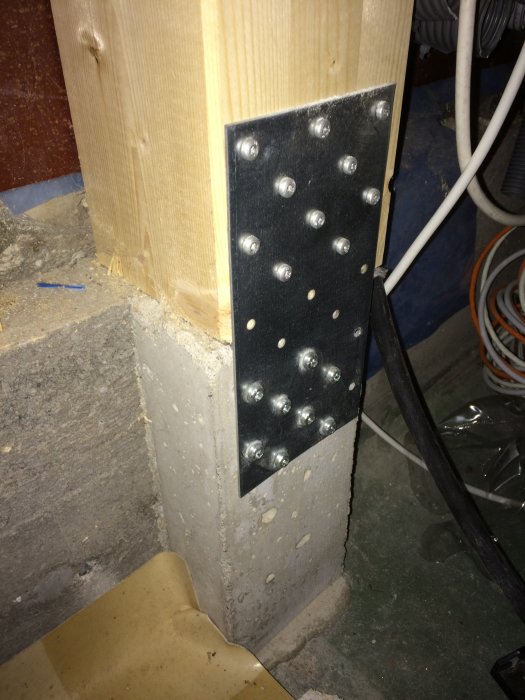
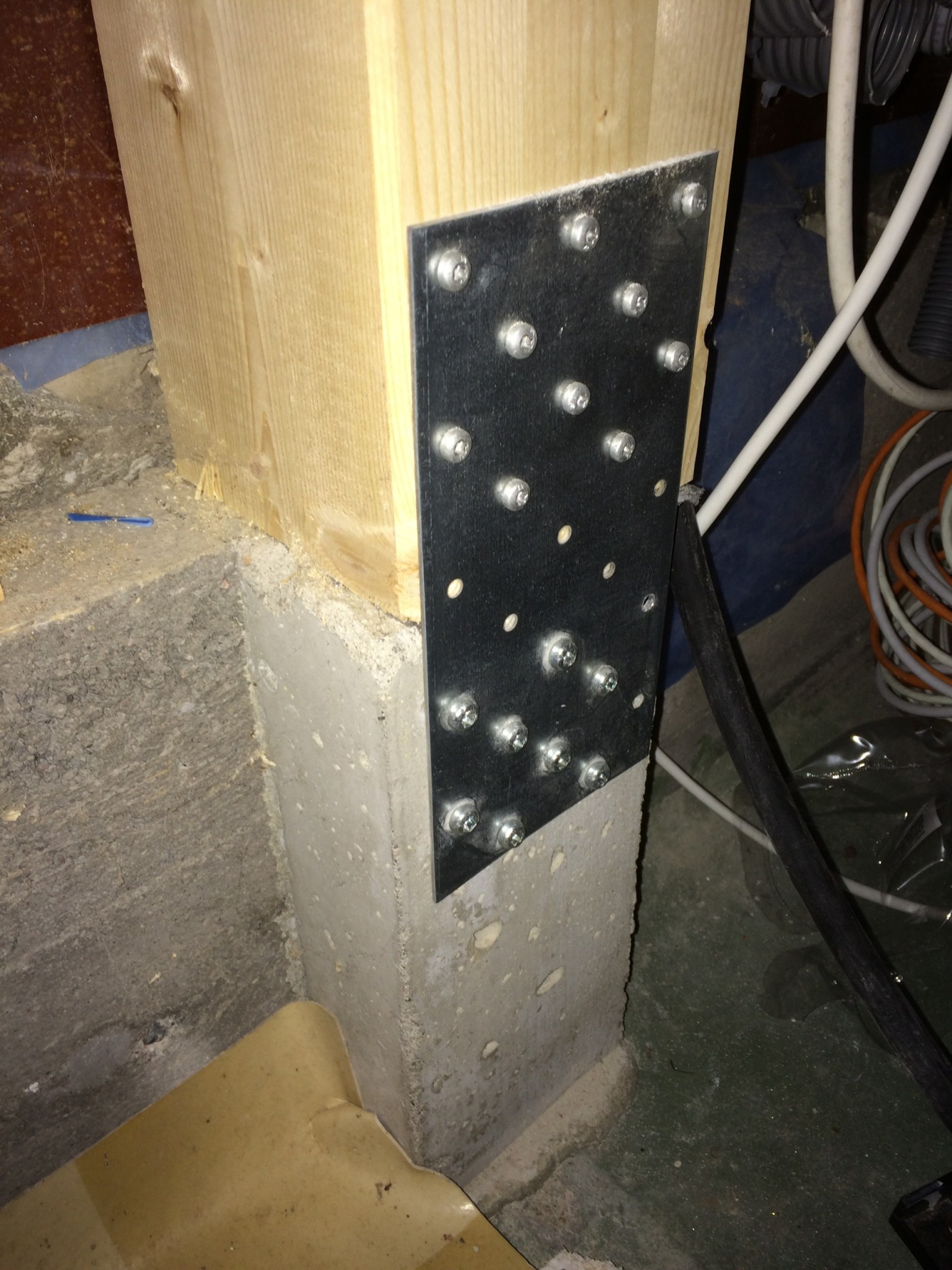
I would have cut the post and cast a small foundation underneath. Then, sill paper between the foundation and post. Fastening with steel plates and anchor screws. Like this.
The plank wall is not load-bearing. Additionally, it blocks some storage space. Remove it, I say.
Agree with Pelpet. Support. Cut off the post one decimeter up from the floor, cast a small flange. Splice the post. Syllpapp in between. Reinforce around the joint with wooden boards or metal plates. Done. Shouldn't be difficult. Remove the wooden wall. Not good to have an encapsulated space in the corner. Better to ventilate it properly.
Thanks for the tips. There's not much space to work with in the first step to cut down, but a little bit might be possible. I like Kurtivan's suggestion. I could try to dig out a bit, cast a post shoe that gets attached to the post. Otherwise, there won't be much of a ledge to speak of.
I've thought a lot about that wall. I was a little unsure if it was load-bearing or not. It feels like opening up the corner is the best option. That's how it'll be! There will be a freezer in the way, though, but it's good for the air to circulate.
You might want to consider re-draining the house? It seems quite damp by your stairs. Also, you should never use organic materials directly on the slab. The concrete absorbs moisture from the ground as the slab is always wet. You get less moisture around the house when it is drained. But the slab keeps absorbing from underneath constantly. If you cast a footing without addressing your moisture problems around the house, the post will still rot. Install a post shoe, and re-drain the house. The solution you're considering, in my opinion, will only postpone your problem.
Have you checked behind the plank wall? As some suggest, it looks very damp. Inside there is probably like a poor crawl space, I would guess. Easy to fix and well worth it. Any damage won't cost more than a short visit to the lumberyard.
The correct method, as several have suggested, is to temporarily brace the stair post and then insert a new piece. Additionally, remove the wooden wall under the stairs. The interesting question is why the rot damage has occurred. My guess is that the temperature in the basement is or has been too high (16 degrees is suitable) and has thus contributed to an excessive amount of condensed moisture in the bottom plate. My experience tells me that it is probably not a drainage issue. Old houses from the twenties like this are usually surrounded by so much clay that no ground moisture seeps in. When there is damage to the foundation, the water usually gushes in. I myself have lived for 30 years in a twenties house with a similar stair construction and with other wooden details lying directly on the concrete slab without any major damage occurring. In the past, wood with higher resistance (= kärnfur) was often chosen for exposed details. When you insert a new piece, it should of course be protected with sill paper.
I strongly claim that it was the built-in spell checker that changed syllpapp to sillpapp! Try it yourself. Syll is suggested to become sylo, syllpapp becomes sillpapp, it does it again. The person responsible wasn't at the building course. Sillpapp must exist in reality, the question is what it is used for?
I firmly claim that it was the built-in spellchecker that changed syllpapp to sillpapp! Try it yourself. Syll is suggested to become sylo, syllpapp becomes sillpapp, it does it again. The person responsible wasn't present at the construction course. Sillpapp must exist in reality, the question is what it is used for?
Haha, I don't think so at all! My phone in no way suggests that something called sillpapp exists! 😀
Probably, sill is unsuitable for protecting wood from moisture. So it probably isn't that
Personally, I would just leave it be unless the post is completely broken and truly rotten all the way through. If it's just a bit frayed at the edges, it means nothing if it is real heartwood, which it likely is. Sometimes it's easy to exaggerate things and think in a "modern" way. The staircase has been there since the 1940s? Maybe older than that. And it will likely stand just as long even if it looks a bit affected.
A bit of an update. The plank wall is gone. Behind and under the stairs was a wooden structure directly against the floor. I would say that corner is the most exposed area of the whole house in terms of external moisture. The wood lying against the floor could probably have been used in some construction. Not a trace of rot.
However, the post is completely rotten. I could stick a screwdriver straight through the entire post. But only the part that is embedded in the slab.
The plan is to unload, cut off, fill the hole in the slab with concrete, and insert new pieces.
As the picture above shows, the post is surrounded by tiles that are cut and laid around it. Would it hold if I filled the hole with concrete, waited a few weeks, and then laid tiles over it? And then inserted a piece of wood that stands on the tile slab? Or will the slab be crushed?
Is the drying time sufficient?
Vi vill skicka notiser för ämnen du bevakar och händelser som berör dig.