
13,711 views ·
11 replies
14k views
11 replies
How to reinforce a truss when relocating a brace?
Attaching photo so you can see the setup.
I shall install 2 skylights on either side of a roof truss. In the photos, only one skylight is installed so far.
Since the windows will extend a bit over the attic, I plan to let the floor under the windows extend a bit into the attic, i.e., push the attic wall, which is under the windows, a bit towards the eaves.
Therefore, I want to move the support post that supports the rafter of the roof truss (the one between the windows).
How do I best reinforce the rafter so that I can move the support post out? Is it possible to do so?
I've been considering using angle iron that I screw into the rafter, along the length of the rafter.
Do I need to have an engineer calculate this, or? Or can one just go with something oversized?
What does the city planning office require? (I actually already have a building permit to remove the roof truss as I initially planned to remove it entirely and install one large skylight.) Do I need to submit a construction notification? Building plan, quality manager...?
(As you can see in the photos, the truss is in 2 parts and jointed right at the support post.)
My last question is regarding the beam visible in photo 3. It runs along the attic wall and rests on the joists. The support posts in the attic wall stand halfway on it. BUT it is actually completely loose when you kick it, not even nailed, and therefore has no function (in my opinion), at least at the spot where the window will be.
What I can possibly imagine is that it is meant to distribute the load to all the joists, even the ones without a support post. I haven't found it in the house plans.
I shall install 2 skylights on either side of a roof truss. In the photos, only one skylight is installed so far.
Since the windows will extend a bit over the attic, I plan to let the floor under the windows extend a bit into the attic, i.e., push the attic wall, which is under the windows, a bit towards the eaves.
Therefore, I want to move the support post that supports the rafter of the roof truss (the one between the windows).
How do I best reinforce the rafter so that I can move the support post out? Is it possible to do so?
I've been considering using angle iron that I screw into the rafter, along the length of the rafter.
Do I need to have an engineer calculate this, or? Or can one just go with something oversized?
What does the city planning office require? (I actually already have a building permit to remove the roof truss as I initially planned to remove it entirely and install one large skylight.) Do I need to submit a construction notification? Building plan, quality manager...?
(As you can see in the photos, the truss is in 2 parts and jointed right at the support post.)
My last question is regarding the beam visible in photo 3. It runs along the attic wall and rests on the joists. The support posts in the attic wall stand halfway on it. BUT it is actually completely loose when you kick it, not even nailed, and therefore has no function (in my opinion), at least at the spot where the window will be.
What I can possibly imagine is that it is meant to distribute the load to all the joists, even the ones without a support post. I haven't found it in the house plans.
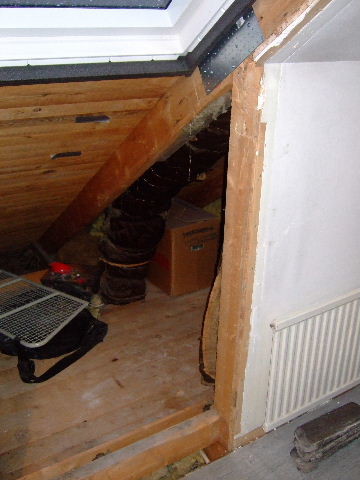
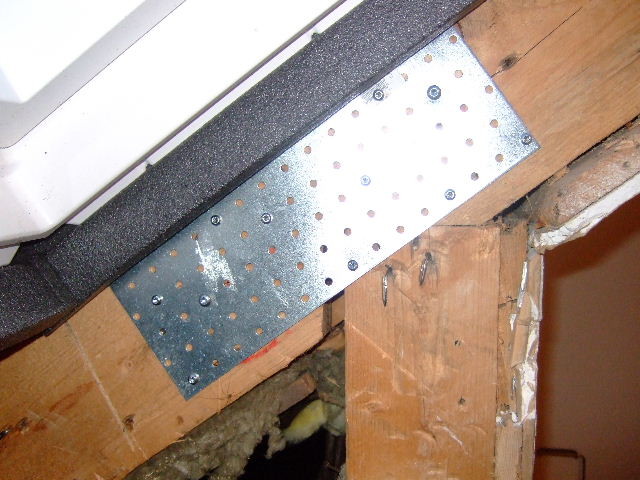
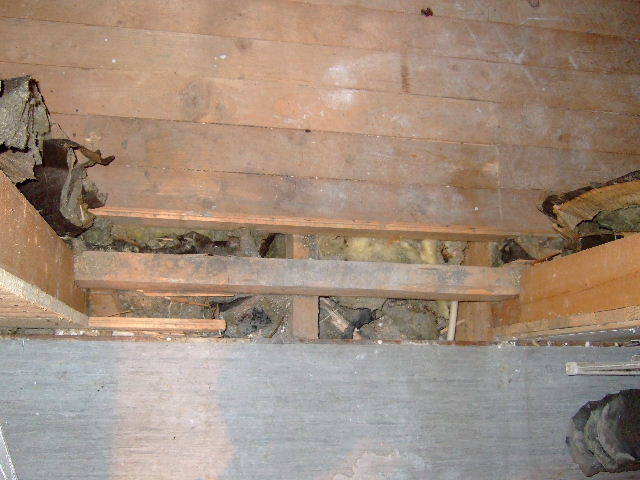
Last edited:
The building notification must be submitted 3 weeks before the construction starts.
I am going to build a dormer and need to support 2 rafters. The builder I am hiring said there wouldn't be any problems, but then I realized that I need a quality manager. Do you think the municipality will agree to let me be that myself?
I am going to build a dormer and need to support 2 rafters. The builder I am hiring said there wouldn't be any problems, but then I realized that I need a quality manager. Do you think the municipality will agree to let me be that myself?
Well, it is called a "follower" and ensures that point load from a roof truss is distributed to several braces. I thinkohlgren said:My last question is regarding the beam visible in photo 3. It runs along the knee wall and rests on the floor joists. The studs in the knee wall stand halfway on it. BUT it is actually completely loose when you kick it, not even nailed, and therefore has no function (in my opinion) at least in the place where the window is to be.
What I possibly can imagine is that it is intended to distribute the load to all the floor joists, even those that do not have a stud on them. I have not found it on the house plans.

OK. Thanks. I'll see if I can find more info on it.injonil said:
The question is whether it can be removed just under the window......? But since it's loose, it shouldn't practically weaken anything. The only thing is if the house settles a bit in the future and the loads redistribute a little.
I've just hired a constructor to calculate how it might be possible to move the support beam 1 meter closer to the eaves.
Unfortunately, he concluded that it would require 10 mm thick flat iron (on each side of the main beam) extending 1.65 meters on each side (up and down) of the two parts of the main beam (i.e., above the splice). On each side of the splice, 4 groups with 4 bolts in each group are required. A total of 32 bolts that need to be 16 mm thick to attach the 2 flat irons to the main beam.
So his advice is that I should skip moving the support beam.
One could theoretically install a completely new main beam from the ridge down to the eaves right next to the existing main beam, but then it would be too wide between the two roof windows that are supposed to sit on either side of the main beam (and they wouldn't fit either because there's already just enough space between the rafters). And it would also involve tearing up a lot of the interior ceiling, etc., to install the new main beam. Too much hassle, I think.
Unfortunately, he concluded that it would require 10 mm thick flat iron (on each side of the main beam) extending 1.65 meters on each side (up and down) of the two parts of the main beam (i.e., above the splice). On each side of the splice, 4 groups with 4 bolts in each group are required. A total of 32 bolts that need to be 16 mm thick to attach the 2 flat irons to the main beam.
So his advice is that I should skip moving the support beam.
One could theoretically install a completely new main beam from the ridge down to the eaves right next to the existing main beam, but then it would be too wide between the two roof windows that are supposed to sit on either side of the main beam (and they wouldn't fit either because there's already just enough space between the rafters). And it would also involve tearing up a lot of the interior ceiling, etc., to install the new main beam. Too much hassle, I think.

Hello. There are probably different rules in different municipalities regarding quality responsibility. It's best to ask the building office. I was responsible myself when we renovated the entrance of our house in Stockholm municipality. It's mostly about making sure the construction is carried out according to the existing guidelines, so there might be some studying involved.
Hello.
Hijacking this thread.
Wondering how it went for you?
Thinking about doing the same thing but without installing windows...
What did the designer say about cutting the follower?
Want to transfer one or two support legs.
Best regards
Hijacking this thread.
Wondering how it went for you?
Thinking about doing the same thing but without installing windows...
What did the designer say about cutting the follower?
Want to transfer one or two support legs.
Best regards
I cut the follower and removed the follower starting from the truss to the left (of the truss with the brace I was going to move out), and the empty truss to the right of it. I reinforced the upright with 2-meter, 5 mm thick angle steel on each side of the upright, which I fastened together with through bolts plus French wood screws, and I supported the upright by placing a beam in the attic on top of the tie beam between the 2 surrounding trusses.
Since the roof became lighter as it was replaced with windows instead of concrete tiles, and since I supported the truss, I assessed it as OK. I did not ask the designer about it.
Last winter with quite a bit of snow on the roof (Skåne), it held up well.
Since the roof became lighter as it was replaced with windows instead of concrete tiles, and since I supported the truss, I assessed it as OK. I did not ask the designer about it.
Last winter with quite a bit of snow on the roof (Skåne), it held up well.
Last edited:
Thank you for the response.
It seems like constructors have a hard time calculating this kind of thing...
I have talked to a roof truss company that didn't think my rafters, which are 50*145mm, should hold. Now they have held for nearly 50 years.
Best regards
It seems like constructors have a hard time calculating this kind of thing...
I have talked to a roof truss company that didn't think my rafters, which are 50*145mm, should hold. Now they have held for nearly 50 years.
Best regards
Click here to reply