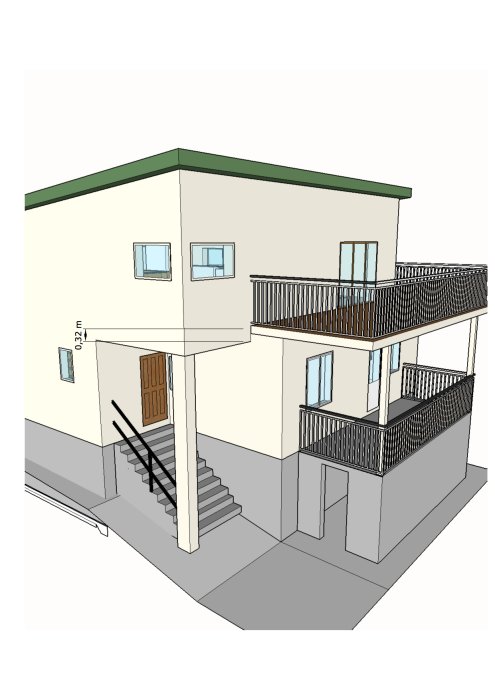
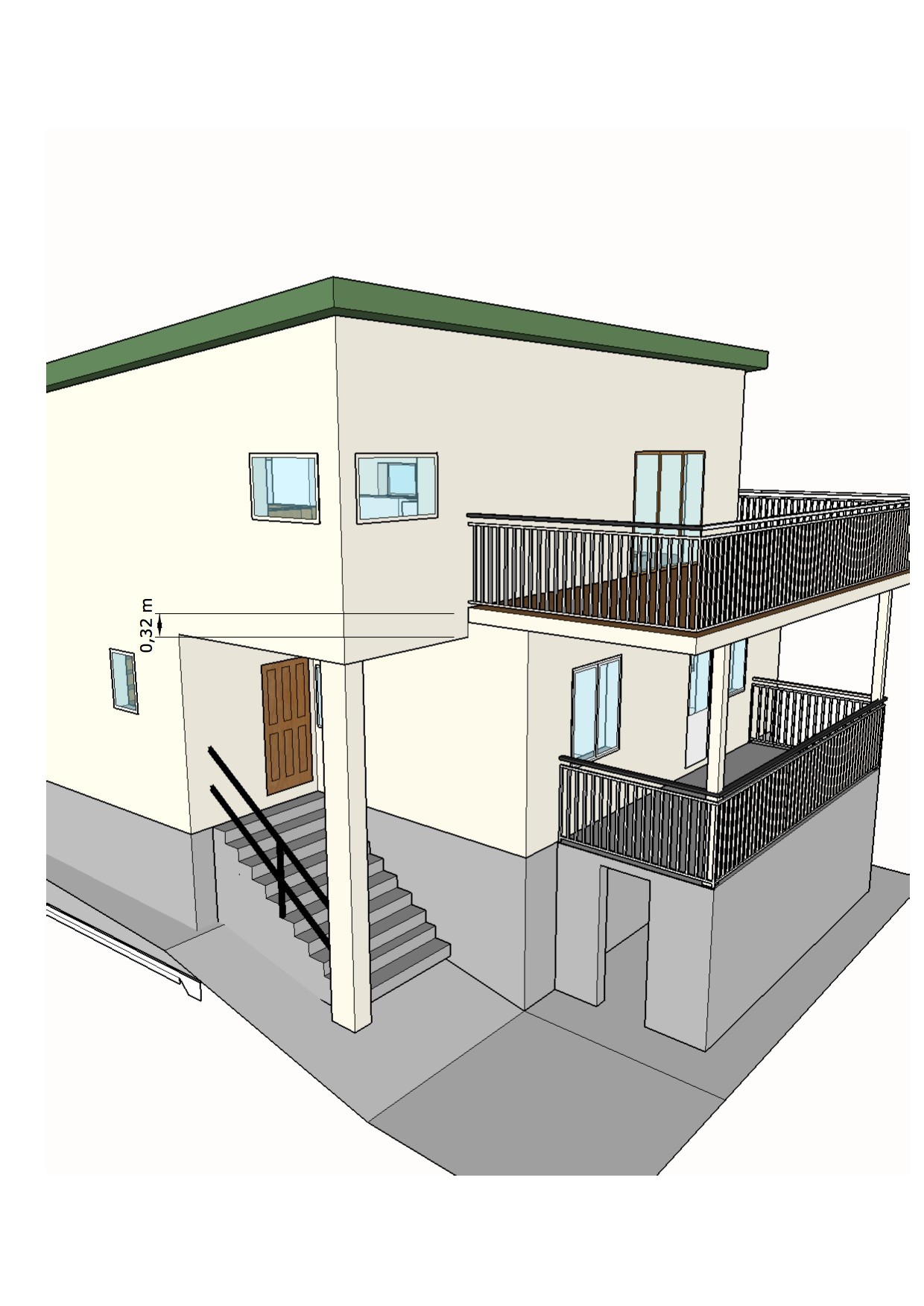
I'm in a bit of a tricky situation: In a week, I have a technical consultation with the municipality, and late in the process, I realize that I've designed a major challenge into our building permit. We're going to add a second floor to our house, and I've chosen to set back one of the walls on the upper floor so that it doesn't align.
The edge beam can then have four support points, a new cast concrete pillar, two load-bearing exterior walls of plank construction, and an interior wall that must be reinforced (possibly by building in a pillar extending down to the foundation wall.
The longest span will then be 3380 mm, I have tried to calculate this as if it were an opening in a wall and added to the load on the roof (for wall alignment, etc.). It should work with a 115x315 glulam.
Getting an edge beam at 315 is not optimal, but it works. Since a terrace joist frame will be connected to the edge beam, the extra insulation is beneficial. I would like to calculate how much load I can take down at the edge of a joist if I make it really strong (e.g., C24 45x220 300c/c with lots of blocking). I imagine that I can let the joist take down part of the load and reduce the dimension of the beam.
My questions:
1. How do I calculate how much a joist can handle? So, the opposite of what's on the wood guide, etc.
2. Is there another solution?
3. Is there a table I can use to calculate the loads from the upper floor?
I have looked at the computational models for openings in facades. In this context, it refers to point loads on columns and distributed loads along the wall plane. I am now trying to calculate this myself using a program from Strusoft called frame analysis.
Click here to reply
Vi vill skicka notiser för ämnen du bevakar och händelser som berör dig.