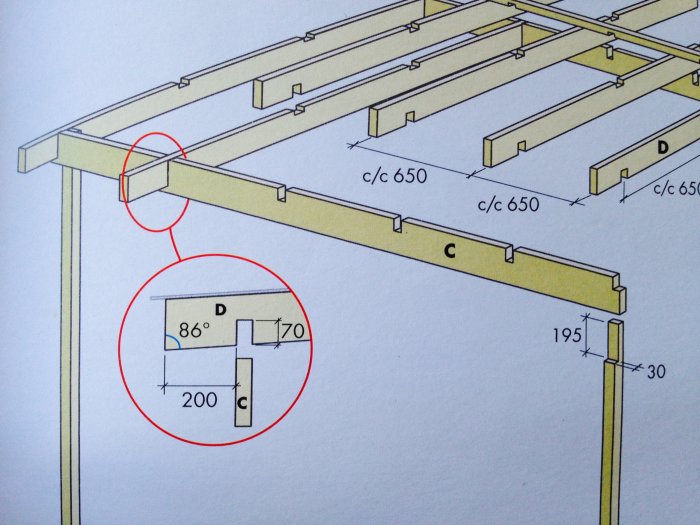
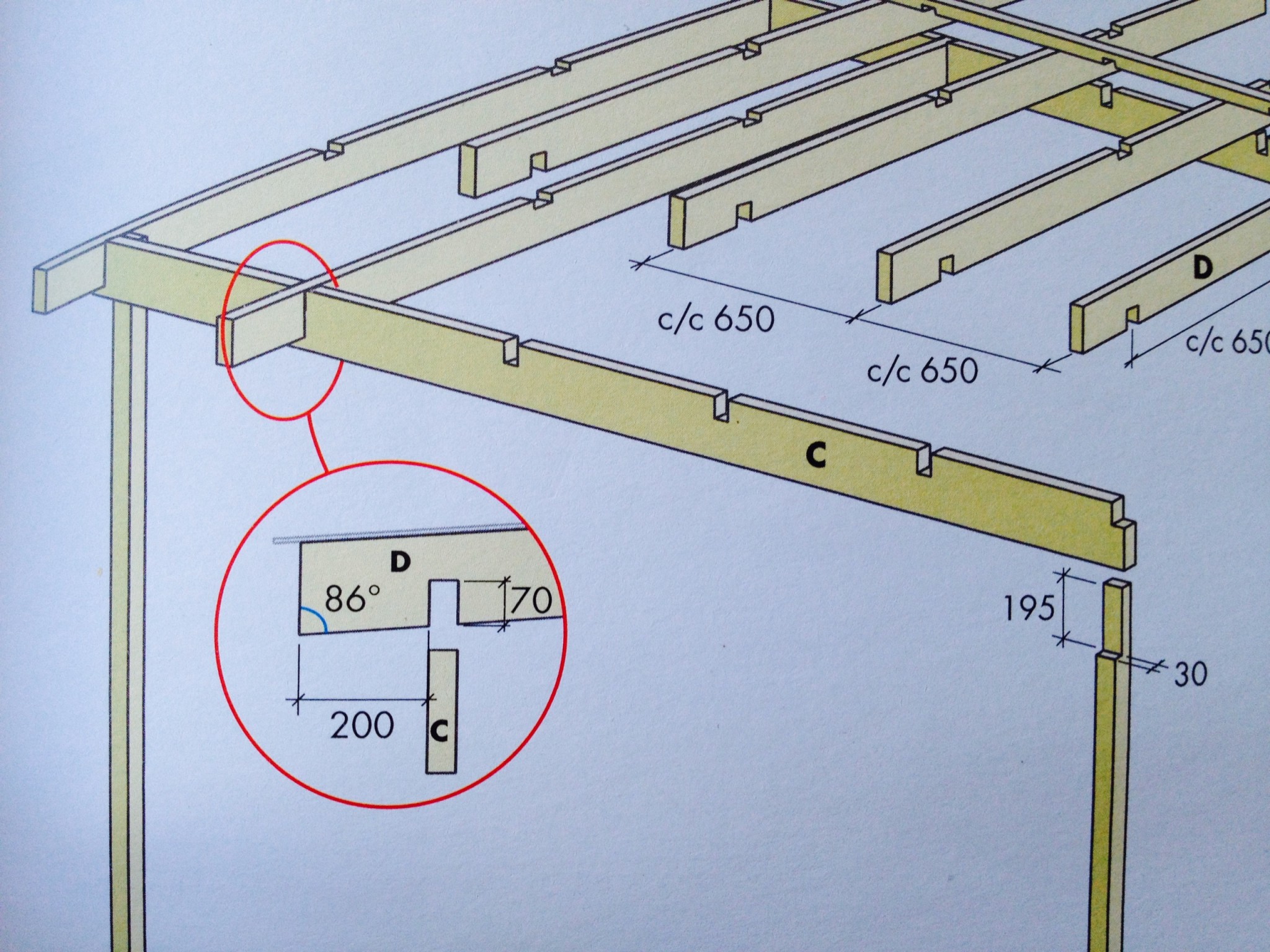
If you calculate (e.g., according to http://www.byggbeskrivningar.se/dimensionering) that the wall plate should be 45x195 and the truss 45x145, i.e., the same dimensions as in the image.
And then make notches in the wall plate and truss 70&75mm to recess the truss into the wall plate, how much does it affect the strength?
In the wall plate, there will be a compressive load, and where the truss is recessed, whereas the truss is tension-loaded but at the same time, the load might not be particularly large right at the end, so it would have been worse with such a notch in the middle of the truss.
Does anyone have a sense if one can assume that such a construction holds as well as if the wall plate and truss were not notched? Or does one need to increase the dimension (and then the entire notching loses its purpose if one wants as sleek a construction as possible).
In principle, the beams would need to be as much higher as the cutouts are deep to maintain load-bearing capacity. If you want to keep the height/bulkiness down (which is completely understandable), you can increase the width of the boards to compensate for the loss of load-bearing capacity due to the cutouts (to some extent).
Another well-known old trick to make things look sleeker (and nicer) is to bevel towards the ends and chamfer the edges.
Edit: Regarding load-bearing capacity, it's a theoretical estimation. The cutouts don't necessarily reduce the bearing capacity exactly as much as they are deep. However, the exact calculations need to be assisted by someone else.
I don't know how the hammarband is affected, but if the construction doesn't need to be open and/or aesthetically pleasing, I would have placed the rafter ties in joist hangers against the hammarband..... If nothing else, just to be able to sleep better...
It will be the weakening that hempularen writes about, you can remove what you have notched out from the collar tie's (but I would call it a load-bearing beam) cross-section. And since strength decreases with the square of the cross-section height, it becomes an extremely large weakening. In short, don't make any notches.
That was about the load-bearing beam; when it comes to the rafters, it's quite alright, you can probably notch out to half without any problem. The bending moment is max in the middle of the span. Issues may arise if you have more than two supports, i.e., more than two load-bearing beams, as you'll have a bending moment where you want to notch out, at all places except the outermost supports. The same applies if you let the eaves stick out far or don't have the second support close to the wall.
What can be done with the rafters is to protect them from longitudinal splitting starting where the notch is. Place a nail plate or a splice board across it.
The original plan was to completely skip the eaves to avoid the "stacked plank look," that is, a substantial wall plate with equally substantial rafters on top, without having everything at the same level. But then you don't get eaves. But then I saw this drawing in a book and thought that maybe you could have it all so it was more the principle I was after.
But of course, maybe you can complement the drawing in the book with joist hangers on the inside. The question then is what deflection the wall plate will get, the notches are filled with wood (from the rafter), so they can't be compressed.
The question is then what deflection the top plate will have, as the notches are full of wood (from the truss) so they can’t be compressed.
Well, wood does shrink and dry over time, and with the seasons. And wood can withstand significantly lower pressure across the grain direction.
So the answer is; you cannot count on any strength from the fact that the notch is filled with other wood, in a different direction.
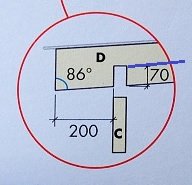
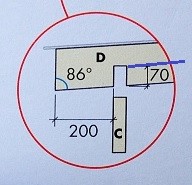
I want to argue that there is a high risk of the trusses cracking according to the blue line below:
The fact that the notch is shaped with sharp corners gathers the tensions there.
Rounded corners would have been much better.
This is exactly what happened to a neighbor's flat garage roof during the snowy winter of 2009/2010.
All of us on the street (it was similar group houses) shoveled our garage roofs except this neighbor.
He smiled smugly at us other fearful ones. He was, after all, a Chalmers professor in construction engineering.
The day after, he was up shoveling, but by then it was too late
Hmm... I wonder how well shot peening works on wood:wow:. However, that fracture mode should be manageable with a joist hanger.
Then I imagine that even if the wood shrinks, there will only be a certain amount of bending in the hammer beam/support beam, but then it stops anyway. And since wood rarely breaks under compression but rather under tensile (I think), the grain direction shouldn't be that important.
But even if it holds, I don't want to go against any sort of established precautionary principle in sizing, so that in about 50 years, I don't get sued back to the Stone Age by some pampered 30-something who has just bought their first house.
But the question was more about whether there is an established sizing model that supports the theory.
why notch out either the beam or the rafter, it's just to mount the beam lower down, then you have to cut into the hammer band but it doesn't matter from a construction point of view anyway
Maybe a bit of confusion. I thought that a load-bearing beam for a roof is called a wall plate, i.e., 45x195mm beam "C" in the picture. However, it may be that the load-bearing beam is just a load-bearing beam and a wall plate is only a horizontal beam at the top that doesn't bear any load from above but just holds together lengthwise. And you can have both a load-bearing beam and a wall plate.
In any case, the horizontal beam that takes the load of the trusses and the trusses themselves (or roof beams or whatever you call these beams).
I haven't really understood the purpose of this project. Do you want to lower the ceiling height or do you want to lower the eaves so that it looks lower?
I haven't quite understood the purpose of this project. Do you want to lower the ceiling height or lower the roof edge to make it appear lower?
I want the trusses and the load-bearing beam at the same level but still have a roof overhang if possible.
The alternative is to have the same level on the load-bearing beam and trusses and skip the overhang or place the trusses on top of the load-bearing beam and create an overhang.
I think the solution in the picture should work with only a minor strength reduction compared to placing the trusses on top of the beam. In the trusses, the tension is less inside (they are designed for the tension in the middle), and in the beam, it's on the compression side, and the hole is filled by the truss.
Vi vill skicka notiser för ämnen du bevakar och händelser som berör dig.