35,161 views ·
20 replies
35k views
20 replies
How do I know which plaster/paint has been used in the basement
I live in a house from the 1920s. It's a 1 1/2 story with a basement, with a brick frame and interior walls. It could very well be the original plaster even though it seems unlikely, as there hasn't been much modernization in the basement.
I'm currently working on one of the rooms in the basement that will become a bathroom. There is 1 exterior wall (uninsulated), two interior walls (plastered brick), and one interior wall that will be newly built (metal studs and moisture-resistant boards). The new wall will be waterproofed and tiled, where the bathtub and shower will be located. On one of the interior walls that will partially be in the shower area, all the plaster has been knocked off; I will probably attach moisture-resistant boards for tiling here. But the exterior wall and the last interior wall remain. The plan was to paint (or perhaps tile) them, but first, they need to be repaired and plastered smoothly regardless of how I choose to proceed.
The next step seems to be figuring out what type of plaster/paint I currently have. I have read some different threads about lime plaster, silicate paint, etc., and the discussion often involves which materials are suitable or not. Since the plaster adheres very well in most areas, I hoped to simply knock off the loose plaster, repair, and paint everything again (or tile, if that's the decision).
- Are there any simple ways to find out what type of paint/plaster is currently in place?
- If it is, for example, lime plaster and silicate paint (or possibly lime paint), can I smooth plaster and possibly paint over this, or does all the paint need to be scraped off?
I'm currently working on one of the rooms in the basement that will become a bathroom. There is 1 exterior wall (uninsulated), two interior walls (plastered brick), and one interior wall that will be newly built (metal studs and moisture-resistant boards). The new wall will be waterproofed and tiled, where the bathtub and shower will be located. On one of the interior walls that will partially be in the shower area, all the plaster has been knocked off; I will probably attach moisture-resistant boards for tiling here. But the exterior wall and the last interior wall remain. The plan was to paint (or perhaps tile) them, but first, they need to be repaired and plastered smoothly regardless of how I choose to proceed.
The next step seems to be figuring out what type of plaster/paint I currently have. I have read some different threads about lime plaster, silicate paint, etc., and the discussion often involves which materials are suitable or not. Since the plaster adheres very well in most areas, I hoped to simply knock off the loose plaster, repair, and paint everything again (or tile, if that's the decision).
- Are there any simple ways to find out what type of paint/plaster is currently in place?
- If it is, for example, lime plaster and silicate paint (or possibly lime paint), can I smooth plaster and possibly paint over this, or does all the paint need to be scraped off?

I would think it's fine to polish that paint. If you scratch the paint and it peels off in large flakes, it's some other paint than silicate or lime paint; lime/silicate paint is more homogeneous with the substrate and should turn into powder or similar colored sand when you scratch it.
OK, thanks, I already had a hunch that it's not plastic paint, but it's just as you describe, it's almost as if the plaster is "colored", meaning it's almost impossible to get the paint off without knocking down the plaster (which is solid where it hasn't more or less come off on its own due to moisture impact). If you rub the paint with your finger, your fingertip turns white.
Then it is probably not silicate paint. Silicate paint has no gloss and resembles lime paint but hardly chalks and doesn't dissolve in water.MMR said:
It might be lime or distemper paint if it turns dark, damp with water. Try with a damp finger
 . Those paints can be washed away with water right down to clean plaster.
If it chalks but doesn't dissolve in water, it could be an old chalking linseed oil paint that was also used on plastered walls that needed to withstand wear. Linseed oil paint adheres like stone to the plaster.
If it burns and smells plasticky, then it's one of the newer types of paint like base-concrete paint.
I actually had both distemper and linseed oil paint in my split-level basement and many square meters of a newer plastic paint that adhered far too well on dry surfaces but bubbled and took a bit of plaster/sand on the damp ones
.Hope this helps to figure out what you have on the walls
gaia
Hmm, nothing that really fits your description. It chalks a bit like dry (but not much at all), and it can be rubbed off with water and a dish sponge but it's not easy, I scrubbed for quite a while but I never really got the color off properly, however, it dissolved as the sponge turned white and on the fingers, it felt almost like when washing away grout, a very soft milky liquid. Scraped a bit with a razor blade and what little comes off is almost like shredding really hard aged parmesan, tiny, tiny shavings. It doesn't darken with water. But sure, it might be linoljefärg, or is it completely impossible to get off with water?
I would have made as many tracks through the "color" into the plaster as my strength allowed It usually works well with the forked side of a decently sharp crowbar, but it often ends with wanting more so you pull down all the "color"
It usually works well with the forked side of a decently sharp crowbar, but it often ends with wanting more so you pull down all the "color"Then it might be some more modern plastic paintMMR said:Hmm, nothing really matches your description. It chalks a bit like it's dry (but not much at all), and it can be scrubbed off with water and a dish sponge but it's not easy, scrubbed for quite a while but I never got the color completely off, however, it dissolved because the sponge turned white and on the fingers it felt almost like when you wash off grout, a very soft milky liquid. Scraped a little with a razor blade and what little comes off is almost like grating really hard aged parmesan, tiny, tiny shavings. It doesn't darken with water. But sure, it might be linseed oil paint, or is it completely impossible to remove with water?
. Definitely not linseed oil paint if it dissolves in water. Scrape a little and heat/burn and smell. Then it will be easiest to repair all the holes and paint over with the same color gaia
Thanks for all the advice. It took another round on the walls, a strong floor scraper, and a hammer drill.
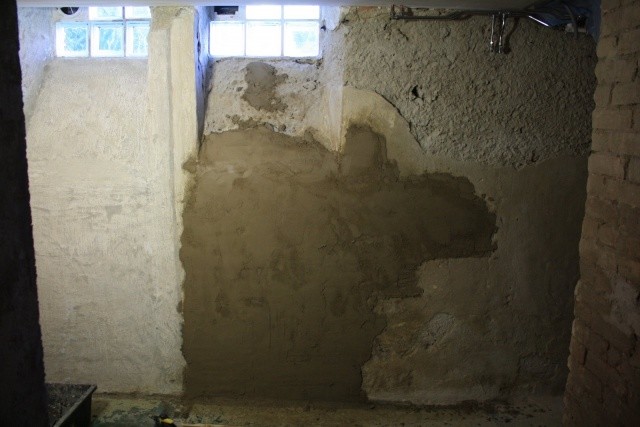
The exterior wall is clearly repaired (plastered and painted) in one area but not in another. The room used to be two storages, and the wall between them I tore down and moved to create a larger room. In the attached image, the left side is clearly newer, probably cement or KC because it's rock hard. The paint flakes I managed to remove burned and smoked, so it's probably a plastic paint; I've managed to scrape it fairly clean. The right side is also more or less cleared of paint and plaster, but here is a much weaker plaster. You can see in the mess that there are two layers, the bottom is probably kalk, the foundation of the house was probably laid around 1918, as you can see, I'm down to the fundament wall which consists of stone and some plaster.
Now, it probably doesn't matter what paint was once there, it now feels more important to plaster with the "right" plaster. What might I use to repair this wall? Should I go with kalk or KC or something else? The wall doesn't need to be as smooth as a baby's skin; in the end, it can have a bit of a "cellar" vibe, as it's just to be painted.
I also have an interior wall that I've stripped of plaster, which is brick; I've heard that you shouldn't use too strong plaster on old brick, as there's a risk of cracking it. It's about a single square meter that needs to be plastered. Any tips?
The exterior wall is clearly repaired (plastered and painted) in one area but not in another. The room used to be two storages, and the wall between them I tore down and moved to create a larger room. In the attached image, the left side is clearly newer, probably cement or KC because it's rock hard. The paint flakes I managed to remove burned and smoked, so it's probably a plastic paint; I've managed to scrape it fairly clean. The right side is also more or less cleared of paint and plaster, but here is a much weaker plaster. You can see in the mess that there are two layers, the bottom is probably kalk, the foundation of the house was probably laid around 1918, as you can see, I'm down to the fundament wall which consists of stone and some plaster.
Now, it probably doesn't matter what paint was once there, it now feels more important to plaster with the "right" plaster. What might I use to repair this wall? Should I go with kalk or KC or something else? The wall doesn't need to be as smooth as a baby's skin; in the end, it can have a bit of a "cellar" vibe, as it's just to be painted.
I also have an interior wall that I've stripped of plaster, which is brick; I've heard that you shouldn't use too strong plaster on old brick, as there's a risk of cracking it. It's about a single square meter that needs to be plastered. Any tips?
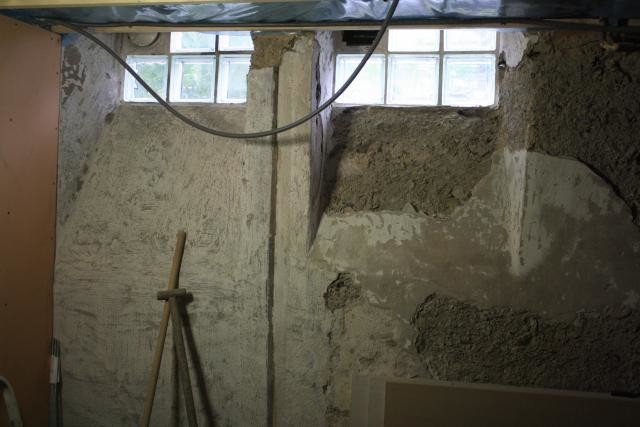
There it came up again, how quickly one forgets. I looked into the construction market and was recommended "Puts och Murbruk C" (Finja) as a golden middle ground, not too hard, not too soft, and it still holds together anyway.
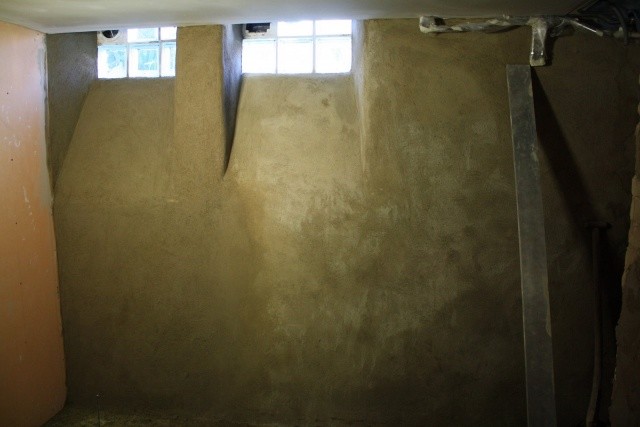
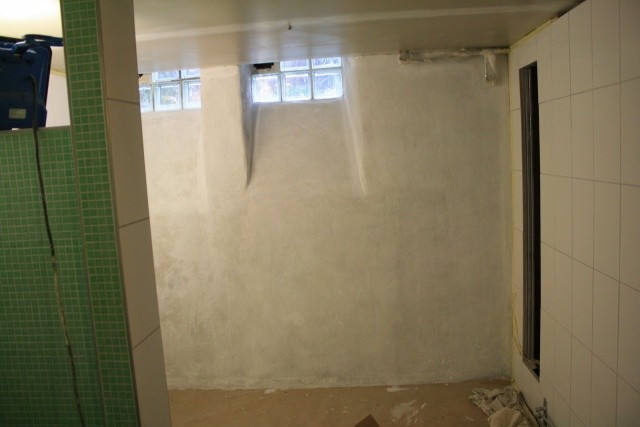
This was my first "plastering project" and it turned out okay, I didn't have the ambition to achieve a 100% smooth result, otherwise I probably would have needed to apply filler on the surface. A slightly undulating and lively wall fits well with the otherwise very angular and "sterile" bathroom, in the last picture perhaps another coat is needed. Attaching some more pictures.
This was my first "plastering project" and it turned out okay, I didn't have the ambition to achieve a 100% smooth result, otherwise I probably would have needed to apply filler on the surface. A slightly undulating and lively wall fits well with the otherwise very angular and "sterile" bathroom, in the last picture perhaps another coat is needed. Attaching some more pictures.