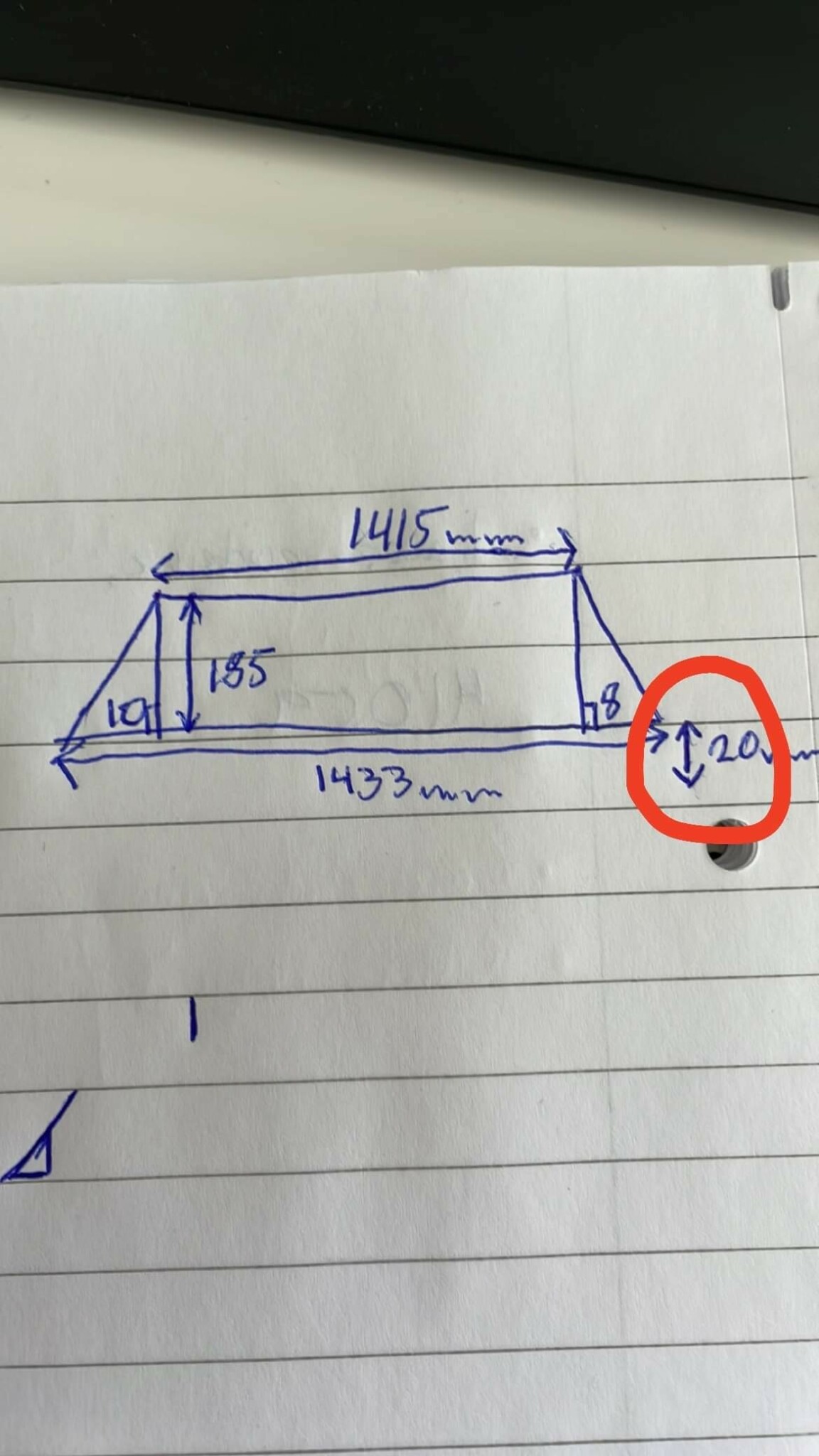
1433 - 1415 = 18.
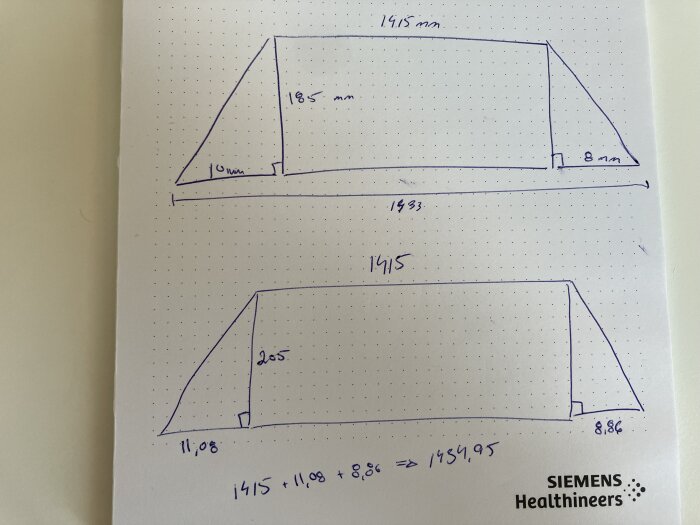
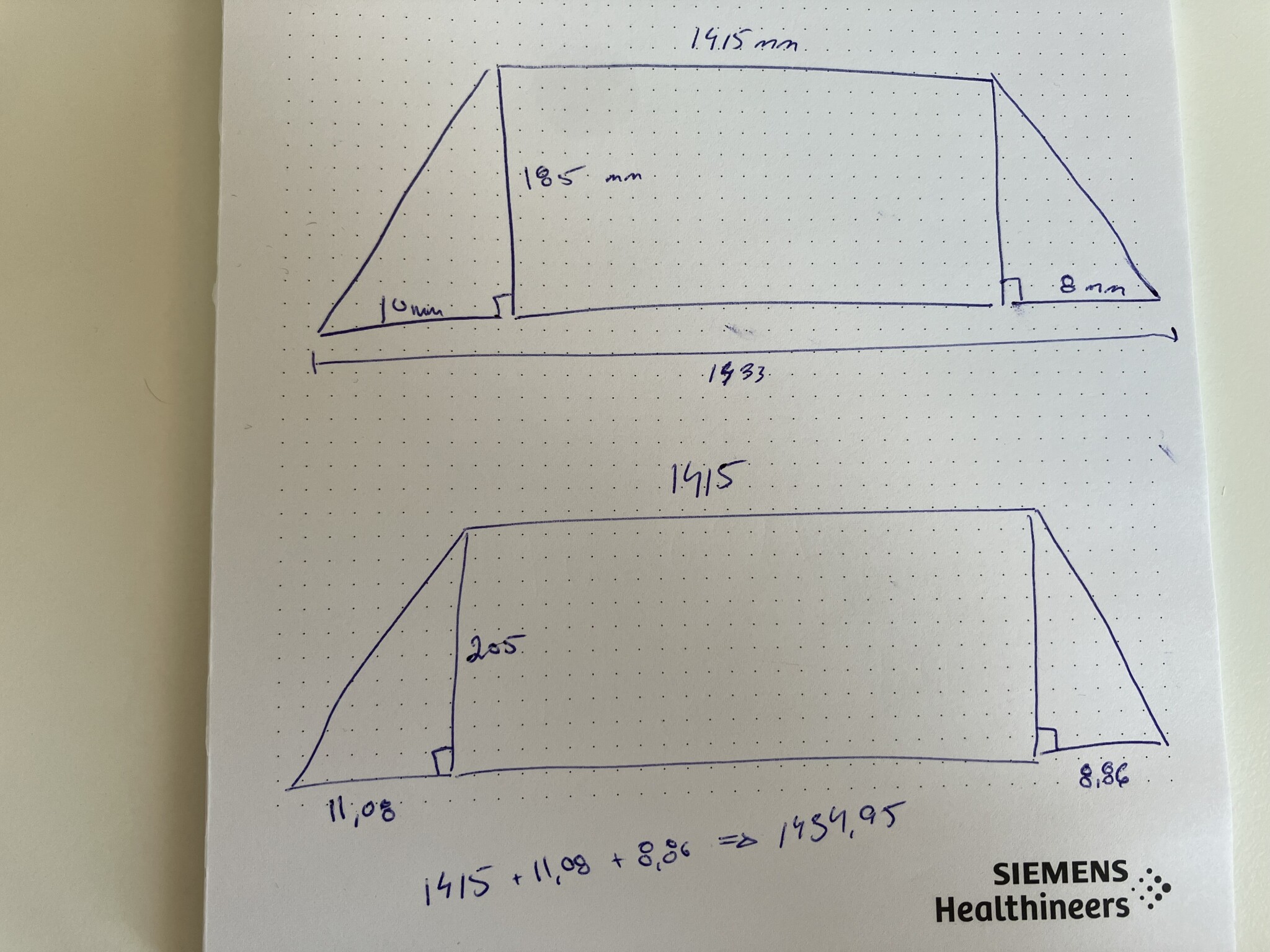
I interpret your notes as indicating that your two triangles have bases of different lengths, one is 10 and one is 8 mm. Then the length of the bases matches the difference between the top and bottom length.
So you have a triangle with base 10 height 185 which should become base 10 height 205, and one with base 8 height 185 which should become base 8 height 205.
tan (V1) = 185/10 => your tan angle in the first case is 86.91.
tan (v2) = 185/8 => your tan angle in the second case is 87.52.
With the help of your angle v1 and v2, we calculate the new length of your bases required in order not to change the angle.
tan (86.91) = 205/X => X = 11.067
tan (87.52) = 205/Y => Y = 8.878
Your new length becomes 1415 + 11.067 + 8.878 = 1434.945
1433 - 1415 = 18.
I interpret your notes as your two triangles having different base lengths, one being 10 and one being 8 mm. Then the base lengths match the difference between the top and bottom lengths.
So you have a triangle with base 10 height 185 which should become base 10 height 205, and one with base 8 height 185 which should become base 8 height 205.
tan (V1)=185/10 => your tan angle in the first case is 86.91.
tan (v2)= 185/8 => your tan angle in the second case is 87.52.
with the help of your angle v1 and v2 we calculate the new length of your bases needed to not change the angle.
tan (86.91)=205/X => X=11.067
tan (87.52)=205/Y => Y= 8.878
Your new length becomes 1415+11.067+8.878= 1434.945
And what will the 1433 measurement be? That is, the longest length measurement?
The 1415 measurement shall remain.
This refers to a windowsill and I just want to know what the longest measurement will be if I add a 20mm overhang to the sill.
As I wrote at the very end. Your new total length becomes about 1435. So an extension of about 2 mm
I received the following response from a math teacher... Can you refute this with an explanation?
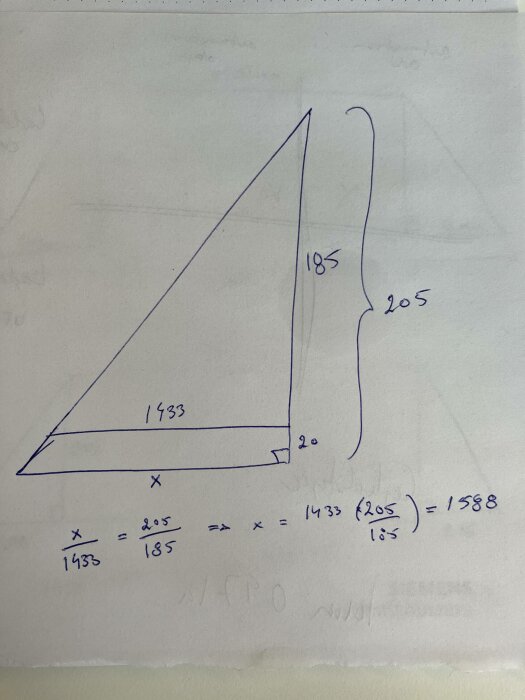
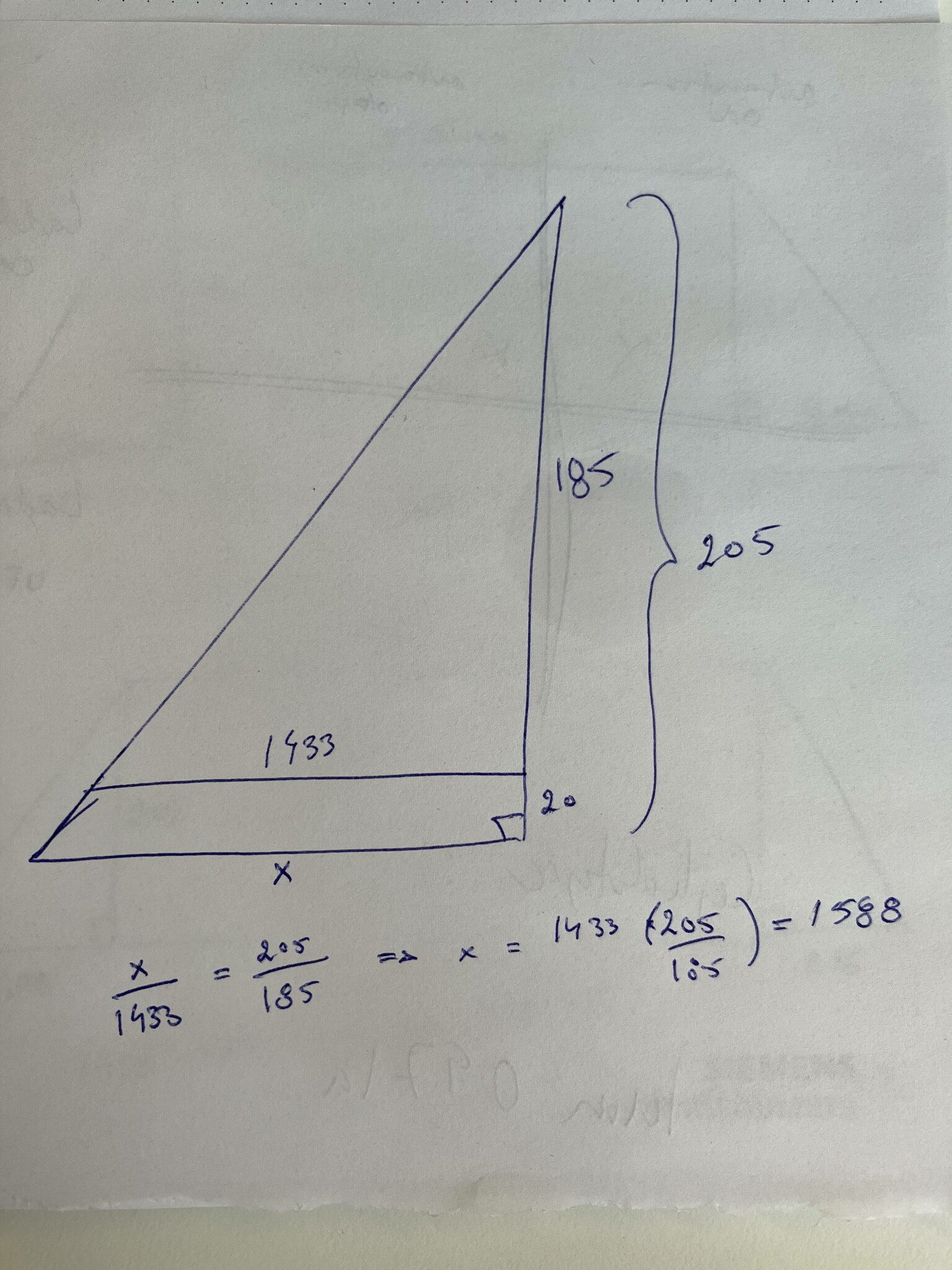
"It's about similarity.
205/185=1.108
1.108*1433= 1588"
The new length measurement is thus 1588 according to her...?
Either she misunderstood what you want to do, or we did.
The similarity she is talking about applies to the two triangles separately.
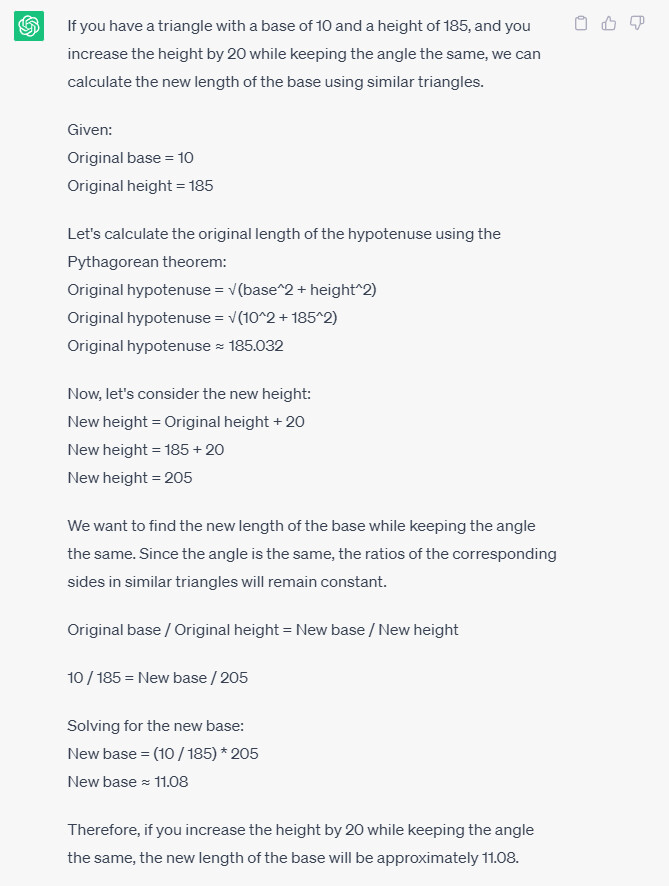
Looking at the one on the left, the ratio between the corresponding sides of the two triangles is the same. Call the distance I noted as 11.08 (the one that is unknown in your question) X. We then have that X/10 = 205/185, or that X = 10*(205/185) = 11.08.
And by the way, don't let the internet solve your math problems! Instead, ask for tips on methods.
The task you have received is the question of whether the relationship between height and base length should be equivalent, how long must the base length be if the height increases by 20 mm.
I don't even know what your 10 and 8 have to do with it.
Her solution 1,108*1433 multiplies your base length 1415 by the factor 1,108. Which it shouldn't. Because your base length remains unchanged regardless of the height difference.
But sure. If you take your external width 18 *1,108 you get 19,944 instead. Which is a much simpler way to calculate that your length has increased by 1.944 mm. Or about 2 mm.
I think you see yourself that it doesn't sound reasonable...
AAfterquake said:
Ok, then there is some information missing.
And by the way, don't let the internet solve your math problems! Instead, ask for tips on methods.
The task you have got a response to is the question of whether the ratio between height and base length should be similar if the height increases by 20 mm, how long must the base length be.
I don't even know what your 10 and 8 have to do with the matter.
The measurements that have been derived come from a measurement of a window reveal, meaning the measurement at the innermost point of the reveal and the measurement at the outermost point of the reveal. But then I want a 20mm overhang and to maintain the same mitered angle, so I sought some guidance from an acquaintance's mother who is a math teacher and then via byggahus.se. Logically, the angle is primary, so that the bench will fit the reveal. So your calculation should be a guide for me. I just became worried when I got an answer about using the calculation for similarity, which I don't really grasp logically right now.
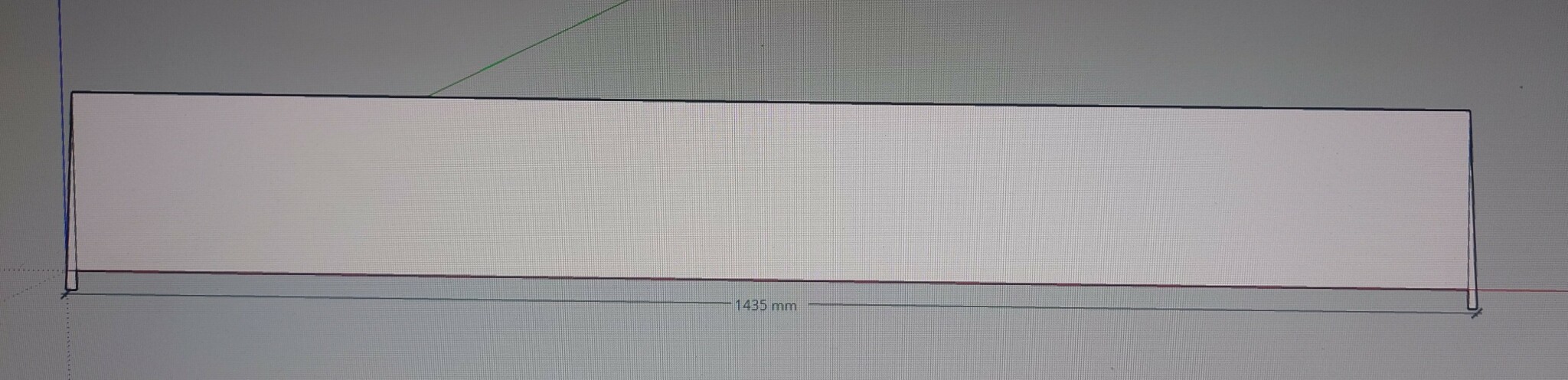
Although it is of course super easy to calculate on pen and paper, a quick sketch in something like SketchUp can make it a bit easier to visualize how it will turn out..
Her solution 1,108*1433 multiplies your base length 1415 by a factor of 1,108. Which it shouldn't. Because your base length is unchanged regardless of the height difference.
But sure, if you take your external width 18 *1.108 you get 19.944 instead.
Which is a much simpler way of calculating that your length has been extended by 1.944 mm. Or about 2 mm
Understood,
Dan_Johansson said:
Even though it's of course super easy to calculate with pen and paper, a quick sketch in, for example, SketchUp can make it a bit easier to visualize how it will be..
[image]
I only have Bluebeam Revu but don't master the program.