
1,295 views ·
3 replies
1k views
3 replies
How do I attach the parasol to the cast plinth? Second attempt
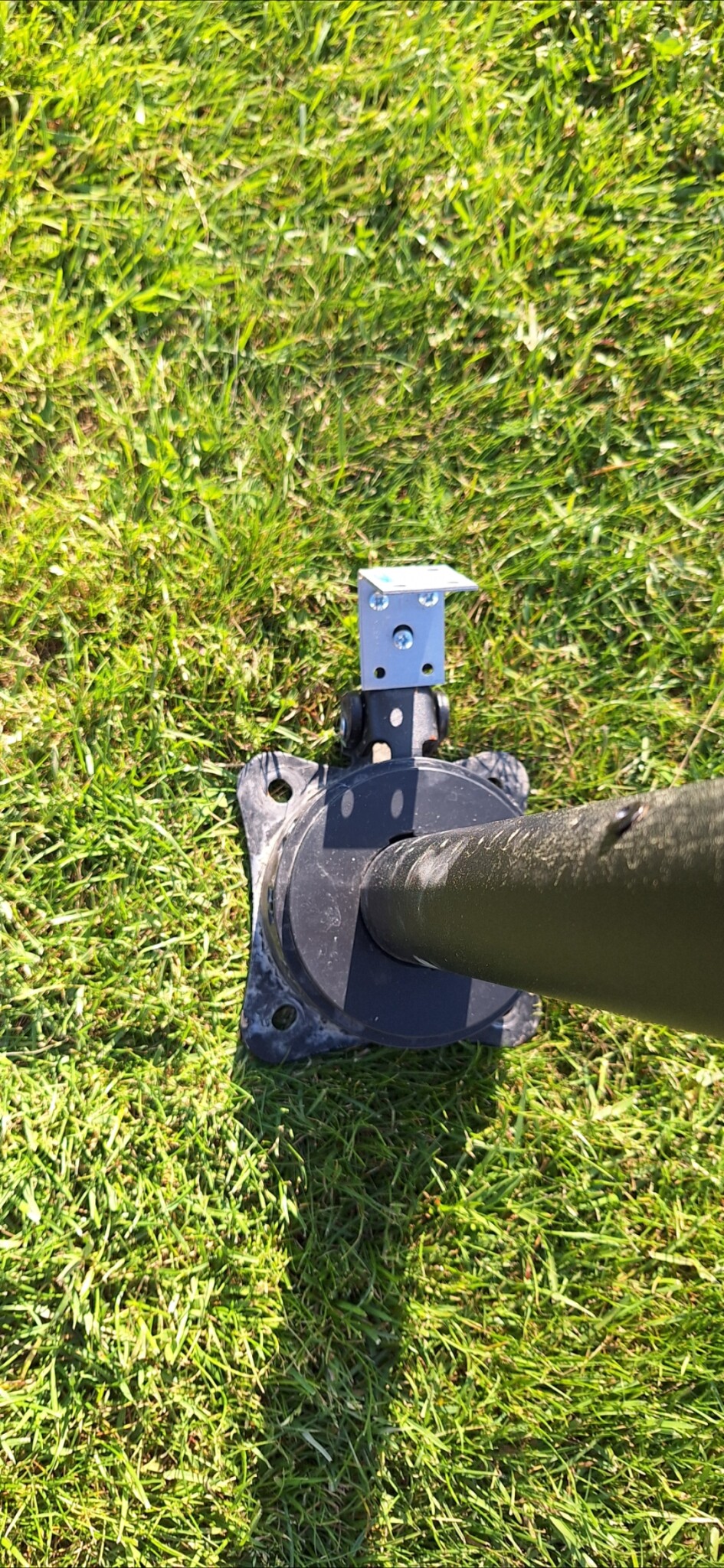
I am considering casting a foundation for a parasol instead of using the included feet. The picture shows the base of the parasol that I will attach to the foundation.
Now I'm figuring out how to do it best. I made an initial attempt to cast a base with quick-setting cement and embedded 4 threaded rods to which I fastened the parasol. Unfortunately, it didn't turn out well; the threaded rods quickly started to come loose. I think it's because I pressed them into the cement mixture a bit too late, which likely meant the cement didn't completely seal around them. Also, it seems that the quick-setting cement was relatively weak, which probably contributed to the rods loosening. Lastly, I noticed that the threaded rods themselves are quite soft, unlike the cement screws I've now bought, which are totally rigid. That might have played a role as well.
The parasol is the kind that hangs off to the side (https://www.jula.se/catalog/tradgard/utemiljo/sol-och-insynsskydd/parasoller/parasoll-021503/) and can be rotated by pressing the foot pedal in the picture, so the round base of the parasol must be able to spin freely (the foot pedal doesn't move, only the round plate at the bottom). To gain some stability, I hammered in some rebar into the surrounding soil, which sits like "spokes" to prevent the foundation from tipping sideways since the parasol has quite a strong pull on its base even in light winds.
Now I'm making a new attempt and am asking for advice on how to fix something that lasts in the long run. I want to be able to detach and replace the parasol if needed in the future, so I would prefer to fasten it with nuts. Is a threaded rod a reasonable choice after all? Provided that I embed them better this time. If so, I would also place some nuts in the embedded part of the rod as anchors, which I missed the first time. Or is it stronger to cast the plate and then drill holes afterward and use something like these: https://www.bauhaus.se/betongskruv-...34383&indexName=nordic_production_sv_products
Edit: should quick-setting cement, like Finja Gjuta Enkelt, suffice or do I need something like coarse concrete that I mix in advance?
Now I'm figuring out how to do it best. I made an initial attempt to cast a base with quick-setting cement and embedded 4 threaded rods to which I fastened the parasol. Unfortunately, it didn't turn out well; the threaded rods quickly started to come loose. I think it's because I pressed them into the cement mixture a bit too late, which likely meant the cement didn't completely seal around them. Also, it seems that the quick-setting cement was relatively weak, which probably contributed to the rods loosening. Lastly, I noticed that the threaded rods themselves are quite soft, unlike the cement screws I've now bought, which are totally rigid. That might have played a role as well.
The parasol is the kind that hangs off to the side (https://www.jula.se/catalog/tradgard/utemiljo/sol-och-insynsskydd/parasoller/parasoll-021503/) and can be rotated by pressing the foot pedal in the picture, so the round base of the parasol must be able to spin freely (the foot pedal doesn't move, only the round plate at the bottom). To gain some stability, I hammered in some rebar into the surrounding soil, which sits like "spokes" to prevent the foundation from tipping sideways since the parasol has quite a strong pull on its base even in light winds.
Now I'm making a new attempt and am asking for advice on how to fix something that lasts in the long run. I want to be able to detach and replace the parasol if needed in the future, so I would prefer to fasten it with nuts. Is a threaded rod a reasonable choice after all? Provided that I embed them better this time. If so, I would also place some nuts in the embedded part of the rod as anchors, which I missed the first time. Or is it stronger to cast the plate and then drill holes afterward and use something like these: https://www.bauhaus.se/betongskruv-...34383&indexName=nordic_production_sv_products
Edit: should quick-setting cement, like Finja Gjuta Enkelt, suffice or do I need something like coarse concrete that I mix in advance?
Last edited:
Best answer
The weights that Jula themselves sell for this product should be placed on the cross of steel profiles that you seem to have removed, and they weigh 15 kg each, so you need to make a fairly wide base that weighs at least 60 kg.
Threaded rod could work but probably needs to be welded to rebar that you should have in your concrete slab that you are casting. The slab needs to be quite large to match the original base's size and it must not be too thin if you are going to put screws in it.
An alternative is to cast the slab and set through bolts with a large washer on the underside and a nut on the top side. Then you can make small wooden blocks in the mold to give space for the washer and screw head when you remove the form. Possibly, you can cast the screw and washer in from the beginning if you want; that should work.
What needs to be cast in should be placed directly so that the concrete seals tightly around the washer and screw.
I would not use "Gjuta Enkelt" but instead buy Finbetong in a bag that you mix with water before pouring it into the mold. I haven't used Gjuta enkelt but it doesn't seem suitable for casting in the way you intended.
Threaded rod could work but probably needs to be welded to rebar that you should have in your concrete slab that you are casting. The slab needs to be quite large to match the original base's size and it must not be too thin if you are going to put screws in it.
An alternative is to cast the slab and set through bolts with a large washer on the underside and a nut on the top side. Then you can make small wooden blocks in the mold to give space for the washer and screw head when you remove the form. Possibly, you can cast the screw and washer in from the beginning if you want; that should work.
What needs to be cast in should be placed directly so that the concrete seals tightly around the washer and screw.
I would not use "Gjuta Enkelt" but instead buy Finbetong in a bag that you mix with water before pouring it into the mold. I haven't used Gjuta enkelt but it doesn't seem suitable for casting in the way you intended.
Thanks for the response!
I've dug out the hole now so I can fill it with enough concrete to reach 60 kg, that was a good point. Unfortunately, I don't have a welder to attach the threaded rods with, but if I cast the rods with several nuts with washers in between, it should still make a good enough anchor, I think.
And since I'm now making the base much deeper, if the threaded rods do come loose, I can drill new holes for cement screws as a plan B.
I've dug out the hole now so I can fill it with enough concrete to reach 60 kg, that was a good point. Unfortunately, I don't have a welder to attach the threaded rods with, but if I cast the rods with several nuts with washers in between, it should still make a good enough anchor, I think.
And since I'm now making the base much deeper, if the threaded rods do come loose, I can drill new holes for cement screws as a plan B.
Click here to reply