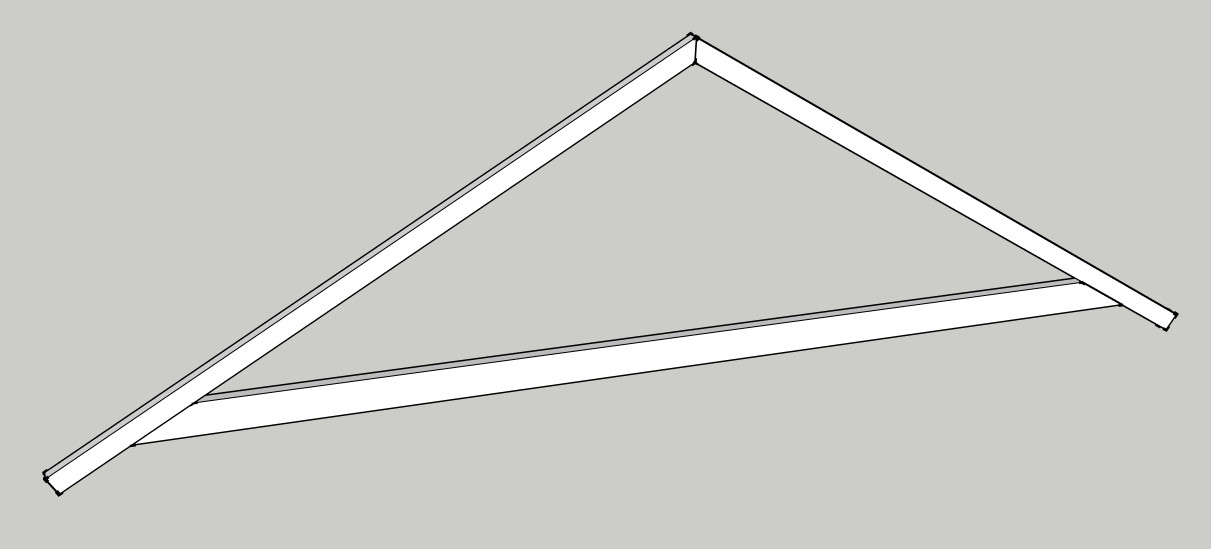
I was up in the attic measuring the existing rafters. They are 5" x 3". They are just leaning against each other without any reinforcing braces like collar ties, any truss construction, or similar. They are simply like an upside-down V.
For fun, I checked with a company that manufactures roof trusses. For my roof, they wanted to use 195+70 trusses, resting on a glulam beam at the ridge.
Clearly, my rafters have worked for about 100 years. Is there really such extreme over-dimensioning on the trusses being built today?
There is a safety factor in everything in structural engineering. In an elevator, you might calculate for 10 times the expected maximum load. I don't know anything about roof trusses, but it should be a few times. The fact that it holds is not proof that they are safely dimensioned.
In airplanes, however, many things have a low factor (like x1.2 and such) because they wouldn't be able to fly otherwise due to the weight. In return, all important parts are inspected frequently...
No idea what the snow's weight has been I haven't lived here a fraction of the house's lifespan!
Huggan, maybe you can help me calculate a bit? I'm thinking about what size rafters I should use for the extension. The existing rafters are about 127 x 76 mm. Calculating the moment of inertia (B * H^3 / 12), it's 12973092.3333. For comparison, the moment of inertia for a regular 170x45 board is 18423750, which is over 40% more than the existing rafters. So it should be enough with a good margin. But at the same time, it feels quite flimsy compared to the 265x45 that the rafter manufacturer wanted me to use...
How "flimsy" rafters can I have? I gratefully accept every cm I can save to get any kind of ceiling height... Already with the existing 127 mm high rafters, I only have 186 cm in ceiling height at the ridge on the upper floor.
It's almost like two 120x45 side by side would manage it, but 127x76 has a slightly better moment of inertia... Another advantage, besides ceiling height, is that it's easier to maneuver the trusses into place if I don't have to build them with such heavy timber.
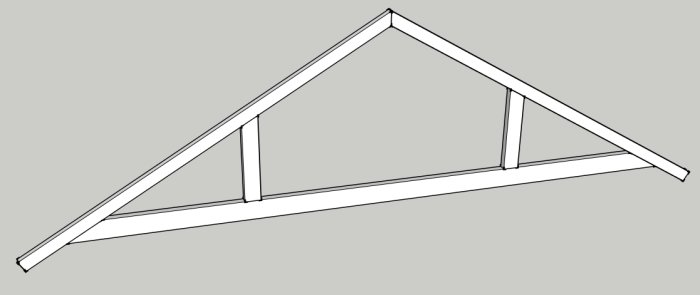
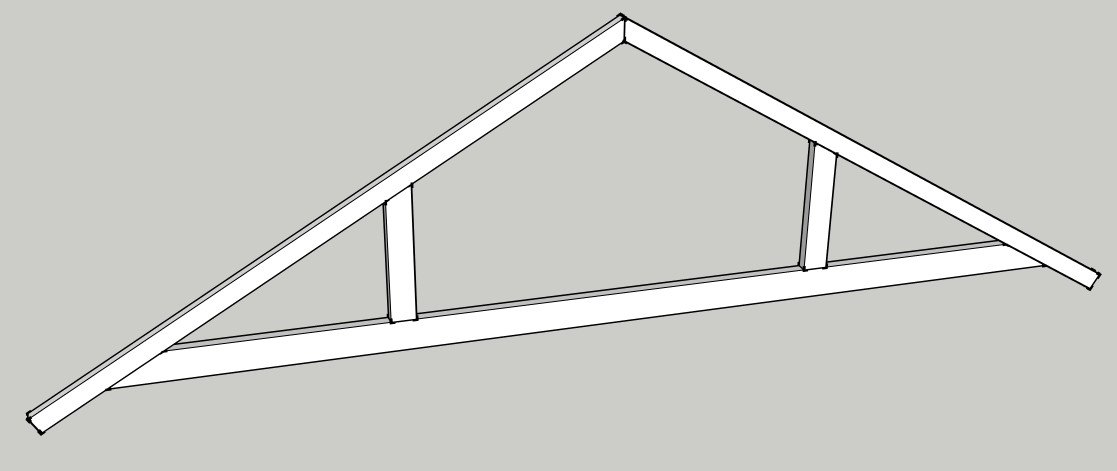
I could imagine this kind of construction to make it a bit stronger, but without losing either ceiling height or room width upstairs (I don't have the exact measurements of how wide the furnished part of the attic is, but you get the idea).
Should help against any potential bending of the truss, right?
It varies a bit. Where I measured, it was between 110 and 115 cm between the rafters.
I also took the opportunity to measure how wide the furnished space is; it was just under 270 cm, so my sketch is quite accurate, I drew it 280 cm wide.
Vi vill skicka notiser för ämnen du bevakar och händelser som berör dig.


 I haven't lived here a fraction of the house's lifespan!