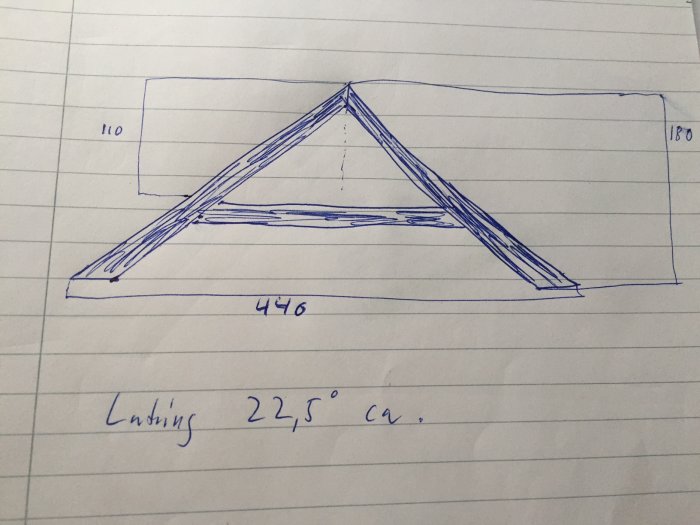
I don't know as I haven't torn it down yet. But they are really old and square (as far as I recall) have only been chicken coops before, like 95x95 or something like that if I were to guess.
Because they are bad and half-rotten as the roof that was on before leaked. The idea is that it will become a summer residence in the outhouse and want to lay a proper under-roof in the form of roughhewn boards, tar paper, and sheet metal.
Then you will probably insulate the roof?
Which means that some height is needed for the insulation. However, it's a summer residence, so not enormous amounts?
If you then take, for example, 45x195 for the outer legs and say a 45x145 for the crossbeam, it should be sustainable with surplus capacity and at the same time provide space for insulation (145 mm in the slanted roof). If you place them with 60 cm center-to-center, it will be easy with insulation and nailing of sheathing and subroof. (Plus, 60 cm center-to-center provides double the load-bearing capacity compared to 120 cm center-to-center.)
The important thing is to use sufficiently large/long/thick nail plates in the connection of the outer legs and crossbeam since I assume the crossbeam sits a bit above the wall height? This means that the tensile forces in the crossbeam can become relatively large, as well as the bending moment on the outer legs from the wall up to the crossbeam. The nail plates must be able to absorb and transfer these loads.
I have no calculations to support this, just some experience from existing constructions. Therefore, the dimensions are generously sized. The cost of timber is generally a smaller part of the total cost, so there's no reason to skimp there. However, it is very important that the work in every detail is well executed. Such as the nail plates that need to transfer loads. If that connection point is not correct, the truss will fail, regardless of other dimensions.
I would use anchor nails because the forces to be transferred do not pull the plate outward, i.e. no risk of the nail being pulled out.
There are recommendations on how (densely) to nail in nail plates, including the dimensions of the plates and exactly where/how they should be placed. Unfortunately, I can't point to any such place on the internet, but try googling or start looking in träguiden, I think I saw something about joining there.
Otherwise, if you can wait a while, hopefully, someone more knowledgeable here on the forum will help.
(Since it is a matter of load-bearing construction, I just want to clarify that as the builder, you are responsible for its stability. I give my advice to the best of my ability, but as I said, I am not a designer. Just so you are aware of that. :|)
You have a good starting point in the dimensions and rafter spacing (cc-measurements) that the existing trusses have. I have old buildings myself and can state that old timber, (which looks shabby), is infinitely much better/stronger than today's fast-grown wood. So with "bought timber" you need to increase the dimensions to match the quality/strength of the old timber.
Click here to reply
Vi vill skicka notiser för ämnen du bevakar och händelser som berör dig.