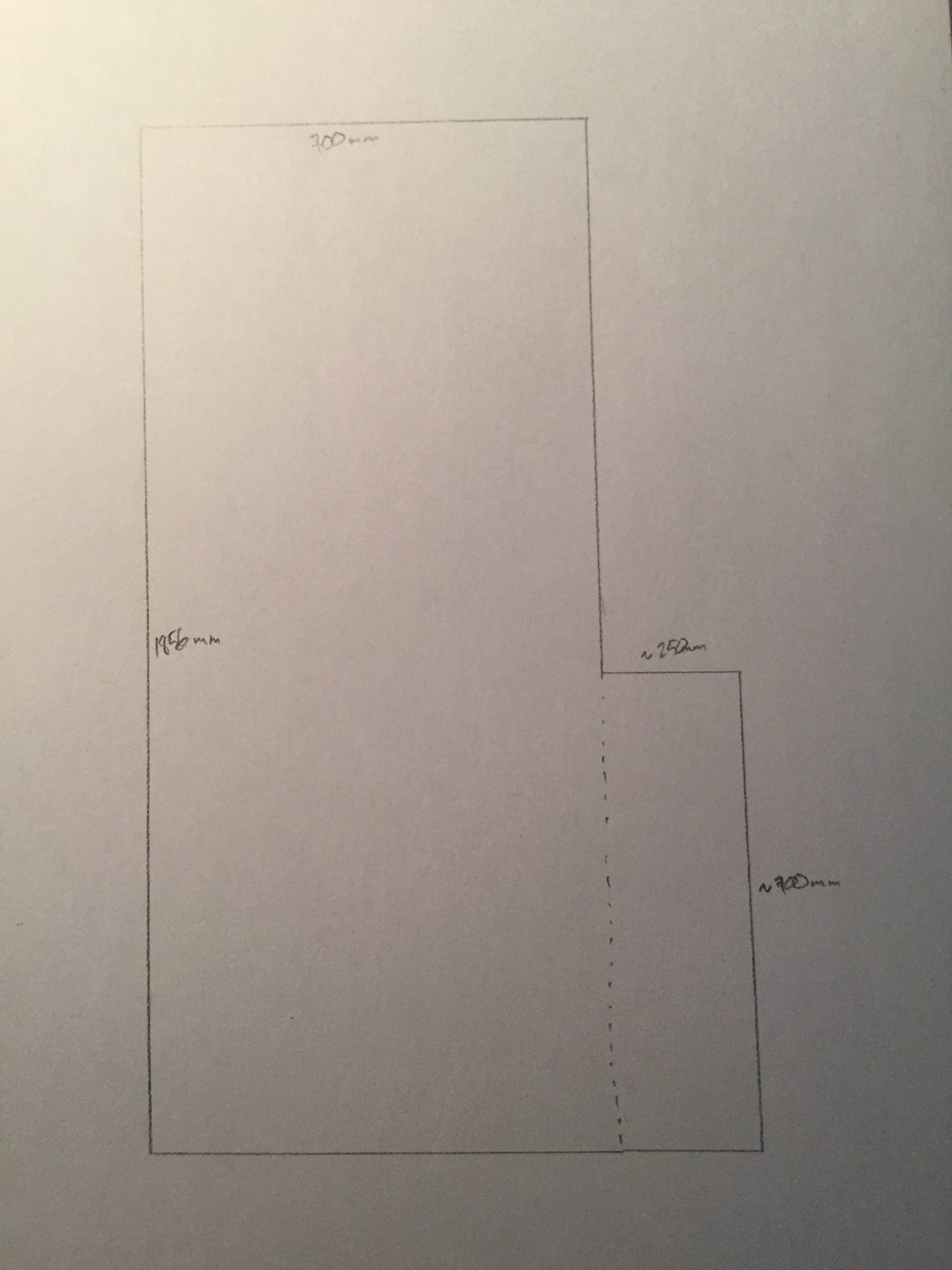
We have a staircase opening in our 1940s townhouse that currently measures about 700x1850mm, with a floor-to-floor height of about 2400mm = steep stairs! We are planning to slightly enlarge the opening to then build a stair that is less hazardous.
The opening goes through a reinforced concrete slab on which a wooden subfloor is placed. Including the subfloor, the slab is about 290mm thick, with the concrete accounting for about 150mm of this. The notch we plan to create is to be at the corner of one long side and measure about 750x250mm. Initially, I thought of bringing out the rotary hammer and drilling a number of small holes and then jackhammering, followed by using repair cement to make the surface smooth and neat. I've seen that in other similar townhouses in the area, similar solutions have been made, although not necessarily opening at exactly the same place as we plan. However, my rational side has made me reconsider a bit.
I thought I'd check what the forum experts think here. Should I hire a structural engineer and core driller for this job, or can I get started myself, with a clear conscience? What would you do?
Regarding the strength, I don't dare to have an opinion. But there is probably a risk that you have extra reinforcement near the edge, and if you cut it, the strength will deteriorate.
I would probably get a cost estimate from a concrete cutting company. The holes will be much nicer if they are sawed. I believe you can also rent a concrete saw.
Regarding the strength, I dare not have an opinion. But there is probably a risk that you have extra reinforcement near the edge, and if you cut it, the strength will be reduced.
I would probably get a cost estimate from a concrete drilling company. The hole will be much nicer if it is sawed. I think you can also rent a concrete saw.
No, and it's probably difficult to know if you're not a structural engineer.. Maybe it's best to have someone come and take a look at it. I got hold of a document from the municipality where it describes what the floor structure is made of:
"Floor structure materials, dimensions, insulation, reinforcement devices: 13-16cm reinforced btg, 10cm filling of wood shavings, wooden floor on joists."
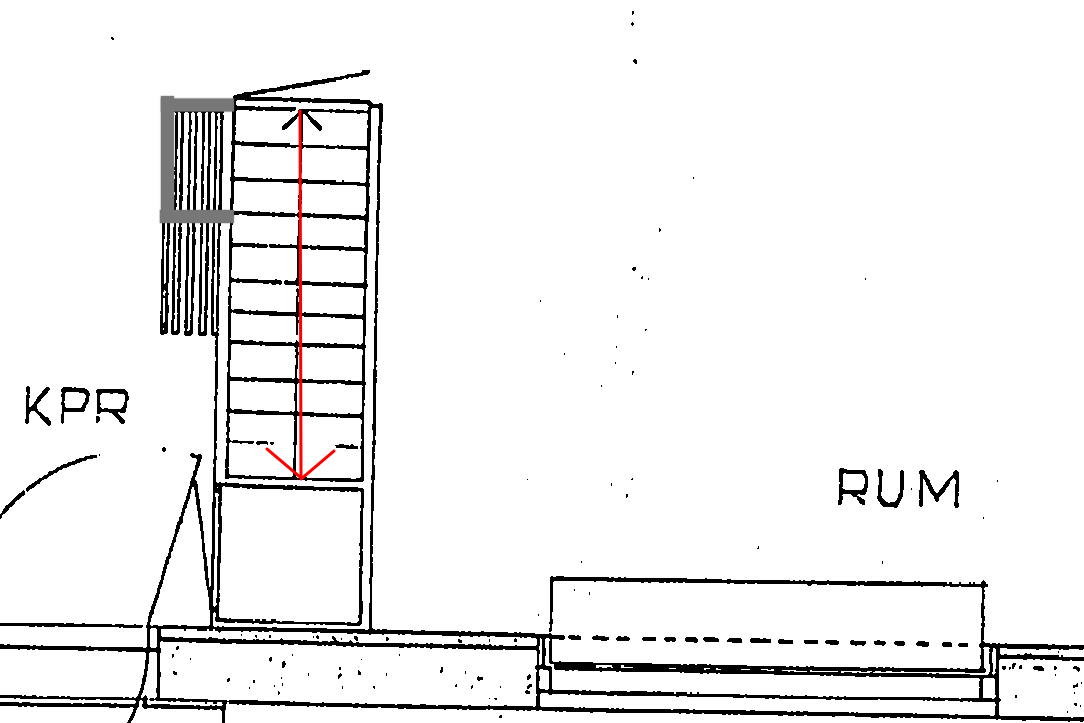
It's doubtful that I can use the drawing I received as further basis for any detailed strength calculations, but I'm attaching it with a mark of where the opening should be enlarged.
Edit
For some reason, the color of my mark disappears when I save the image. In any case, I have drawn a small rectangle to the left of the stairs.
You need to get hold of a reinforcement drawing to know for sure. The alternative is to use a metal detector to trace the iron. However, I think there is a very high risk of iron being near the edge of the opening. Without clarity on that, I would refrain from chipping the concrete. Hempularen is correct that concrete sawing will look much better. Have you considered changing the direction of the stairs and thus getting a longer stair flight without the issue of hole cutting?
I have also heard that chiseling can cause too much vibration, which can weaken the floor. So maybe sawing will be the option then..
From what I understand, there are two alternatives - dry or wet sawing. The thing is, I don't want water to gush over the joists, as that would mean damage to the wooden floor lying there. In that case, it will have to be dry sawing and a lot of plastic covering and maybe renting an air purifier?
What do you mean @justusandersson? It's hard to describe our problem without a sketch, so here's a simple one. The main problem is that we have very limited space anyway. Otherwise, we would have gladly installed a normal-width and steep staircase..
If the main problem is the staircase's inclination, you can turn it 180 degrees without changing the hole's size. Attached images are just schematic drawings.
To test my variant, you need to make a to-scale drawing. The plan and the section don't match. You can see that clearly. With a step height of 17 cm, you can take three steps outside the opening without hitting your head on the ceiling.
Spontaneously, I would say that one should think twice before taking this hole even if it isn't that large. It is likely that the joists run parallel to the stairwell, which means there is extra reinforcement on the long sides of the hole, known as "support bands," which function to carry the section above the hole. It might work to just cut the hole, but this could lead to unsightly cracking due to moment redistribution in the joists. What I understand is that there are no reinforcement drawings? I am more inclined towards justus’s suggestion to work with the design of the staircase itself. Would an L-shaped staircase work, starting under the KPR in the basement? Couldn’t an "extra" step be added in the curve beyond those justus mentioned?
If the main problem is the slope of the stairs, you can turn it 180 degrees without changing the size of the hole. The attached images are just principle sketches.
[image]
[image]
Thank you for the suggestion! However, the problem is that the floor is about 300mm thick, floor-to-floor about 2450mm, which means that the floor-to-ceiling height downstairs is about 2150mm. Under the ceiling, we can barely fit a step at all. Just as @tobbbias says, we would have to open the hole lengthwise quite significantly in that case.
@Jarlingar Okay, so you don't think a novice can put a diamond blade on an angle grinder and achieve an adequate result that way?
@bossespecial You say so? Not what I found. I will check with the City Planning Office next week, but the houses are from '44, so I'm not too hopeful that such precise drawings exist. Or what do you think?
As I wrote above, it will be difficult to achieve something safer than what we currently have. We've looked at a U-shaped staircase that starts and ends across the long side of the stairwell. But this would mean steps along the walking line (and with the walking line completely against the standard moved closer to the wall to "help" the stairs) would be about 22cm, and a step height of about 24.5cm. Doesn't feel great. If we manage to open this projection we're talking about, we get a tread depth of about 24-25cm (same step height), which at least means we meet a standard in terms of stairs...
What is the space below the stairwell, directly to the right of the front door? I would say that you can open up this piece without worrying about the reinforcement in the slab, if it is indeed a piece of the slab? Another option is to just chamfer the concrete to achieve the last step, then you don’t cut any iron as these are at the bottom. You have a lot going for you with the superstructure?
@bossespecial There we have bedrooms upstairs, which are already on the small side. It is the upper floor that limits us the most, while we want to avoid starting projects that involve major measures on both floors. To open to the right requires us to rearrange the two rooms we have on the right side of the entrance, and to the left of the entrance, next to the hallway, there's a living room, which limits us somewhat to the left as well. In length, we are again limited by the bedrooms - the door to one is only about 10cm from one end of the hole today.
Where exactly do you mean you can phase out? Where the intended edge is? Isn't it harder to remove a rectangular piece that is also flat, than to saw off the entire edge?
@Jarlingar Alright... And I don't think chiseling is an option. Don't want to generate too much vibration.
Okay, on the plan it looked like there might be a wardrobe that could be sacrificed? It is more difficult and cumbersome to phase out, but at the same time, you don't cut the irons. You can solve the uneven surface with leveling compound.
Vi vill skicka notiser för ämnen du bevakar och händelser som berör dig.