
5,833 views ·
11 replies
6k views
11 replies
Ground moisture turned concrete to sand in basement wall
Planning to re-plaster the basement wall, I discovered when scraping it clean that ground moisture has likely turned the concrete into sand at floor level in several places. I scraped away everything loose, and it left quite deep holes in several spots. Underneath, there was wet sand. From what I understand, it could be poor quality concrete, like "krigsbetong" (the house was built in the late 1920s). There are no visible signs of settlement in the wall otherwise. Could it be sufficient to fix it with some form of repair concrete, or should larger measures be considered?

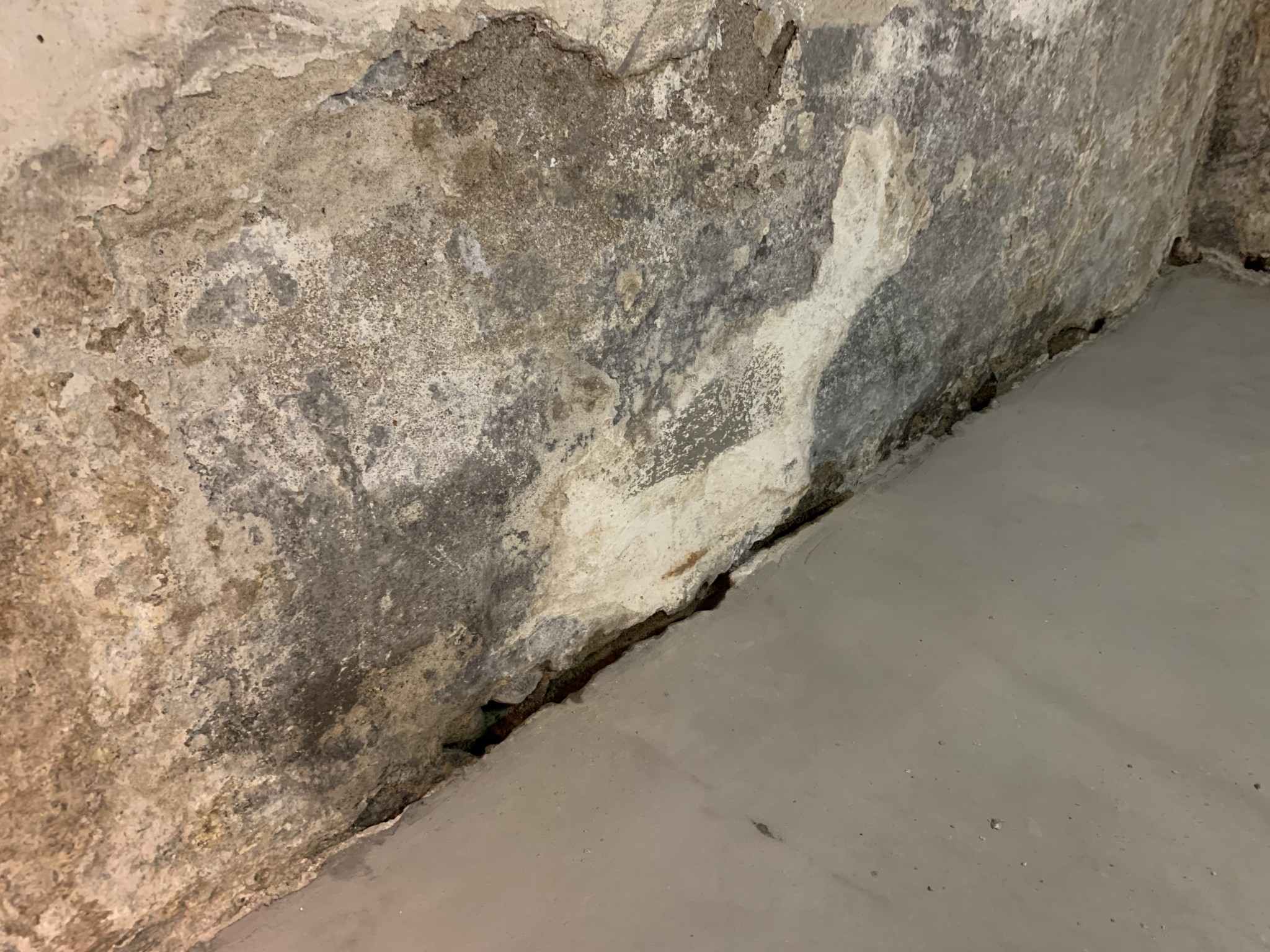


The house was drained a few years ago with isodrän (double boards) but there is still ground moisture. The particular wall in question is mostly above ground on a slope, so I plan to check how it looks on the outside in the spring. The question is how I should address the "holes" in the wall and under the wall. I'm considering new concrete up to ground level and then repair mortar for the walls.O Ovation said:
For the walls, I'm thinking of trying Weber dry renovation which is supposed to be very diffusion-open.
If you have isodrän with the plastic up, it might be as simple as the moisture coming in between the isodrän and the wall from ground level.R Rekoll said:The house was drained a few years ago with isodrän (double boards), but there is still ground moisture. However, this particular wall is largely above ground on a slope, so I plan to check how it looks on the outside in the spring. However, the question is how I should fix the "holes" in the wall and under the wall. I'm considering new concrete up to ground level and then repair mortar for the walls.
For the walls, I was thinking of trying Weber dry renovation, which is supposed to be very diffusion open.
Got advice to repair with hydraulic lime NHL5 from Målarkalk (apparently a lot of lime in the original wall). Was easy to fix. We'll see how well it holds.D dger said:
The mortar can be used for masonry and jointing, not just plaster. I applied it in two rounds and completely filled the holes with that lime mortar, so not just "surface level." There is also lime concrete for floors, among other things, but was recommended to use NHL5. We'll see how well it holds in the long run.F FDT said:
I live alone in a house from 1932 without drainage. It's quite leached in some places. Like sand. But, from what I've heard from older builders, they used to throw all sorts of rubbish and debris from the local cement factory to keep the costs down. The problem was the base material rather than the moisture. However, in our case, the walls are perhaps 40cm thick. No significant settling. We have had two out of four rooms replastered with hydraulic lime mortar from St Astier and then painted with silicate paint from Alabaster a year ago. Very satisfied with the result. A bit of moisture penetration in a couple of spots, but you have to give a 90-year-old without drainage some leeway. Skilled craftsmen, specializing in building conservation, didn't think it was so bad, and I feel much more at ease now.
I can add that I have filled some several cm deep holes myself with the coarser hydraulic mortar, 0-4mm) NHL 3.5. The craftsmen also fine-tuned the walls with air-setting CL90 (0-1mm)
Click here to reply
Similar threads
-
Hur montera bastudörr i vägg av lättbetong
Bastu -
Gjuta betonggolv i öppen källargrund, trotts markfukt?
Grund & Markarbeten -
Ground moisture has turned concrete into sand?
Building Materials and Construction Technology -
Nytt badrum ovan betongplatta med tillskjutande markfukt
Grund & Markarbeten -
Diffusionspärr, markfukt, betong och klinkergolv
Golv