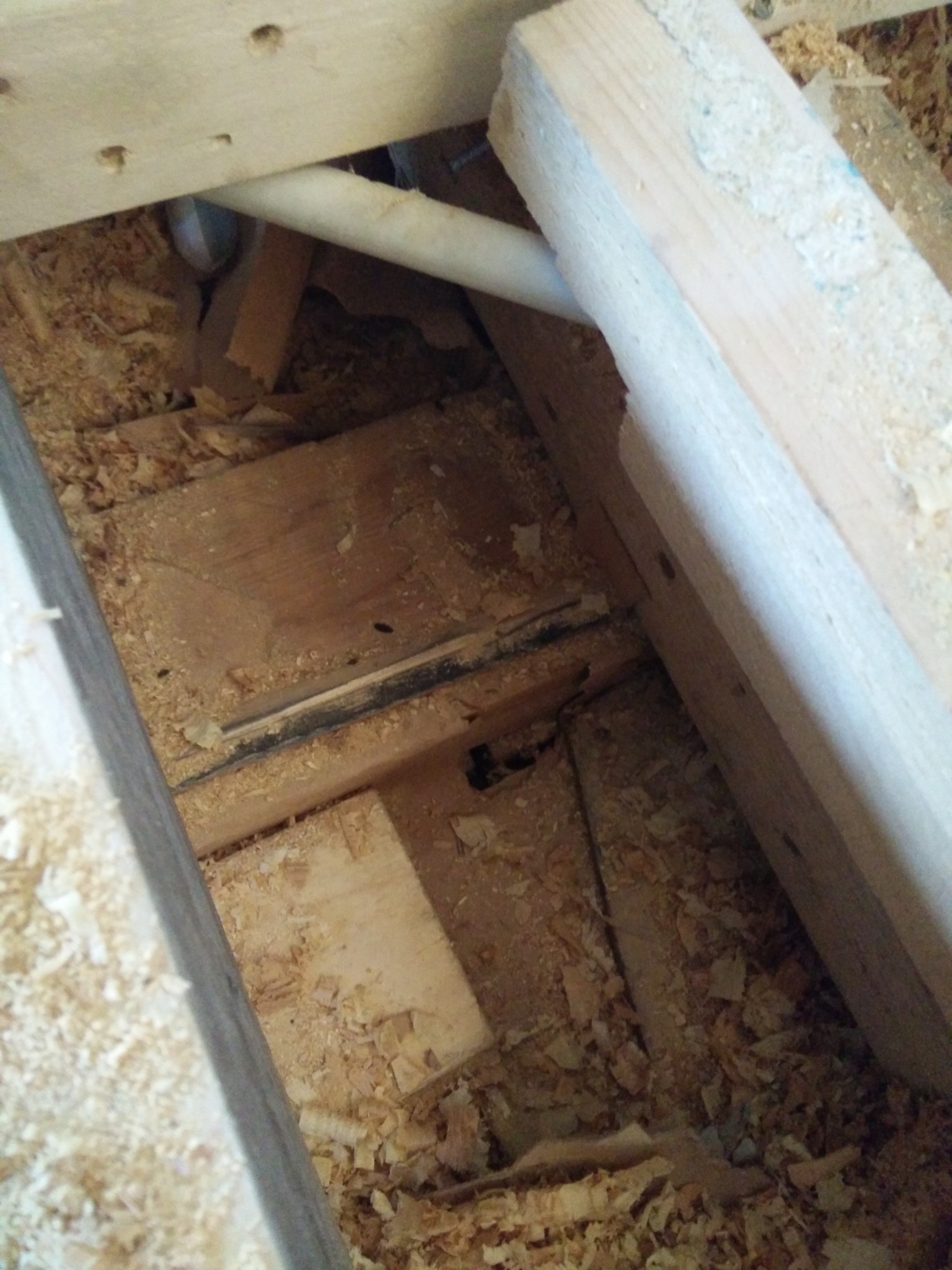
I will screw-glue higher beams (45x220) onto the existing ones (about 60x175) as well as insert new beams between the old ones for a new bathroom.
I can access at least one of the supports at the outer wall and will hang the other end on noggins between the existing beams.
How should I appropriately handle the support? The existing studs are notched, but there is also a hole made in the standing plank wall and the beam extends in. Does this have any actual load-bearing function or is it more for protection against tipping?
In other words, should I make corresponding holes for my new beams even if I can't do more than slide them in?
The dimension of the existing floor joists is probably 21/2x7 inches. A bit unusual, 3x7 inches was almost standard. The joists were laid as the plank frame was erected, as it is the one that provides bearing. The horizontal plank is not part of the support. The notch is likely to ensure that the plank aligns with the ceiling panel that is nailed from underneath to the joists. I would be interested to know how you reasoned when you came to your solution?
The dimension of the existing floor joists is probably 21/2x7 inches. A bit unusual, 3x7 inches was almost standard. The joists were laid as the plank frame was erected, as it forms the support. The horizontal plank is not part of the support. The notch is presumably to bring the plank level with the ceiling panel nailed underneath the joists. I would like to know how you have reasoned to arrive at your solution?
Much more logical that the plank wall itself is load-bearing I was a bit misled by the fact that a lower beam had been attached next to the room, resting solely on a nailed block on the horizontal plank and then attached to some braces between the other floor joists.
To return to your question; the house is originally from '39 but the roof was raised and an extra floor added in the late '70s.
Currently, there are the existing joists, and either a raised 95 joist or several blocks with a 45 joist lying on top have been nailed to align and raise the floor about 5 cm.
In part of the upper floor (dormer), the plan is to build a new bathroom. Since the existing leveling of the floor was probably inadequate for a bathroom, and I have about 22-23 cm to work with to match the level of the other rooms, I'm considering installing 45x220 joists. Around the area where the bathroom will be, there was a floating parquet floor, unfortunately, a bit uneven and wavy in some places, but it seems to be only where the previous owner chose to have the fastening points too far apart on the thinner joists.
I have the possibility to tear up the existing floor a bit away from the actual bathroom, but not the possibility to tear from outer wall to outer wall.
I am still a bit uncertain about the primary purpose of your planned action. If it is to level the floor, then you might choose other dimensions. If it is to reduce sway and deflection, I think there are better solutions.
My primary goal is to have a better-adapted floor structure where the bathroom is to be built. Currently, there is a center-to-center distance of about 75cm between the beams.
The 50mm elevation nailed to the side of the existing beams is generally poor and should be removed. However, the goal is to maintain roughly the same height in the new solution to connect to the other floor areas.
The bathroom is planned to have a float concrete layer and tiles.
So the main goal is really to reduce sway and simultaneously ensure a level surface as a bonus. It feels like I have slightly different conditions since someone has previously attempted to modify the floor structure.
If you give me a task about span, I will consider whether I can come up with something creative. Flytspackel and tiles are quite heavy. Flytspackel weighs about 22 kg per cm and square meter and tiles approximately the same.
I can double-check when I get home, but I would say about 6.5 m span. In the middle, there is a plank wall that I assume the beams rest on. Otherwise, I think I should experience a terrible sway on the entire upper floor with that span?
The bathroom itself will be located by one of the outer walls and will extend about 1.8-2 meters onto the beams.
6.5 meters between the exterior walls.
Seen from the exterior wall where the bathroom will be built, it is 3.5 meters to the central wall.
Two of the floor joists by the bathroom and the dormer are laid on the old chimney stack about 2.5 meters apart (one of them ends there). It is also flush with the chimney stack where the central wall continues the last bit, though this is further in the house and not where the bathroom will be built.
Measured upstairs, I have torn up the floor about 3.3 meters from the exterior wall, so I should be relatively close to the interior wall; it would probably have been possible to tear up a bit more if it meant a significantly better result.
The reason for my preference for 45x220 is probably mostly because I have some lengths lying around, but it might not be the best solution?
Thank you very much for taking the time to give tips and suggestions!
The starting point should partly be that the deflection of the floor joist should remain under 1/300 of the span. Then, I think one should follow the modern deflection requirements. They are based on tests with many people and truly enhance the experience. I believe there are two main approaches you can follow. Either you glue what is required to the existing beams to achieve sufficient stiffness and a flat floor, or you install new beams between the old ones.
Option gluing: Either you do as you planned, screw-gluing 45x220 (I assume it's C24 class) from the side of the existing beams. You'll need to fix some type of beam shoe so they can get support in the plank wall. The downside of this solution is that it increases the height before the flooring material by about 45 mm. Or you screw-glue wedges on top of the existing beams so that the floor becomes flat and gains a height of at least 200 mm. On top of that, you screw-glue floor particle board or something similar. Then the floor height before the flooring material increases by 25 mm.
Option new beams: Insert laminated beams 90x180 between the existing beams.
What a good idea to have some actual background on the requirements for the floor structure!
Do you mean that the screwed-and-glued joist should also be attached to the plank wall (outer wall) with a joist hanger or angle bracket? Or are you referring to potential new joists between the existing ones?
Does it have a significant impact if I reach all the way to the load-bearing inner wall, compared to being about 30cm away?
Can an extra joist between two existing ones be hung on a nogging, or how should one solve the point near the inner wall? If you reach all the way to the inner wall, do you do it the same way then?
It probably doesn't matter a lot. Avoid timber with many knots.
The plan now leans toward a combination of gluing on top of the existing ones and embedding an extra beam because of the wide center distance.
I have also found the interior wall and can see vertical planks. There is also a beam between some floor beams at the support as it is a slightly wider doorway on the floor below.
Is it okay if the timber you glue on top is not in one piece the whole way? I thought of ripping a 45x70 short beam to a 60mm width and screw-gluing it in place. Once the glue has cured, I'll probably remove the screws or countersink them a bit more. Then I'll attach a straightedge and use a circular saw to level the beams.
Does this sound like an okay solution?
Vi vill skicka notiser för ämnen du bevakar och händelser som berör dig.

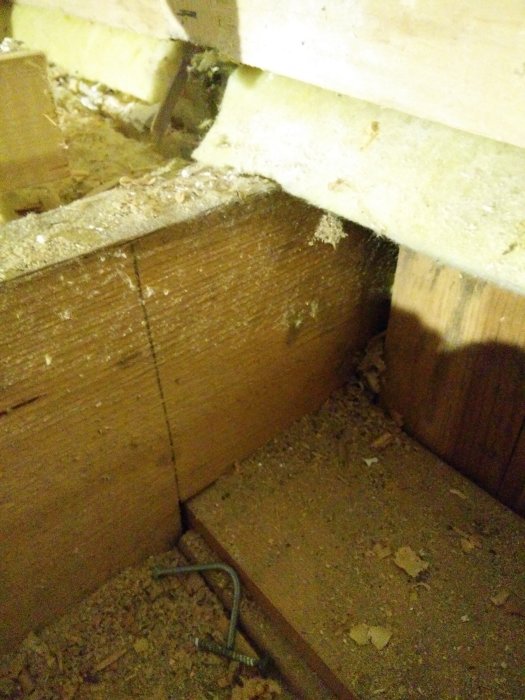
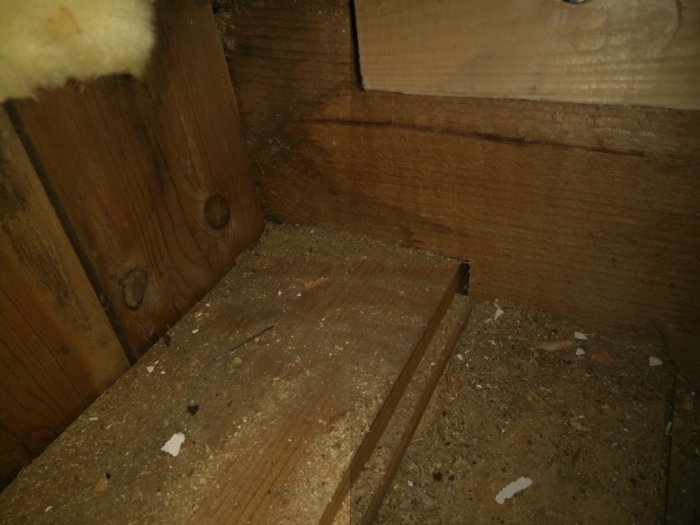

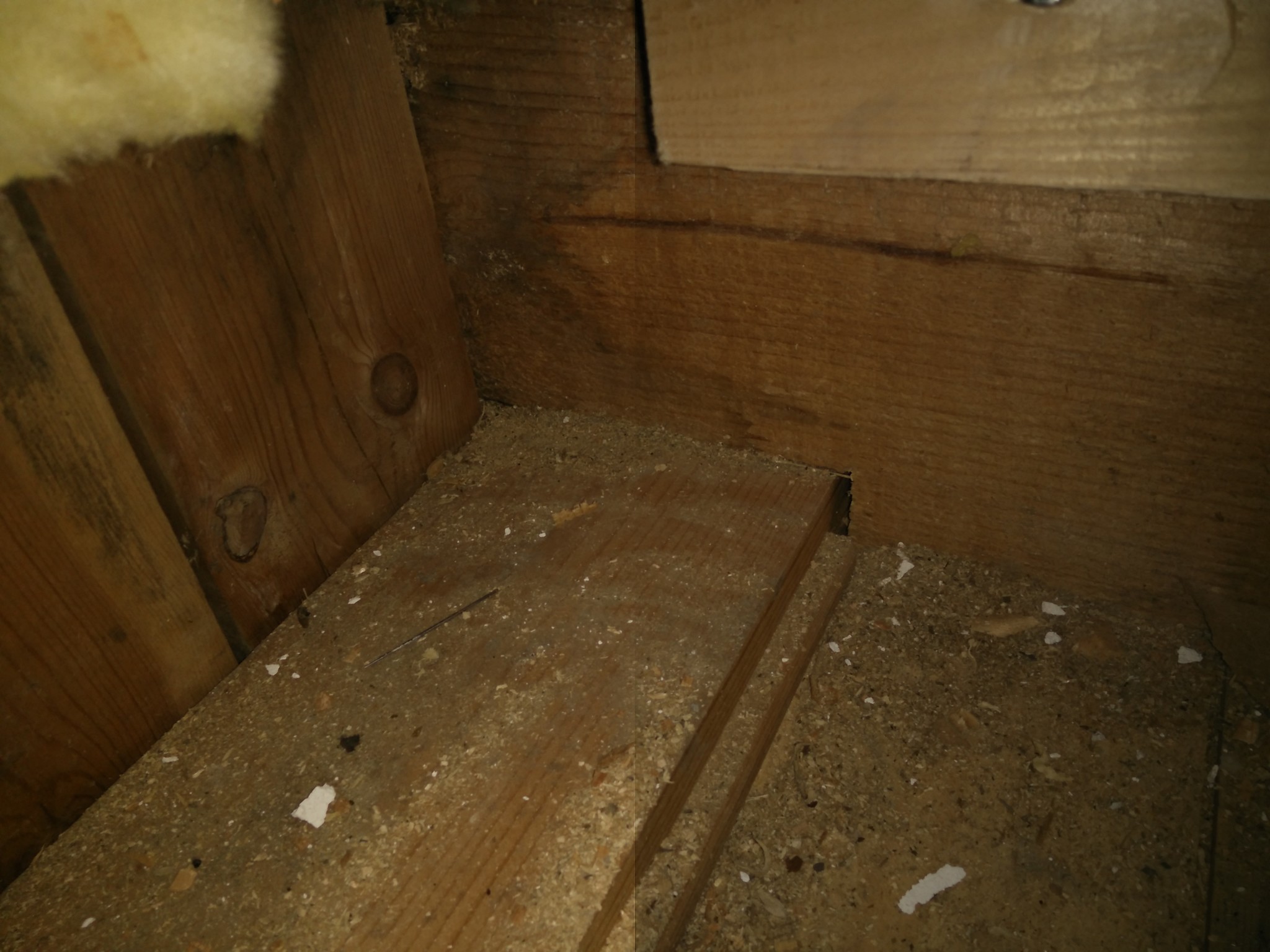

 I was a bit misled by the fact that a lower beam had been attached next to the room, resting solely on a nailed block on the horizontal plank and then attached to some braces between the other floor joists.