
37,581 views ·
12 replies
38k views
12 replies
Failed installation on porous plaster. Molly, hooks etc.
Hello,
During the fall, I've been renovating a bedroom in my new condominium. Since I lack experience, it has been time-consuming, and I've faced my setbacks, but at the same time, I've learned a lot and had quite a bit of fun along the way. I am happy and proud to have done it myself. Right now, only installing the moldings remains (which I will probably address in a separate question).
During the renovation, I've followed many pleasant discussions on Byggahus and received tremendous help. I found all the information I needed and therefore didn't ask any questions myself. However, I've now reached my limit, and I need to ask for help with a seemingly simple matter.
I need to put up a string shelf on a drywall. Simple, I thought, and bought these drywall hooks (http://www.drywallinfo.com/drywall-news/wp-content/uploads/2009/07/hercules-hooks2.jpg) that I've used myself in my old apartment. Then I hit a snag. I can insert them, but not turn them any direction. Could it be due to too thick drywall?
Instead, I bought a molly plug (4 mm http://baatplassen.no/img/15/15276/expanderskruv_mollyplugg_1.jpg). You should only need a screwdriver. When we screwed it in, it created a small crater (okay, I'm exaggerating, but my spackle soul hurt). We can't get it to expand; it just twists and creates a bigger and bigger hole. Could it be due to too thick drywall?
Oddly enough, it's this setback that makes me want to give up. The hole aches in me. I now need to get the shelf up to cover the hole. My question is, how do I do it without risking creating another big hole? I can't handle another unnecessary hole.
Thank you for your time and help!
Linn
During the fall, I've been renovating a bedroom in my new condominium. Since I lack experience, it has been time-consuming, and I've faced my setbacks, but at the same time, I've learned a lot and had quite a bit of fun along the way. I am happy and proud to have done it myself. Right now, only installing the moldings remains (which I will probably address in a separate question).
During the renovation, I've followed many pleasant discussions on Byggahus and received tremendous help. I found all the information I needed and therefore didn't ask any questions myself. However, I've now reached my limit, and I need to ask for help with a seemingly simple matter.
I need to put up a string shelf on a drywall. Simple, I thought, and bought these drywall hooks (http://www.drywallinfo.com/drywall-news/wp-content/uploads/2009/07/hercules-hooks2.jpg) that I've used myself in my old apartment. Then I hit a snag. I can insert them, but not turn them any direction. Could it be due to too thick drywall?
Instead, I bought a molly plug (4 mm http://baatplassen.no/img/15/15276/expanderskruv_mollyplugg_1.jpg). You should only need a screwdriver. When we screwed it in, it created a small crater (okay, I'm exaggerating, but my spackle soul hurt). We can't get it to expand; it just twists and creates a bigger and bigger hole. Could it be due to too thick drywall?
Oddly enough, it's this setback that makes me want to give up. The hole aches in me. I now need to get the shelf up to cover the hole. My question is, how do I do it without risking creating another big hole? I can't handle another unnecessary hole.
Thank you for your time and help!
Linn
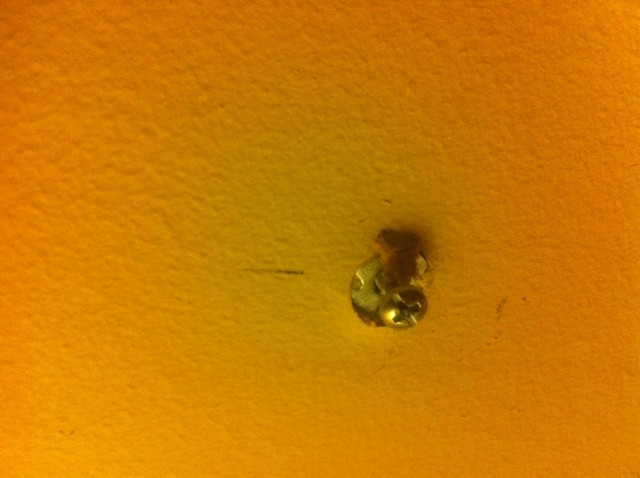



Thank you for the response! As I understood from the modest instructions on the packaging, this type wouldn't require a Mollytång, but it's always needed? Do you think that if I buy a mollytång, it will work? You don't think there might be something else causing issues?

When drilling, please note how deep it goes so you know if you have single or double drywall - It requires different molly depending on the number of drywall layers.
1 drywall 13mm thick
2 drywall 26mm thick
Also, get a molly pliers for easier and better installation.
1 drywall 13mm thick
2 drywall 26mm thick
Also, get a molly pliers for easier and better installation.
It is possible to install molly without special pliers. You should try to screw without the plate behind tearing into the drywall. If I remember correctly, it is usually easiest if you press the plate with small tabs into the wall before you start screwing so that the plate is properly fixed. Look at the screws you have left to get an idea of how they work.
You are completely sure that it is a gypsum wall then? So it's not plastered lightweight concrete for example?
Otherwise, pliers are the way to go, it should be possible to get it to stick even if it has spun in the hole because once it has expanded, it is significantly larger than that hole.
Otherwise, pliers are the way to go, it should be possible to get it to stick even if it has spun in the hole because once it has expanded, it is significantly larger than that hole.
Thank you for all the answers.
Yes, I'm quite sure it's plaster.
In summary, it seems that 1) I will buy a molly tool tomorrow 2) I will try to expand the one that's there 3) Otherwise, it should work to place new mollys in new spots using the molly tool.
Yes, I'm quite sure it's plaster.
In summary, it seems that 1) I will buy a molly tool tomorrow 2) I will try to expand the one that's there 3) Otherwise, it should work to place new mollys in new spots using the molly tool.
I bought my molly pliers at Ö&B 15 years ago and it's still with me.... It didn't cost much... I remember hesitating back then if I really needed it. But I can't understand why people don't say that such pliers are worth their weight in gold when mounting a molly. What you can do if you don't have the pliers is to put a really big washer between the plug and the screw when tightening the plug.
Also, as mentioned above, it's important to have the correct thickness of the plug based on the amount of gypsum. Look at the "neck" of the plug. If it's 26mm, it's for double gypsum. They are also usually called 4D (D==double) instead of 4E (E==single). The 4 stands for the screw's thickness.
Also, as mentioned above, it's important to have the correct thickness of the plug based on the amount of gypsum. Look at the "neck" of the plug. If it's 26mm, it's for double gypsum. They are also usually called 4D (D==double) instead of 4E (E==single). The 4 stands for the screw's thickness.
Fischer gkm! This way you don't have to know the number of shelf layers or buy pliers. Easier to remove and restore if the shelf placement becomes outdated later on as well.
Click here to reply