I have removed two exterior walls in a room in our house, everything except the brick has been removed. They were thin, the previous owner was a smoker and other things, and there were rodents living there, which we heard, and "caves" were dug here and there in the insulation.
The walls consisted of:
Brick
Air gap - more or less.
Insulation/vertical studs
Drywall - thin, less than 13mm.
The mortar on the inside of the brick was so uneven that it must have reached the insulation, after the insulation was removed there was insulation lint left. I have now tapped it with a bricklayer's hammer so that the wall is more even. If it doesn't bulge on a larger scale then :x.. But it shouldn't be that bad; it wasn't until the old wall was removed that it became visible how poorly it was done, the outside of the brick wall looks okay.
I imagine the new wall like this:
Brick
Air gap
Weather-resistant paper
Insulation/vertical studs
Vapor barrier
Horizontal studs/installation layer
Chipboard or similar
Gypsum board
I am thinking about using wooden studs (it's above ground level) on sill paper. There is a "channel" between the brick wall and the slab at the bottom, which I assume is for drainage (I've tested it ). But. Now comes the part I haven't done before. And when I think about how it should be done, I feel that some experience in planning would be helpful...
From what I understand, it is common to assemble the frame laying down (?), and then raise it. The sill paper complicates things a bit, it must be in place, and then you raise the frame on top of the paper, right? Because if you try to twist the frame somehow while it's on the paper, which rubs against the concrete... then there won't be much left of it, right... The weather-resistant paper complicates things even more, it needs to be applied before the frame is in place. And above all: How do you handle weather-resistant paper in corners? How do you avoid gaps? If you plan to have a stud in the corner, it should be airtight, and you avoid trying to fold the weather-resistant paper around the corner to make the paper from the two walls overlap each other? (How would you even attach the flap from the paper on the other wall? Because one wall must be raised when this is done, you can hardly assemble two frames laying down at an angle and then raise them...)
Yes, as I said, I'm starting from scratch here, this is the first time I’m doing this. But there will probably be more, as other rooms in the house have similar problems.
The next consideration is a bit larger: One of the walls has a window. Which protrudes a bit into the room. If it was only about the frame, it shouldn't be harder than not assembling the part of the frame that contacts the window, raising the frame and then measuring/sawing/fitting those parts of the frame? But then there's the weather-resistant paper. The air gap is about an inch, so you can't reach between the frame and the brick when the wall is raised... It's an old window, probably original (-67), so it should be replaced. So it's not an excluded option to simply remove it entirely first. You would still have to measure some, but then nothing prevents you from raising the wall.
But it would be enormously interesting to hear how someone with experience envisions this! Do you remove the window, install a frame with weather-resistant paper on it without worrying about the window, and cut away what’s needed from the outside, outwards/through the hole in the brick wall? Or is it perhaps smarter to take it in several steps? Install the frame, raise it, measure the "critical parts" around the window, and fit them. Then lay the frame back down and attach the weather-resistant paper to the frame with the window hole ready? Is it perhaps that pragmatism based on the situation at hand is most important? But some sort of "basic procedure" I assume exists?
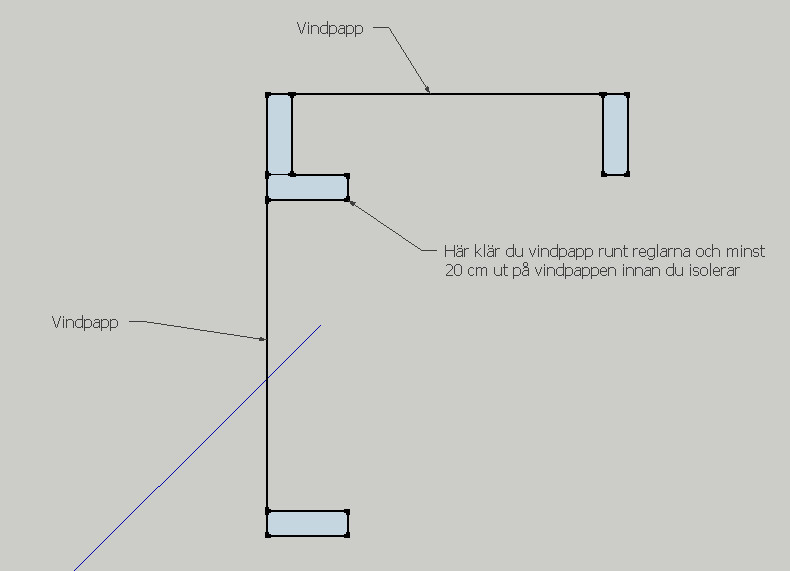
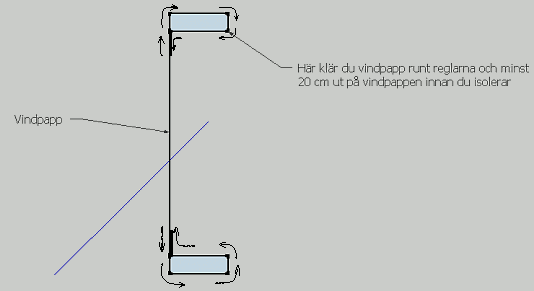
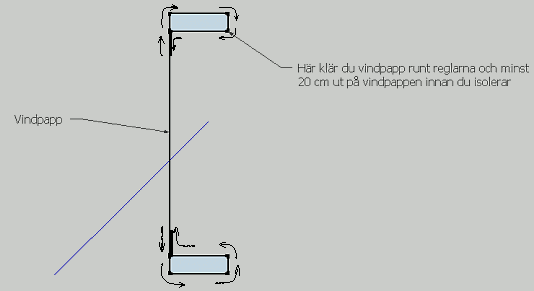
The Syllpapppen you fasten under the sill to make it easier. Complete the wind barrier in the corner before laying the insulation and wrap around the studs in the corner and then 20 cm out onto the wind barrier.
You attach the base paper to the bottom plate so it becomes easier. You complement the corner with wind paper before you put in insulation and wrap around the corner studs, extending 20 cm onto the wind paper.
Thanks for the reply! Good tip about the base paper, of course. It's those simple things that should be obvious that are the best .
But with the wind paper part, I'm not quite following. Probably because I've never seen this done. Or maybe I'm overthinking it. If I understand you correctly, I'm supposed to erect the frames for both walls—after applying the wind paper—and then add about 40 cm (20 cm out from the corner in each direction) of wind paper on top to seal the corner. But wouldn't "on top" mean between the studs and the brick, i.e., the space that the air gap provides? So, 2-3 cm? Because once you erect the frames, which are as long as the room's sides, there isn't much space to move them around; you probably have to place them directly, right? Or should I not do that and instead assemble a *part* of the long side's stud frame first until the corner is done, and then build it out? Because thinking about it, it seems like the structural integrity wouldn't be affected...
Ahh. Of course. You put up the paper separately on the frames and then place the frames tightly together to make the joint tight. And that is probably the way that is practically doable. Oh gosh... I was thinking about applying overlapping paper jointly for both frames, in the air gap, and also making it reasonably tight. And I couldn't figure out how to do that. *shake my head* You can complicate things if you want.
And the rest is about measuring what's needed. Probably I'll put up the shorter pieces around the window after the frame is erected, should be easiest to get exact measurements then. Suddenly this feels much easier. Thanks!
Click here to reply
Vi vill skicka notiser för ämnen du bevakar och händelser som berör dig.

 ). But. Now comes the part I haven't done before. And when I think about how it should be done, I feel that some experience in planning would be helpful...