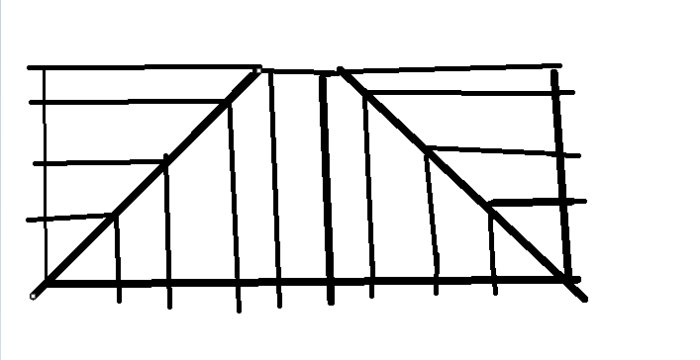
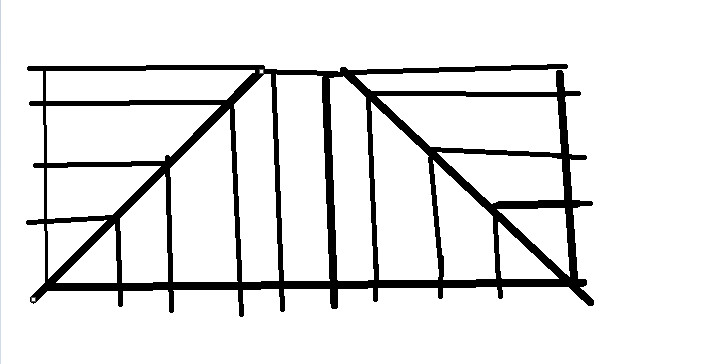
I have another thread, but I'm turning to this part of the forum hoping to get help with the beam dimensions I need for the roof of a "American" style porch.
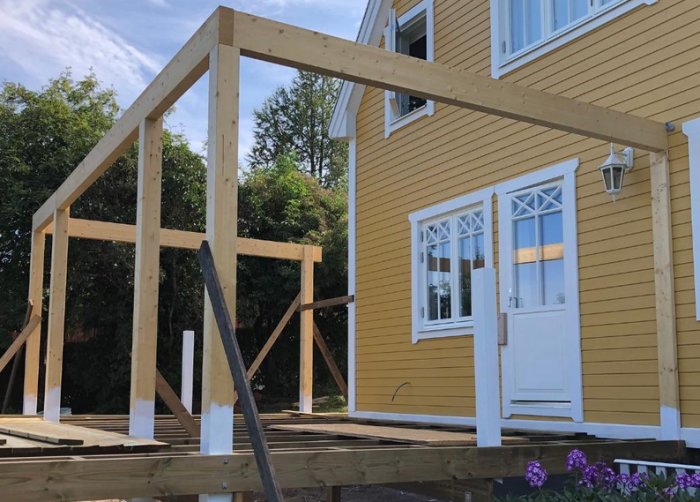
The existing frame that rests on pillars is approximately 6.2m x 3.8m. There will also be a 40-50 cm overhang. The beam is 225x90 Glulam.
Snow load zone 1.5-2.0 (northern Stockholm).
I aim for a 14-degree pitch, but it will inevitably be a compromise.
1. The short side in the picture has a span of 3.6m. Do I need another pillar where there is currently a railing post?
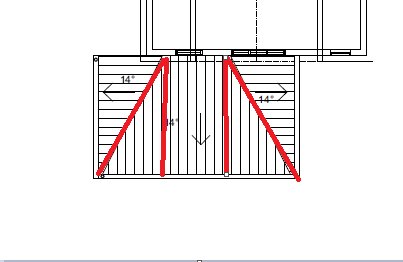
2. When I continue with the roof, can I use 225x90 Glulam (which I happen to have some of) for the rafters I've marked in red below, and the rest with 225x45 lumber C24?
Would it require a 60 cm center-to-center spacing in that case?
The diagonal beams will have a span of maybe 4.4 m.
I find it difficult to apply the tables from TräGuiden to this type of roof.
Yes, that PDF helps a bit.
On pages 32-33, you can see that a 90x225 glulam beam can handle a 9.29 m free span with 120 cc in snow zone 2.
It sounds like I can use that for the diagonal beams in my roof. What makes me uncertain is that a number of joists will be attached to the two diagonals. Like this:
If you want the roof slope to be the same in all directions, the roof sections must be as long forward as they are to the sides. Since the depth of the veranda in this case is somewhat greater than half its width, a small ridge at the top is required to maintain this requirement. I think it's an unnecessary formality. A slightly lower roof slope at the front won't be noticeable. Therefore, the diagonals should be drawn to the midpoint. The diagonals will then be about 4.75 m long and should preferably be 90x270 if the roof is not made too heavy. 90x225 should be sufficient for the shorter beams.
If you want the roof pitch to be the same in all directions, the roof slopes must be equally long forward as to the sides. Since the depth of the veranda in this case is slightly greater than half its width, a small ridge at the top is required if this requirement is to be maintained. I think it's an unnecessary formality. A slightly lower roof pitch at the front won't be noticeable. The diagonals should therefore be drawn to the midpoint. The diagonals will then be about 4.75 m long and should preferably be 90x270 unless the roof is made too heavy. 90x225 should suffice for the shorter beams.
Hi Justus,
Thank you for taking the time to respond.
Yes, I've gained a better understanding regarding the roof angles. Unfortunately, we've opted for a flat piece at the top, meaning not pulling the diagonals together. I realize that the differences in roof pitch outwards/to the sides increase. What I'm considering now is 10° outwards and just under 14° to the sides. Is that a bad idea?
In any case, I'm increasing to 90x227 on the diagonals. Is it unwise to notch them 45 mm out at the pillars, so that all the ridges are on the same level on the topside? Maybe I could reinforce slightly with screw-laminated plywood in the worst case?
Then I need to decide how everything should be attached to the wall. It's a 6 cm plank wall (which I assume I must screw into) plus 2x45 cross-batten additional insulation. My carpenter friend thinks I should fasten a beam firmly on the existing panel, which I then screw the ridges into. Then, a thicker beam below for the ridges to rest on. How does that sound to you?
Do you mean 90x270? A four-degree difference in roof pitch is hard to perceive. However, one shouldn't go down to too low pitches as it affects the choice of roofing material.
It is always better to build on the lower beams rather than notch them, even though 45mm out of 270 is quite marginal.
The fastening should be done in such a way that an exposed panel can be replaced. Some form of metal covering is needed that goes behind the panel and protects the transition between the wall and the roof.
You mean 90x270? Four degrees of difference in roof slope is hard to perceive. However, you shouldn't go down to too low slopes because it affects the choice of roofing material.
It's always better to build on the lower beams than to notch out, even though 45 mm out of 270 is quite marginal.
You should make the attachment so that the exposed panel can be replaced. Some form of metal covering is needed that goes in behind the panel and protects the transition between wall and roof..
Yes, 90x270 of course.
I have a recognized skilled metalworker coming in the next few days to say how he wants it.
I have cut out the panel and (after the picture) attached a substantial beam with French screws into the plank wall. Then I attach the beams properly to the beam and, if possible, with some screws directly into the plank. Maybe secure with an angle bracket.
Click here to reply
Vi vill skicka notiser för ämnen du bevakar och händelser som berör dig.