
4,817 views ·
23 replies
5k views
23 replies
Dimensional timber framing garage roof
The roof consists of trusses. There are 4 trusses that are about 8600 mm long, with 2 anchored at the outer edges and along the wall frame, and 2 hanging freely in the middle (supported, of course, at each end).
The house was built in '79 and is designed in this way to withstand all snow loads, etc. But I want to be able to store as much as I can in the attic (mainly seasonal items but also other heavy bulky things that aren't used often). The trusses are probably not designed for this, so I thought about making one or two reinforcements to strengthen it so I can sleep well at night.
In the middle of the garage, between two trusses, there is an attic hatch, otherwise it would have been obvious to have a reinforcement in the middle. I don't know if I need to do a reinforcement on each side of the hatch, or if I can just do it on one side.
I've thought about cutting the trusses and making an embedded beam reinforcement with joist hangers to avoid losing ceiling height (currently 220cm), but what dimensions should I go for the glulam, both for the beams and the posts? The trusses are 170mm (plus 27mm battens). I've seen 180mm glulam which I can just trim a bit of height from, but what thickness should it be and what dimensions should the posts have? The wall frame dimension is 120mm and I would prefer to hide the posts inside the wall behind the plasterboard. I will probably need to hire an engineer for the building permit, but I still want a clearer picture of what's potentially ahead. Engineers aren't cheap...
Does anyone have any thoughts or considerations?
The house was built in '79 and is designed in this way to withstand all snow loads, etc. But I want to be able to store as much as I can in the attic (mainly seasonal items but also other heavy bulky things that aren't used often). The trusses are probably not designed for this, so I thought about making one or two reinforcements to strengthen it so I can sleep well at night.
In the middle of the garage, between two trusses, there is an attic hatch, otherwise it would have been obvious to have a reinforcement in the middle. I don't know if I need to do a reinforcement on each side of the hatch, or if I can just do it on one side.
I've thought about cutting the trusses and making an embedded beam reinforcement with joist hangers to avoid losing ceiling height (currently 220cm), but what dimensions should I go for the glulam, both for the beams and the posts? The trusses are 170mm (plus 27mm battens). I've seen 180mm glulam which I can just trim a bit of height from, but what thickness should it be and what dimensions should the posts have? The wall frame dimension is 120mm and I would prefer to hide the posts inside the wall behind the plasterboard. I will probably need to hire an engineer for the building permit, but I still want a clearer picture of what's potentially ahead. Engineers aren't cheap...
Does anyone have any thoughts or considerations?
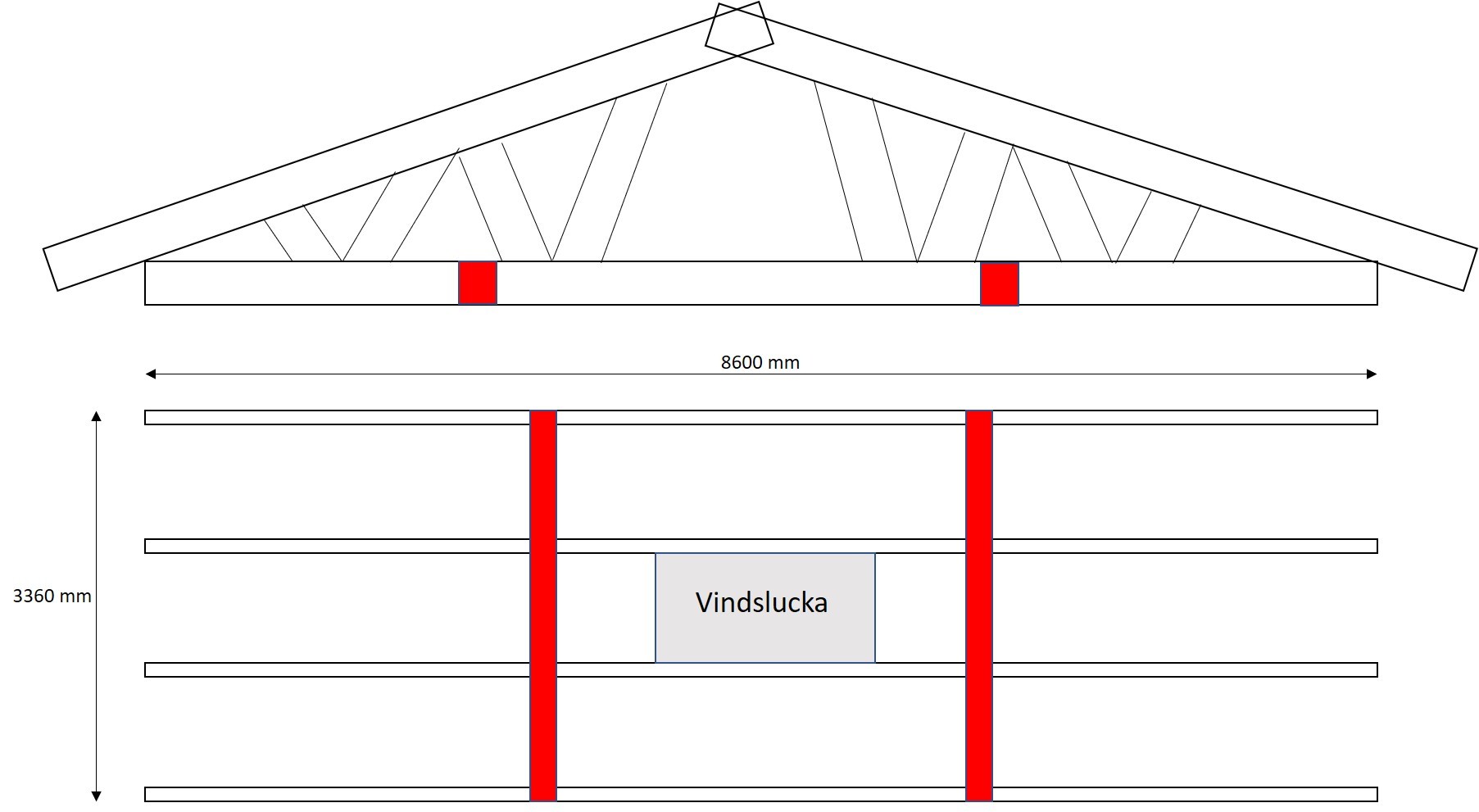

Do not cut parts in the trusses! Trusses do not function like regular rafters. If you want to reinforce the joists for storage, you can insert laminated veneer lumber beams between the trusses and lay a floor on these. With a span of 8.6 m, they will be quite hefty items, like 140x360 mm, if you want to achieve normal joist standards.
Instead of cutting the rafters (which sounds like pure idiocy, if you excuse the term), perhaps you can lay the new beams on top of the lower beams of the rafters (where you have red in the top drawing). Then secure the rafters to the new beams with some form of nail plates. Do you have space in the attic for new beams on top of the existing ones? You will get a significantly stiffer construction even if you only use one of the beams, even if it becomes asymmetrical. The distance from the end to the bracing point will be shorter for both sides, but a little differently shorter.
Whether you really need to reinforce is another matter. Just because you're loading a lot of junk in the attic, I can't imagine reinforcements are necessary.
/Fredrik
Whether you really need to reinforce is another matter. Just because you're loading a lot of junk in the attic, I can't imagine reinforcements are necessary.
/Fredrik
Thanks for the heads-up that truss rafters behave differently; I hadn't thought about that. The plan was to do something fairly simple and inexpensive; a huge beam would be expensive and too complicated. I've already laid the cheapest laminate flooring I could find in the attic. I don't want to redo it.
Cutting rafters and doing recessed beams isn't a big deal in itself, for the record. But as mentioned, it can be different with trusses...
If I place the beam on top, it will create strange and complicated spaces up there; it's crawl space as it is. But thanks for the tip!
Okay, but what if I were to use metal beams under the rafters? They don’t take up as much space, so maybe that's possible. What type should I use then? Is there anything to consider in terms of quality or similar?
edit: I've read that HEB beams are a stronger H-beam, but maybe I can manage with two standard HEA beams? Can one use glulam posts with them?
Cutting rafters and doing recessed beams isn't a big deal in itself, for the record. But as mentioned, it can be different with trusses...
If I place the beam on top, it will create strange and complicated spaces up there; it's crawl space as it is. But thanks for the tip!
Okay, but what if I were to use metal beams under the rafters? They don’t take up as much space, so maybe that's possible. What type should I use then? Is there anything to consider in terms of quality or similar?
edit: I've read that HEB beams are a stronger H-beam, but maybe I can manage with two standard HEA beams? Can one use glulam posts with them?
Last edited:
A truss is constructed from bars that are connected at joints to form triangles, which are the most stable construction elements. One uses the material optimally and can bridge large spans with relatively slender dimensions. Cutting off a bar is like removing a card from a house of cards. It doesn't help to place beams as support underneath. If you want a loft that can withstand more load, you must replace the truss rafters with more traditional ones. Fully possible, but labor-intensive above all.
The question still remains what you are afraid might happen. Are you going to load up concrete pigs in the attic??? Heavy moving boxes with books will probably weigh the most unless you collect anvils or wheels for old trains.
If you really want to reinforce for increased loads on the attic floor (because that's all that's being added, right?), then think about where the center of that load will be on each side and then place a beam underneath (however you're going to access it???) that can handle that load. You don't need to reinforce more than that and I guess a fairly small beam will handle it.
Justus, you probably have a better grasp of this than I do. Is reinforcement really necessary?
/Fredrik
If you really want to reinforce for increased loads on the attic floor (because that's all that's being added, right?), then think about where the center of that load will be on each side and then place a beam underneath (however you're going to access it???) that can handle that load. You don't need to reinforce more than that and I guess a fairly small beam will handle it.
Justus, you probably have a better grasp of this than I do. Is reinforcement really necessary?
/Fredrik
I think I understand what Justus is explaining, that if you lighten the load at a point in the truss, the rest of the structure will be loaded in a way that it is not designed for? Am I interpreting that correctly? But what if you do beams under each point in the w-shape? Shouldn't that distribute the load as evenly as possible? How much weight is required to disrupt the entire structure? Maybe I should consult with a constructor after all to calculate what it can withstand.
Yes, it's bikes, sleds, skis, boxes with construction/painting/electric materials, memorabilia, boat stuff, building materials, and all sorts of junk you hoard but still use once a year.
Yes, it's bikes, sleds, skis, boxes with construction/painting/electric materials, memorabilia, boat stuff, building materials, and all sorts of junk you hoard but still use once a year.
The most effective way to significantly increase storage options with a limited effort is to install glulam beams between the W-trusses and bridge the distance between the glulam beams with slightly sturdier timber. You can also choose to do this over a limited distance. Installing longitudinal beams under the truss joints is much more costly with less effect.
Interesting. Could you describe a bit more precisely where the reinforcement would take place? Would they be placed along the roof parallel to the W-trusses? They would then need some support to positively affect strength, so I assume it should be done in a different way.J justusandersson said:The most effective way to significantly increase storage possibilities with a limited effort is to install glulam beams between the W-trusses and bridge the distance between the glulam beams with slightly stronger timber. You can also choose to do this over a limited distance. Installing longitudinal beams under the trusses' junctions costs much more with less effectiveness.
One places glulam beams (one needs to calculate the dimension) in between the w-trusses and lays heavier floorboards on them. The top of the beams will be higher than the bottom chords of the trusses, so there will be no conflict. The diagonal braces will, of course, be in the way.
Ah, parallel to the lower horizontal beams of the rafters then. One simply builds a floor that "floats" over the rafters and does not burden them. In this case, the floor was already laid, but I was curious about your solution and it is of course a good alternative another time.
It feels like the most solid solution. Unfortunately, as mentioned, the floor is already laid, and adding multiple large beams would be too big of a project. That's how it feels at the moment, anyway. Additionally, the garage door is at one end, which means I would probably need to install a strong header over it that can support the new beams. It would be like rebuilding half the garage structure.J justusandersson said:
Isn't there a simpler solution that might not be 100% but would be effective without negatively affecting anything else, like seriously compromising the truss structure?
Post a floor plan if you have one, so the discussion can be more concrete.
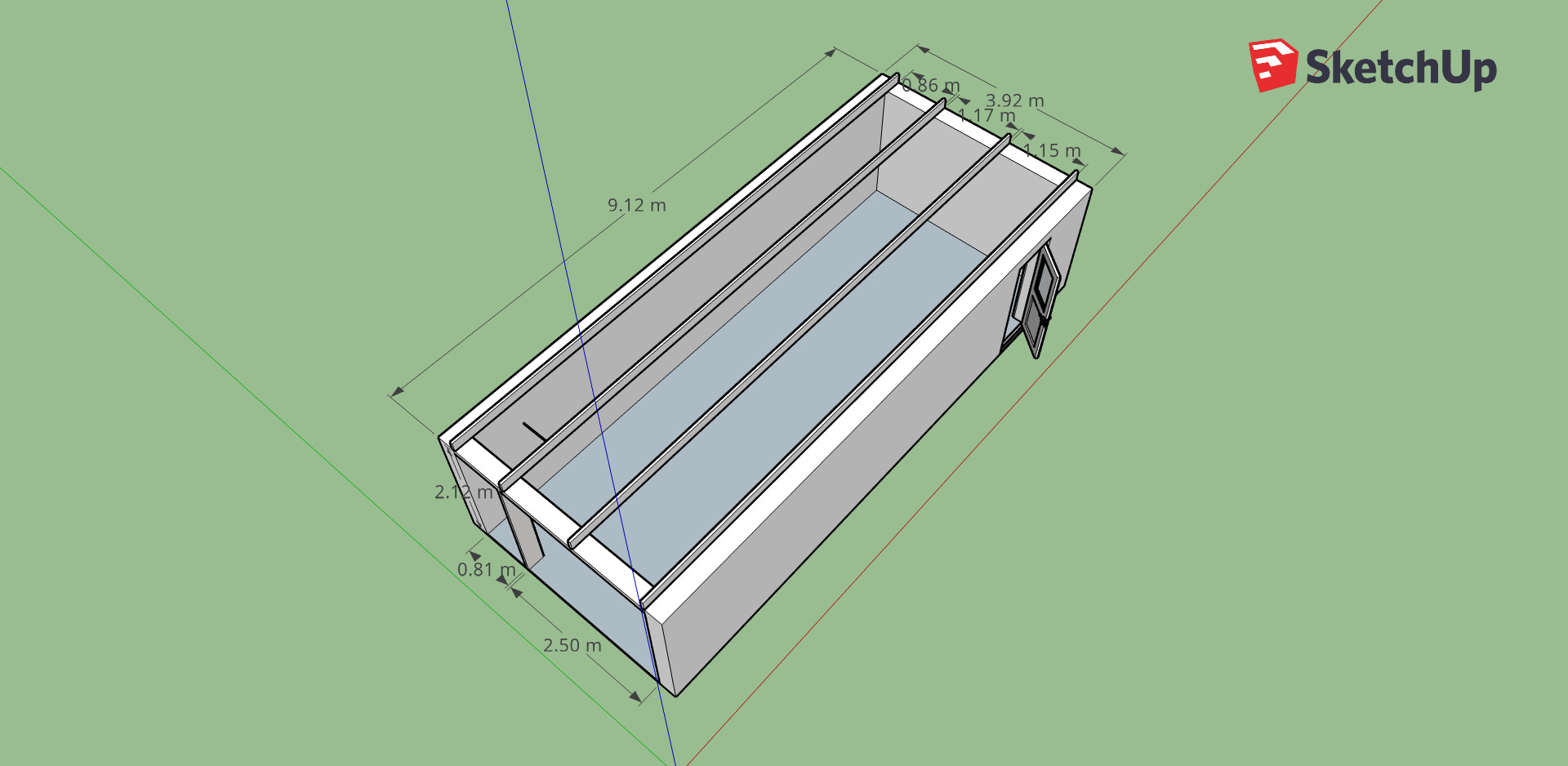
Didn't have a floor plan, but I drew it up with exact measurements in Sketchup. A separate image of the truss will come, otherwise it becomes too cluttered. The studs are 45*170.J justusandersson said:
Can you screw-glue another set of 45*170 onto the rafters, with metal plates?
Do you gain anything by adding between existing rafters and attaching 45*170 studs to these? (a sketch of what I mean will come). Then the load is distributed a bit more, but the total load in the middle remains the same though.
Last edited:
I suspected that there was something I didn't understand! So the rafters are positioned lengthwise. One solution is to lay beams across them above your newly laid floor on the rafters. With a span of only about 3.2 m, reasonable dimensions can be achieved. The exact dimension depends on how much you want to load.