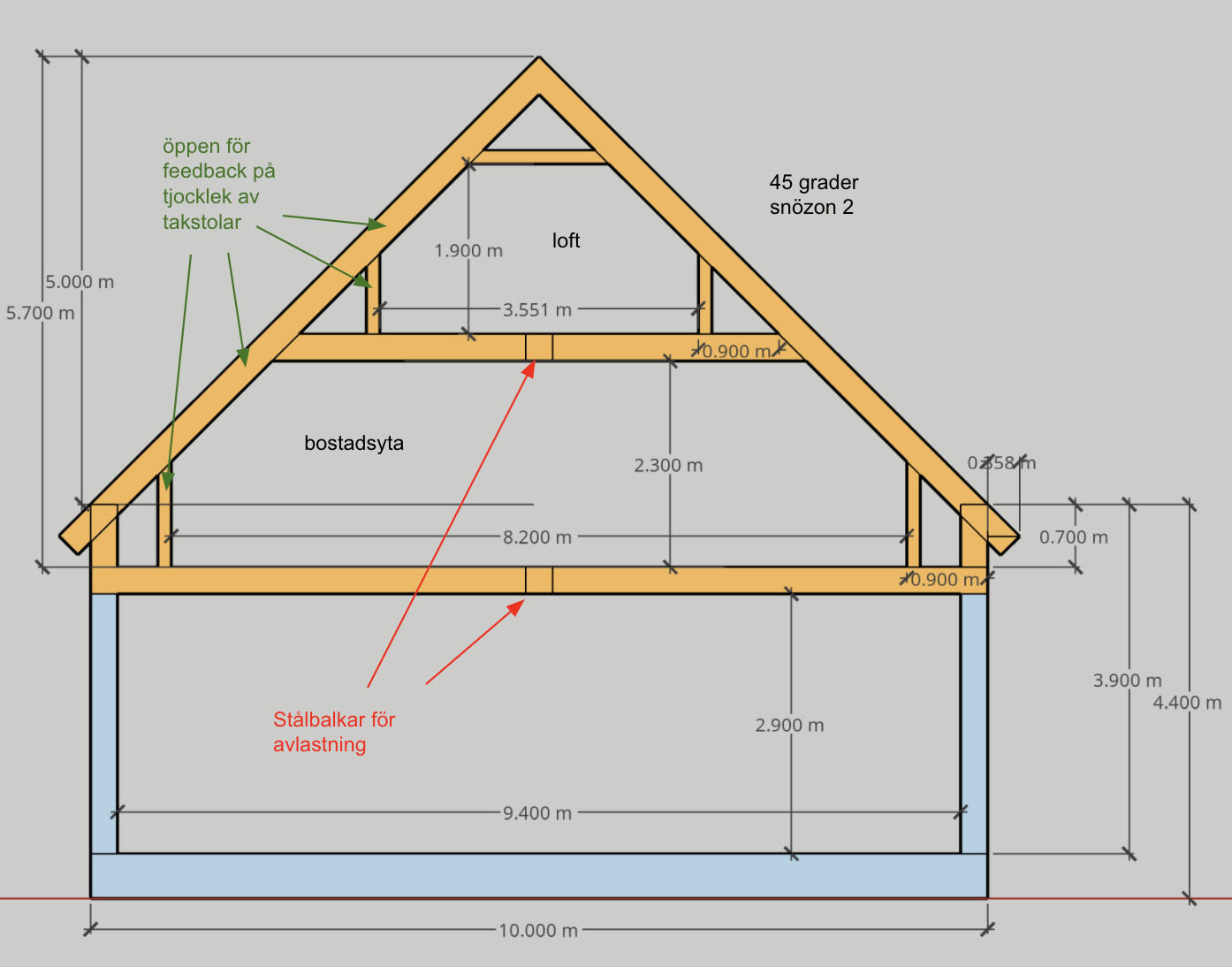
We are looking at a special construction and need help from a skilled designer/engineer to size and calculate the following conceptual building with trusses:
The house is approximately 10 x 10.5 meters with two residential floors and an attic where the span is at most 10 meters. We will have several rooms on the residential floors but would prefer not to limit ourselves in terms of the exact layout by pre-determining where the load-bearing walls should be. We are therefore considering whether it is possible to use, for example, two transverse steel beams on each floor (or more?) to support and, in practice, reduce the span to 5 meters.
We need to understand the dimensions of the trusses, such as the thickness of the trusses/flooring, to enable this and any other limitations to proceed with a more detailed layout. The measurements given in the image are the ones we preferably "want to lock."
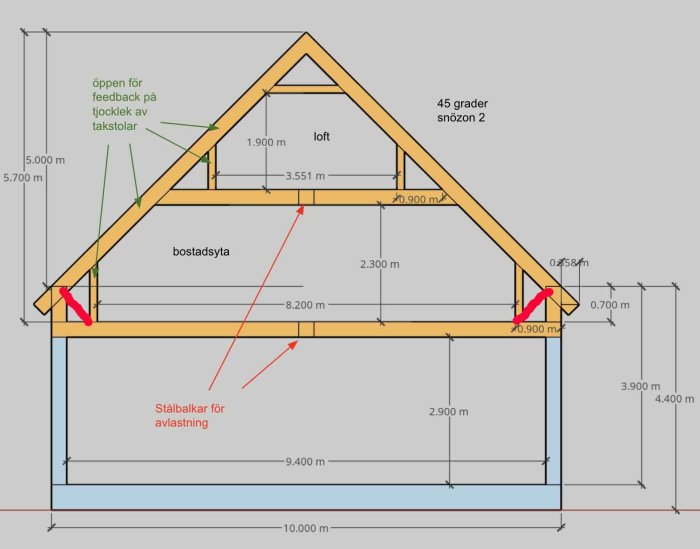
I don't believe in the solution with steel beams. With a span of 10.5 meters, they become enormous. It's better to make the entire truss including floor joists in glulam. The upper ones probably around 90x315, the lower ones maybe 215x405. The raised wall requires diagonal braces (marked in red on my modification). The entire project, including dimensioning, should be left to a truss factory. A 45° roof pitch facilitates the dimensioning of the rafters.
1) The span is 10m, not 10.5m (but probably makes little difference).
2) Agree that steel beams are not fully thought-out yet, BUT the idea was that these two transverse ones would in turn be attached to two vertical steel beams against the bottom plate. Like this:
XXXXX
X. X
XXXXX
X. X
X. X
bottom plate
=> the load-bearing capacity of these should logically be at least as great as in the outer walls, or am I wrong?
=> wouldn't the "practical" span then be reduced to 5m? and you can manage that without glulam?
3) With a glulam solution: Do you mean that the floor joist dimensions increase to 315+ and 400+? The challenge with this is that it steals ceiling height.. When houses were built in the past, they didn't use glulam and it seemed to work, didn't it?
Even a 5 m span requires glulam (or masonite beams or kertobeams). I think it would be unnecessarily complicated and expensive to involve steel in truss constructions. The construction height isn't a problem when you're building new, is it? American architects were given the answer "The sky is the limit" when they asked how tall they could build. The difference from the past is interesting. Partly, they used logs in much heavier constructions than what is available today, and partly, they accepted much more deflection in the floors. Additionally, the knowledge about how the strength of wood is affected by moisture and long-term loading was not as good.
The construction height is an issue due to the zoning plan and demand for room height. I am willing to accept higher costs (such as steel beams, glulam beams, etc.) to limit the floor thickness to a maximum of around 300mm if possible. But also interested in how the dimensions of the rafters will be since this affects the volume/area inside.
By the way, if one buys a house frame from the supplier, can they assist with construction solutions?
I only have one comment/question about one of the measurements, guessing that the 70 cm between the top edge of the floor structure and the roof line is because you want to classify it as a loft and not as two floors. I have talked to my municipality about this and got the answer that the roof line should be drawn when the roofing is done, i.e., accounting for the sheathing and possibly battens and roof tiles on top of the rafter, otherwise it will be 70 plus about 10 cm which may then be classified as a two-story house. I'm considering rafters myself and it's simpler and gives better height to calculate from the roof line of the rafter as done in your drawing, I would want to do that myself.
Click here to reply
Vi vill skicka notiser för ämnen du bevakar och händelser som berör dig.