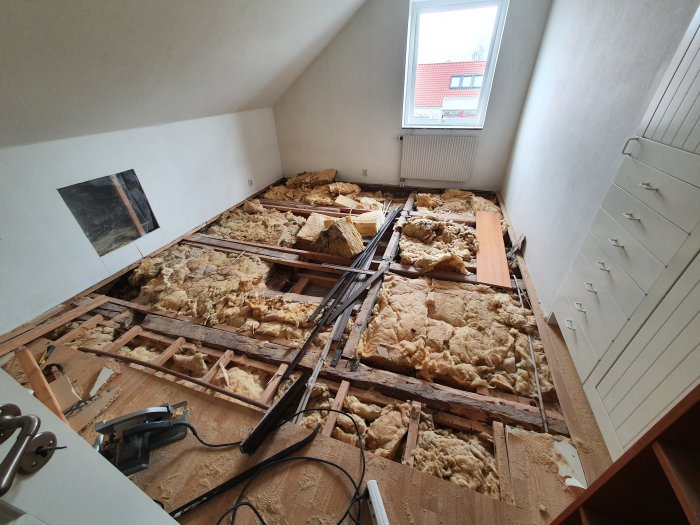
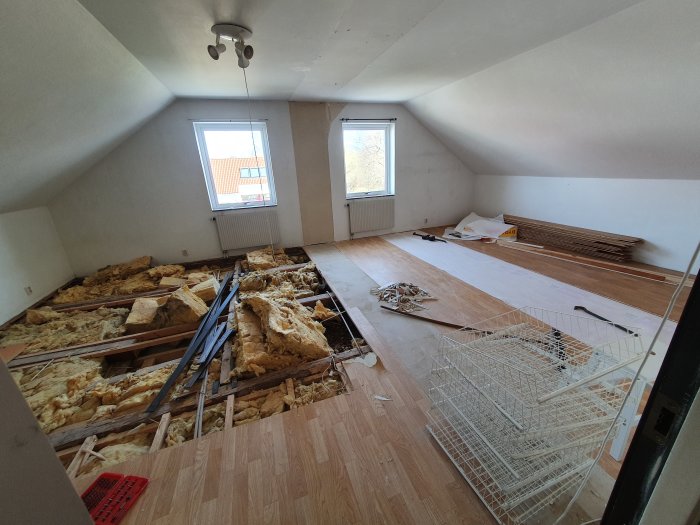
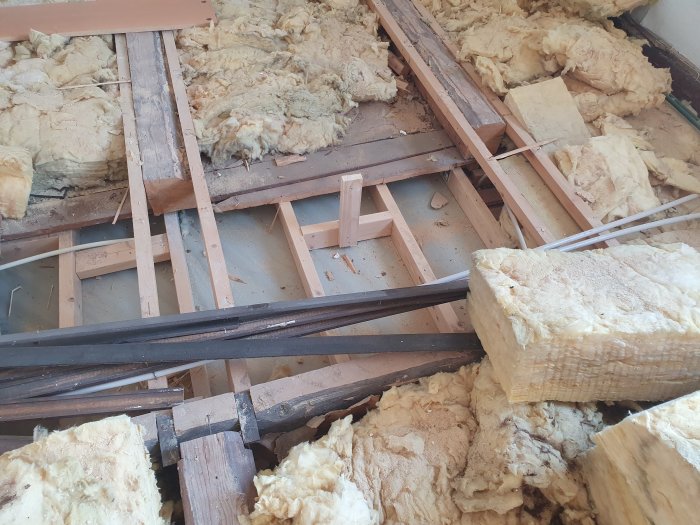
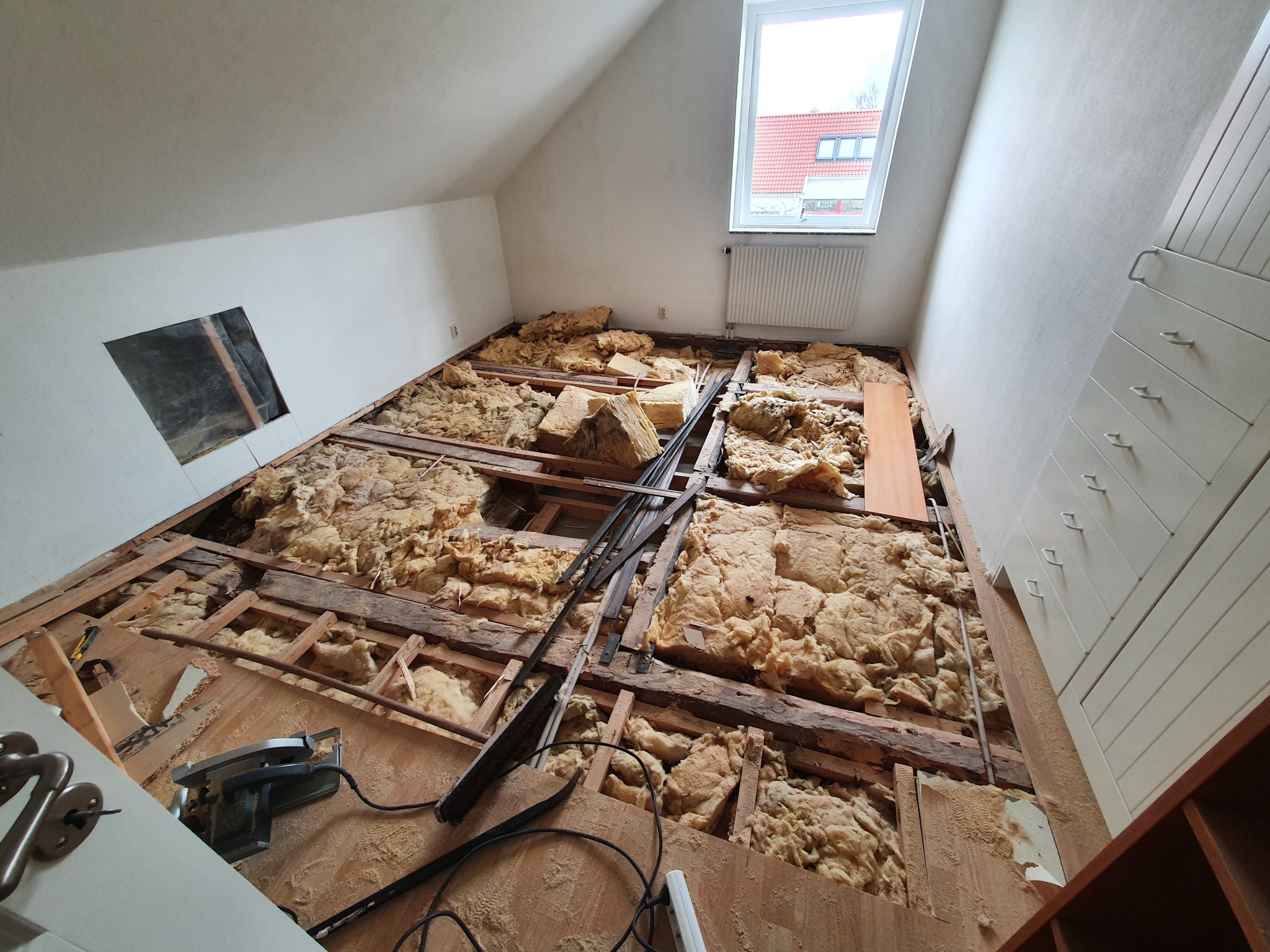
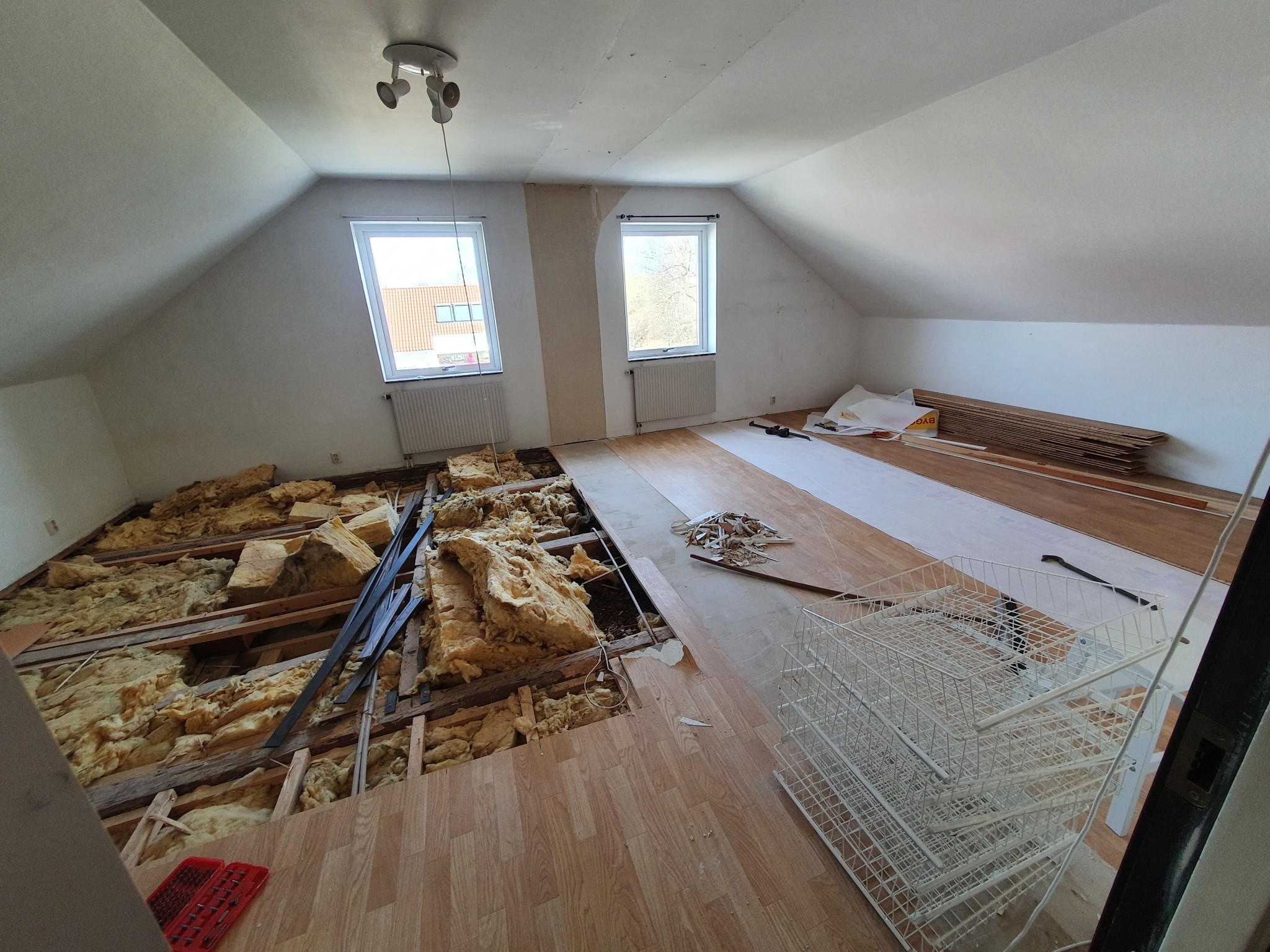
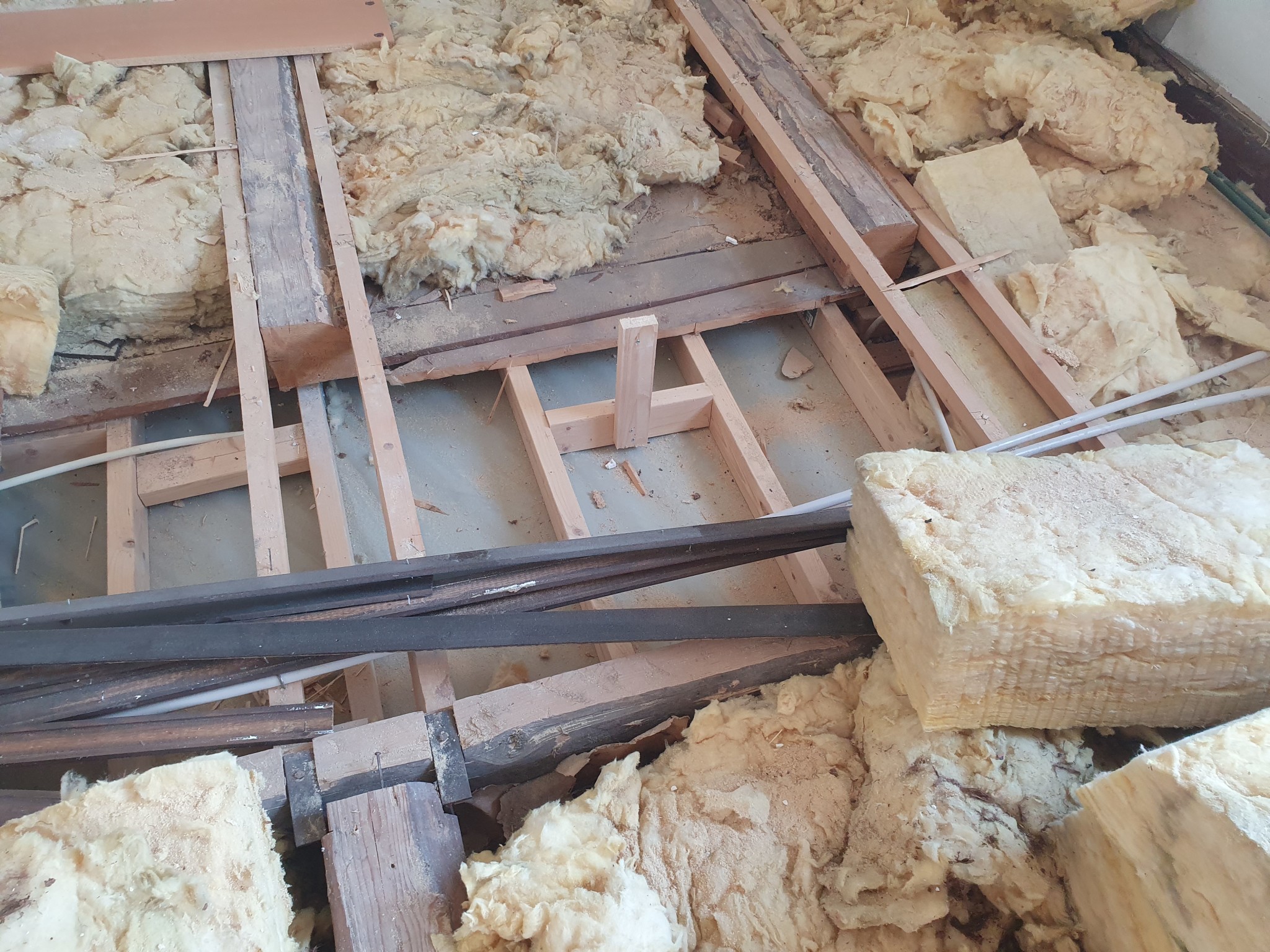
I have a small problem with a newly purchased house, built in 1908, so a slightly uneven floor was to be expected. I had a plan as an Easter project to make it a bit more stable where there was a small dip. However, the more that was opened up, the bigger the problem appeared, the dip turned out to be because two rafters have been cut off, probably for a staircase once upon a time. There is a support on one side but not the other, the side without it has sunk about 10 cm lower than the other side while the other has started to point upwards (not touching the base of the beam shoe on the support), probably when we started putting moving boxes in the room on the other side of the load-bearing wall, it also cracked in the ceiling below.
So I just want some opinions on whether this can be considered a hidden defect (which it seems to be since an inspection was done and nothing was noted about the floor on the attic floor), and some input on my intended solution.
I have thought of solving it by placing 195x45 on either side of all the beams (even the intact ones, this is the highest height that fits without raising the floor significantly) and then two in between to achieve 300 mm c-c. The span is a little under 4.2 m so it should be OK with screw-glued particle boards.
Not entirely clear in either direction. You mentioned that the floor was uneven. Something you intended to address.
I interpret that as there were indications that the floor wasn't entirely correct. Given that, you can't expect a flawless load-bearing structure.
What the inspector discovered or didn't discover doesn't really matter for the question of whether it's a hidden defect or not. If the inspector missed this, the inspection company might be liable for compensation.
In addition, it doesn't sound like the fix will need to be particularly expensive. There are court cases where a hidden defect wasn't deemed to affect the property's price (and it's the "defect in value" you can be compensated for, not what it costs to fix the defect). If the defect is too cheap, it is considered not to have affected the price (if it had been known at purchase) in a provable way.
This could, as mentioned, be a "hidden defect." Far from certain, but at least not impossible. However, first check if you can solve it yourself in a reasonably simple and inexpensive way. You seem to have a good solution in mind. Getting something through as a hidden defect is anything but easy. It takes much time and energy. So try to avoid it if possible.
Not completely clear towards either direction. You mention that the floor was unsteady. Which you planned to address.
I interpret this as there being indications that the floor was not entirely correct. Because of this, you can't expect an error-free framework.
What the inspector discovered or didn't discover doesn't really matter for the question of whether it's a hidden defect or not. If the inspector missed this, then possibly the inspection firm could be liable.
Additionally, it doesn't seem like the remedy will need to be particularly costly. There are legal cases where a hidden defect wasn't deemed to affect the property's price (and it's the "value fault" you might be compensated for, not the cost of fixing the fault). If the fault is too inexpensive, then it's considered not to have affected the price (if it had been known at the time of purchase) in a provable way.
However, the unsteady floor became noticeable after moving in and with higher stress than there probably was before. I mainly meant that considering its age, more deformation was more acceptable than it is today, and one could expect more sway than in a newly built house.
But yes, it's not completely clear, I agree, but the problem is precisely that it's a defect that was not expected and is relatively severe. If we had placed some heavier items in that room, it could have collapsed into the kitchen below. It's only 2 pieces of 45x45 with a span of about 1.5 meters holding it all up. And it was necessary to tear down partition walls shown in pictures to attach beams properly, and similarly, the knee walls will need to be demolished to attach beams to the outer wall, so it is more costly than one might initially think now that it is more serious.
Also, pertinent to the matter is that there is a hidden defect insurance from the seller's side, so the case will likely be addressed against the inspection company (Anticimex in this case).
Yes, that wasn't pretty. I agree with you that it should be possible to make a case against Anticimex if they have chosen to insure against hidden defects.
But you probably shouldn't take any more actions right now, and you should wait for a verdict from the other party. Otherwise, I think it will be harder to get any compensation, based on what I've read before.
The legal cases cited here on byggahus involve a latent defect (I recall it was a fault in drainage) where the cost was 40,000, and the house in question cost approximately 2.5 - 3 million. The court found that the defect was too minor in relation to the price of the house. So even though the defect was considered a latent defect in all aspects, it didn't warrant compensation. Another case involved a bathroom in a condominium (different laws apply, the Sales Act applies to condominiums, the Land Code applies to property purchases, but the formulations about latent defects are similar in both laws), where the defect cost 150,000, but the condominium had cost over 7 million. The defect was considered too minor to have affected the price.
However, if you are going to claim a latent defect, it is important that you notify the seller immediately, before tearing down too much. If you wait too long to report the defect, your right to compensation expires.
Given that the floor was so shaky that you planned to address it, it doesn't really matter what the cause was, you had formal reason to suspect that something wasn't quite right. The fact that the house is over 100 years old and has undergone several major renovations can also be motivation for a more in-depth investigation. And as mentioned, the cost to address it is relatively small, so there's a high risk you're just spending time and energy on something that doesn't result in any value creation. Keep in mind that your counterpart is an insurance company with lawyers processing your "application."
The legal cases that have been cited here on byggahus. One concerns a latent defect (I believe it was a drainage issue) where the cost was 40,000, and the house in question cost if I remember correctly about 2.5 - 3 million. The court considered that the defect cost too little in relation to the price of the house. So even though the defect was considered a latent defect in all aspects, it did not provide compensation. Another case involved a bathroom in a condominium (not the same laws, the Sale of Goods Act applies to condominiums, the Land Code applies to real estate purchases, but similar formulations regarding latent defects in both laws), where the defect cost 150,000, but the condominium had cost over 7 million. The defect was considered too small to have affected the price.
But if you are now going to claim a latent defect, it is important that you immediately notify the seller before you tear things apart too much. If you wait too long to report the defect, your right to compensation will lapse.
It should be pointed out that it is not just a matter of form that purchases of condominiums are covered by the Sale of Goods Act and real estate by the Land Code. They are completely different legal frameworks, so in a dispute regarding a latent defect in a property, how the legal system has ruled on defects in a condominium is irrelevant and vice versa. Furthermore, according to the Sale of Goods Act, the primary rule is that the seller remedies the defect, while according to the Land Code, it is about making deductions from the purchase price or canceling the purchase.
A hidden fault is unlikely if the house is from 1908.....then you should expect surprises if the interior looks like a Myresjö house from '82.
I believe more in a torn-down chimney at the location in question.
You would have needed to reinforce the floor anyway. So why even try to get it as hidden defects when it was marginal extra work?
We had no plans to reinforce the floor and fully accepted that older joists creak and bend more than modern ones, but when we started putting in moving boxes, it quickly became clear that the joists couldn't be significantly loaded without problems, i.e., the room can't be furnished "normally." To fix the problem, there will be quite a few potential consequences:
- As mentioned, a partition wall needed to be torn down due to access to the load-bearing wall.
- Knee walls will need to be torn down for similar reasons, access to the outer wall to attach new beams (these have no flooring, and their sill is lower than the floor itself, i.e., you can't fit new beams due to height and can't crawl behind).
- Unfortunately, it seems that the wiring needs to be redone in the space as they cross almost every beam, and if you put in new ones, it feels incredibly stupid to cut the same notches and lose the integrity of the new beams.
If you do this yourself, the material cost isn't that high, but not everyone can/wants to do that, and the price of the house would probably have been significantly lower if it had been revealed during the inspection that the joists are weakened and need to be repaired before you can furnish/move in, as it stands right now, about 1/3 of the upper floor is unusable since moving in.
But I'm aware that it's an uphill battle when it comes to hidden defects, so I am grateful for all the input.
I perceived that you were aware of some floor deflection even before the purchase. Now it sounds a bit more like a hidden defect. So it might absolutely be worth the effort to report it to the seller and the insurance company. Then you'll have to see how the company reasons.
If you go that far, it's not a lot of money and energy you need to spend. You might need to postpone further actions until the insurance company has had a chance to inspect. It might also be valuable for you; the representative from the insurance company might provide some tips on appropriate measures, even if the company denies compensation.
That you have the opinion you have is one thing, but surely the room can't have been unusable before? It sounds very strange if you couldn't have normal things in there. That it sags and hangs is one thing, but that it would be unusable seems a bit exaggerated to me.
Hidden defects are hardly the case if the house is from 1908... then you should expect some surprises if the interior looks like a Myresjö house from '82.
I believe more in a removed chimney at the location in question.
Surprises yes, but since this is such a serious defect in the load-bearing structure, there must be a limit somewhere, especially since the inspection did not indicate anything at all, and this could only be revealed by cutting up a significant part of the floor in a room.
And it is a removed staircase; I have obtained drawings where the staircase is depicted. One might say this should be an indication of problems and should have been checked before purchase, but that's a bit where the question lies, whether it's reasonable to assume that absolutely everything is wrong when it looks OK externally during a visual inspection.
Vi vill skicka notiser för ämnen du bevakar och händelser som berör dig.