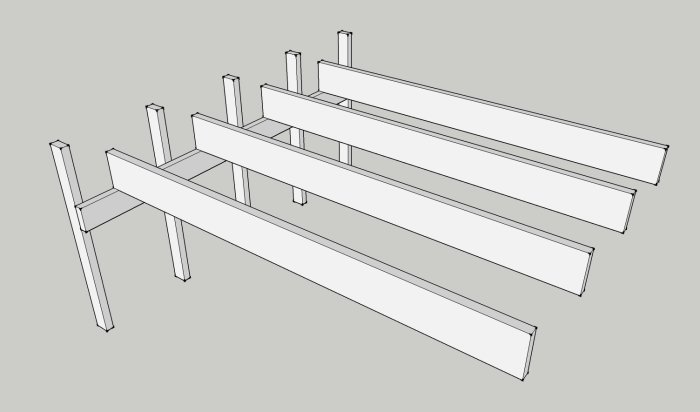
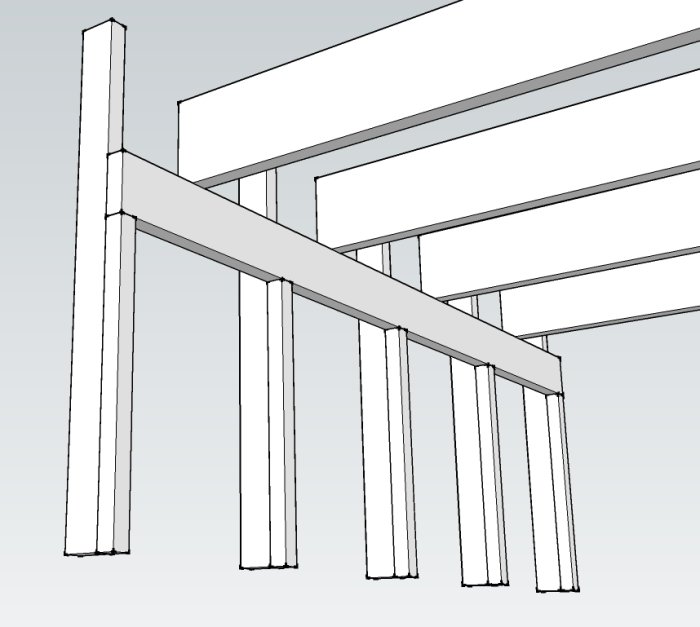
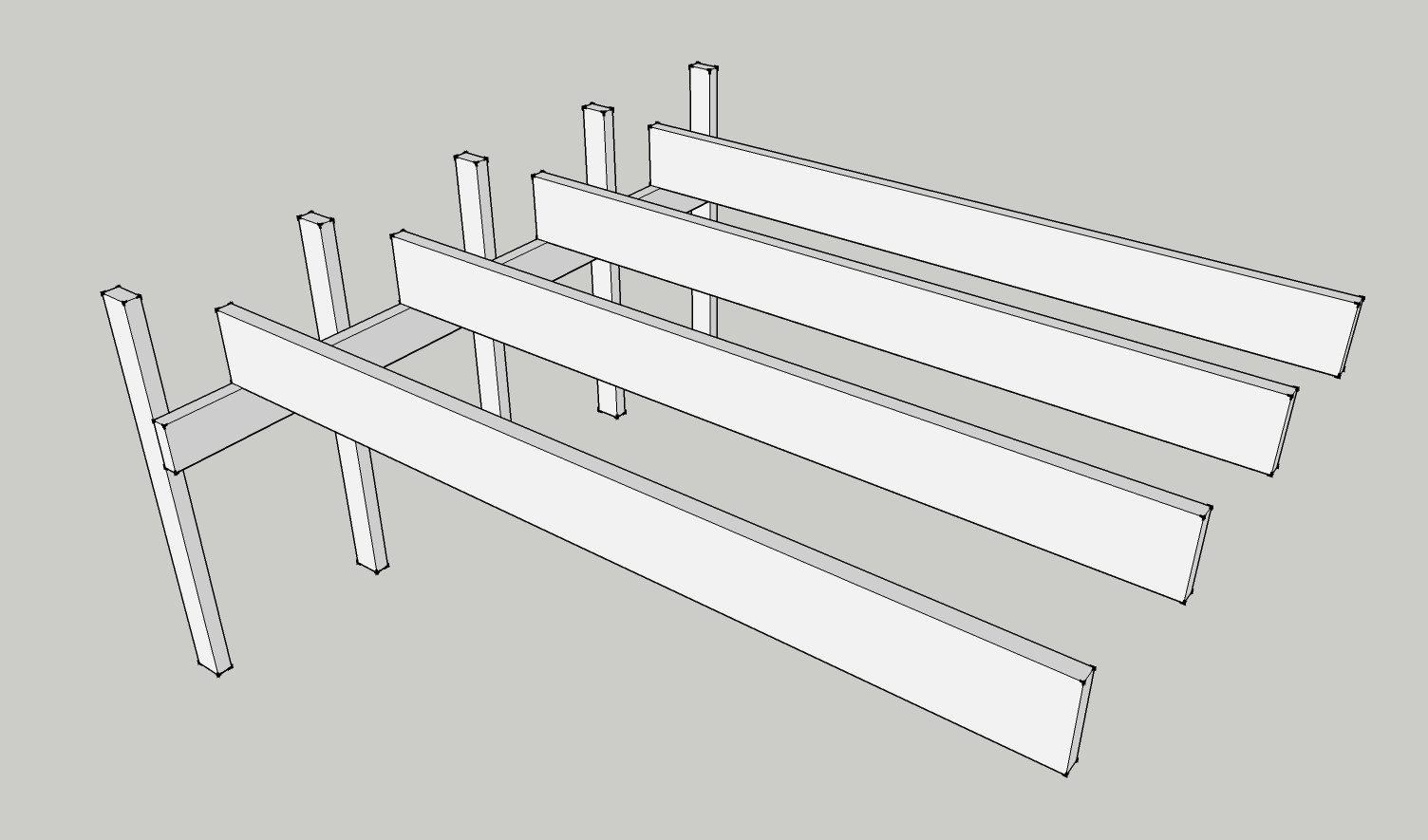
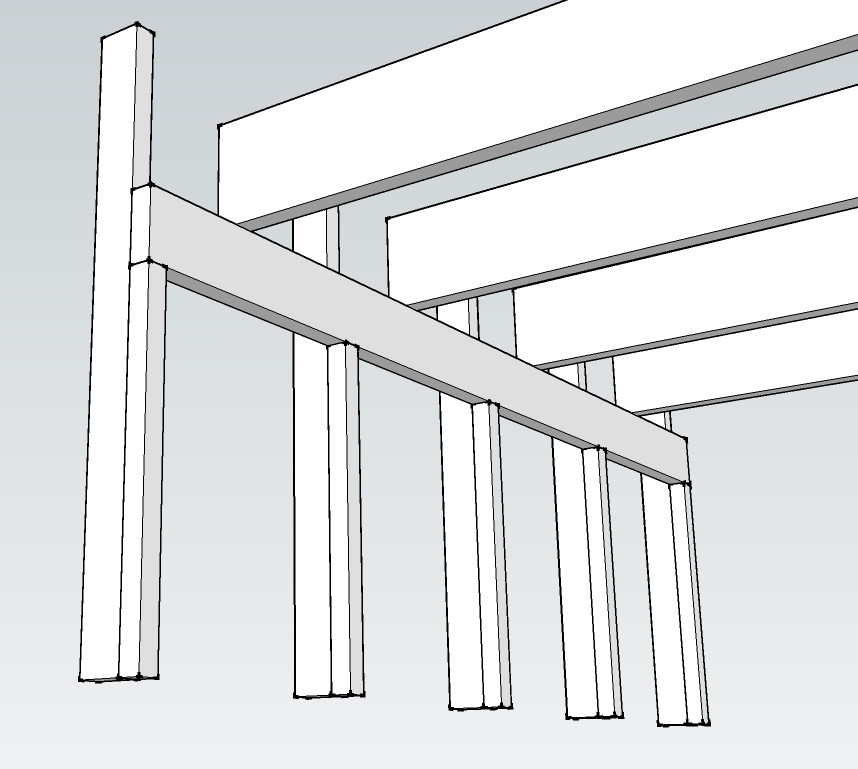
I hired a company to replace the roof on an attached garage. The entire roof is being replaced, including roof joists due to moisture damage. The question concerns the connection between the roof joists and the wall shared with the house. This is a principle sketch of how it looks:
The standing studs are the wall shared with the house (90 mm studs with 60 cc). The house is higher than the garage, so the garage's roof joists rest on a horizontal stud, attached to the side of the standing studs.
Last year I tore out an old asbestos wall here and re-framed a new freestanding one with metal studs, double gypsum, OSB, and finally thin plywood as the surface layer. In connection with that, I replaced the horizontal stud, which was a 90-stud nailed to the wall studs, as I thought it looked weak to support the entire garage roof's weight. I then replaced it with a 145-stud, which I screwed with three 6x100 screws into each wall stud instead.
Now when the carpenter is going to replace the entire garage roof, he wants to open up the new wall to reinforce this structure by nailing a 45 stud onto the existing 90 stud, which the horizontal stud would rest on.
I would prefer to avoid opening up the new wall and instead just use the existing, new stud as it is. There are some penetrations and other special solutions, and I have sealed one of the gypsum layers with acrylic sealant for good soundproofing, for example, and it is painted. If the wall needs to be opened, I think it would be unnecessarily much work for potentially no benefit.
But the key question is whether the existing structure will hold or not. I obviously should have done it better from the start; I reacted to the old construction with a 90 mm nailed stud seeming very weak, but at the same time, it has handled all the roof's load for 40 years. The new structure with a screwed 145-stud should handle much greater loads than the previous one and thereby should not be a problem, or what do you think?
One could also place the new roof joists flush against the wall studs and screw-glue that connection; it is a reinforcement that could be done without damaging the new wall.
Spontaneously, it feels a bit weak with 3 screws that essentially have to take the entire load from a roof beam. If we guess a span of 5m and cc60 on the roof beams, then it becomes 3sqm of roof per beam. And if we brainstorm a bit about snow load and dead weight, maybe 1000kg (I have no idea of the correct figure) per beam. That gives 500kg that should be supported by the wall, by 3 screws.
Yes, that adds quite a bit of load... By the way, it's snow zone 2.0, with a 4 m span and a flat felt roof, so if one neglects snow shoveling, there can be a lot of snow up there.
Anyone else who has an opinion on what I should do? Both more and less qualified guesses are welcome. 500 kg on three 6 x 100 screws is probably a lot, but what if you also mount the roof beams flush against the upright studs? That would create a surface of 90x220 mm where you could maybe put five screws in + glue?
It's boring, it's never fun to tear down something you've completed, but as already noted there's a lot of load on a couple of screws. Depending on what the garage looks like, I might have attached the studs on the outside of the finished wall. Then you avoid having to spend on new drywall layers, etc. It won't be super neat.
I have a similar construction in my garage, but with heavy bolts attached to CC60 in the support beam, with vertical studs at the bottom since the garage is offset against the house. I sometimes shovel the roof once a day in the winter to avoid too much load, but on the other hand, the garage has been standing for 40 years, so it sometimes feels excessive
I came to my senses and opened up the new wall so it can be reinforced to the new roof. It wasn't too much work and the sheet material I can screw back again when it's done. Thanks for the input. I told the carpenter that I hope the rest of the house is better built than the garage, he agreed
Click here to reply
Vi vill skicka notiser för ämnen du bevakar och händelser som berör dig.