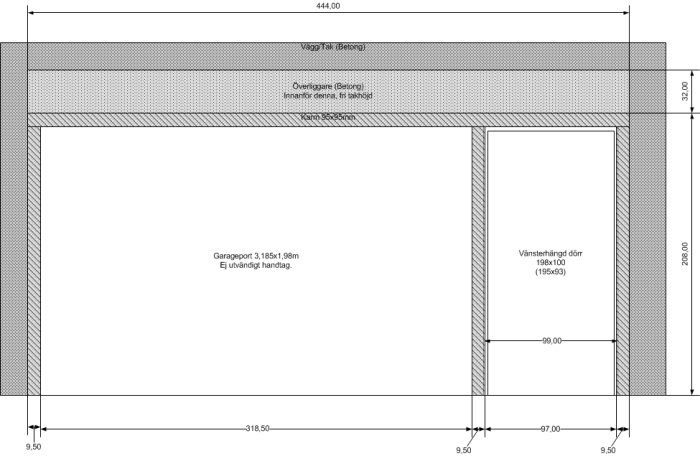
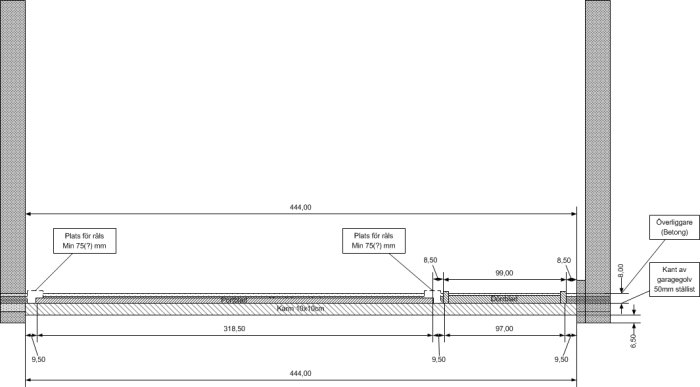
I am planning for a new garage door and pedestrian door for me and my neighbor's townhouse. We have an opening of 444x208cm, and the garage door will be installed in this opening. It will be installed in the opening, not inside. The manufacturer says it's possible, but we'll need to build a frame of 10x10cm to secure the door.
I've been thinking about how to make it all look nice, and I feel pretty much ready. But before I order the door and garage door, I need to be sure about the measurements. Therefore, I need to find out if there is a suitable material to build the frame from.
Beijer has a 95x95mm stud, and I have included it in my drawing below. But the question is whether such a stud is good, or if we need to choose a laminated beam instead to avoid twisting/bending. It would be unfortunate if the doors start to fit poorly due to twisting in the wood. Both the door, garage door, and frame will be black and will face west, so there is some exposure to the sun.
Thank you. I talked to Beijer today "Ask someone who knows" and got the advice to build with studs in multiple layers that are glued. Like a 45x95 set with setting glue and expansion bolt/lightweight concrete screw against the ceiling/wall. Then that stud is covered with another 45x95 with glue in between. In this way, you get homemade laminated wood and also cover the larger screw holes after the expansion/lightweight concrete screw.
Thanks. Went and talked to Beijer today "Ask someone who knows" and got the advice to build with studs in multiple layers that are glued. So that a 45x95 is set with adhesive and expanding bolt/light-weight concrete screw against the ceiling/wall. Then that stud is added with another 45x95 with glue in between. In this way, you get homemade glued laminated timber and also cover the larger screw holes after the expanding bolt/light-weight concrete screw.
Seems sensible
Nah...not so sensible. Those are too coarse pieces. Studs are made of spruce, a worse wood than pine which frames are normally made of. Cut thinner pieces and release the tensions in the wood and then glue them to the desired dimension or buy ready-made glued laminated timber and build with it.
I forgot to mention that I plan to use planed 45x95 instead of studs, which are usually rounded at the corners. This is to give the impression that it is a thick frame and not built in several layers. Planed 45x95 is in pine at all the hardware stores I find it at least. Sawing and gluing together feels time-consuming. Would it be an idea to build on 34x95 planed instead, i.e., it becomes an additional layer?
I forgot to mention that I considered using planed 45x95 instead of studs, which are usually rounded at the corners. This is to give the impression that it is a thick frame and not built in multiple layers. Planed 45x95 is made of pine at all the building markets I find it anyway. Cutting and gluing it together seems time-consuming. Would it be an idea to build on 34x95 planed instead, i.e., it will be an additional layer?
You're mixing up the terms. A stud is planed with rounded corners and is made of spruce. Planed wood is joinery wood of pine that can be found at building stores but usually stands among the moldings and definitely does not come in 45x95 or 34x95. Buying planed pine is more expensive than laminated wood. But it's a more "correct" type of wood for frame making.
I work with IT on a daily basis and am more of an interested and meticulous amateur when it comes to construction. Thus, I may be using the wrong words. But if Bauhaus sells something under the title planed 34x95 or 45x95, I would believe that it is what it says.
It doesn't state on Bauhaus’s website whether it is spruce or pine, but there are others who sell "similar" timber and actually specify that it is pine.
Bauhaus charges 10:95 SEK/m for 45x95, while laminated beams (albeit in spruce) cost 88:95 SEK/m. So from a price perspective (if I have indeed got the right type of wood), the method of building yourself holds up well. Another argument Beijer gave was that it is much easier to attach a 45mm stud to a wall and over a top plate, which you then attach to—compared to attaching something that is 10cm thick at once. Building multiple layers also covers the hex screw, which otherwise must be countersunk and plugged.
I argue that Bauhaus does not use the correct term and makes it confusing for consumers. All studs in the building trade are planed; a stud is cut at the sawmill to e.g. 50x100 but to get exact dimensions, all studs are planed to exact dimensions, in this case 45x95. Planhyvlat is described here http://www.planhyvlat.se A stud has a certain moisture content and it is not uncommon for it to twist or warp, planhyvlat has a lower moisture content and is usually stored in a warm space in the building market. Planhyvlat is much more expensive than regular fast-growing spruce used for studs but is a much finer wood. (Snickerivirke)
Oh, there are some skills here Thank you so much for the answers.
What do you think about Ekesiöö's range then? Ekesiöö feels like a more professional wood shop than Bauhaus. In their range, there's "Planed Pine Quality A" and "Planed Pine Quality B". Besides this, we have among other things a category simply called "Reglar".
45x95 is available as "Planed Pine Quality B" and "Regel" - but not "Planed Pine Quality A"
I guess I'll have to go there and talk to them to find out what kind of wood they sell, as there's no direct explanation of what the difference between A-B quality means. The only clue is that the picture shows a knot-free plank for A and a small knot for B.
Wow, there is some knowledge here Thank you very much for the answers.
What do you think about Ekesiöö's range then? Ekesiöö feels like a more professional timber trade than Bauhaus. In their range, there is "Planed Pine Quality A" and "Planed Pine Quality B". In addition to this, we have a category simply called "Reglar".
45x95 is available as "Planed Pine Quality B" and "Regel" - but not "Planed Pine Quality A"
[link]
I might have to go there and talk to them to find out what kind of timber they sell because there is no direct explanation of what the difference between A-B quality means. The only clue is that the picture shows a knot-free plank on A and a small knot on B.
You are right on that! It's about knots. Just like when talking about reglar, there are different classes C14, C18, C24 where only certain classes can be used in load-bearing parts due to knot density.
Kertobalk? I’m beginning to wonder what it is you are actually going to build? Are you building a frame or are you going to set up the studs for the opening where the frame will be attached?
If you buy a garage door or an exterior door, the frame is included.
Vi vill skicka notiser för ämnen du bevakar och händelser som berör dig.