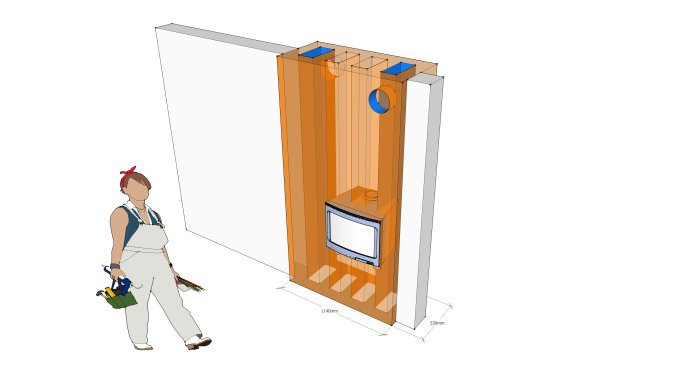
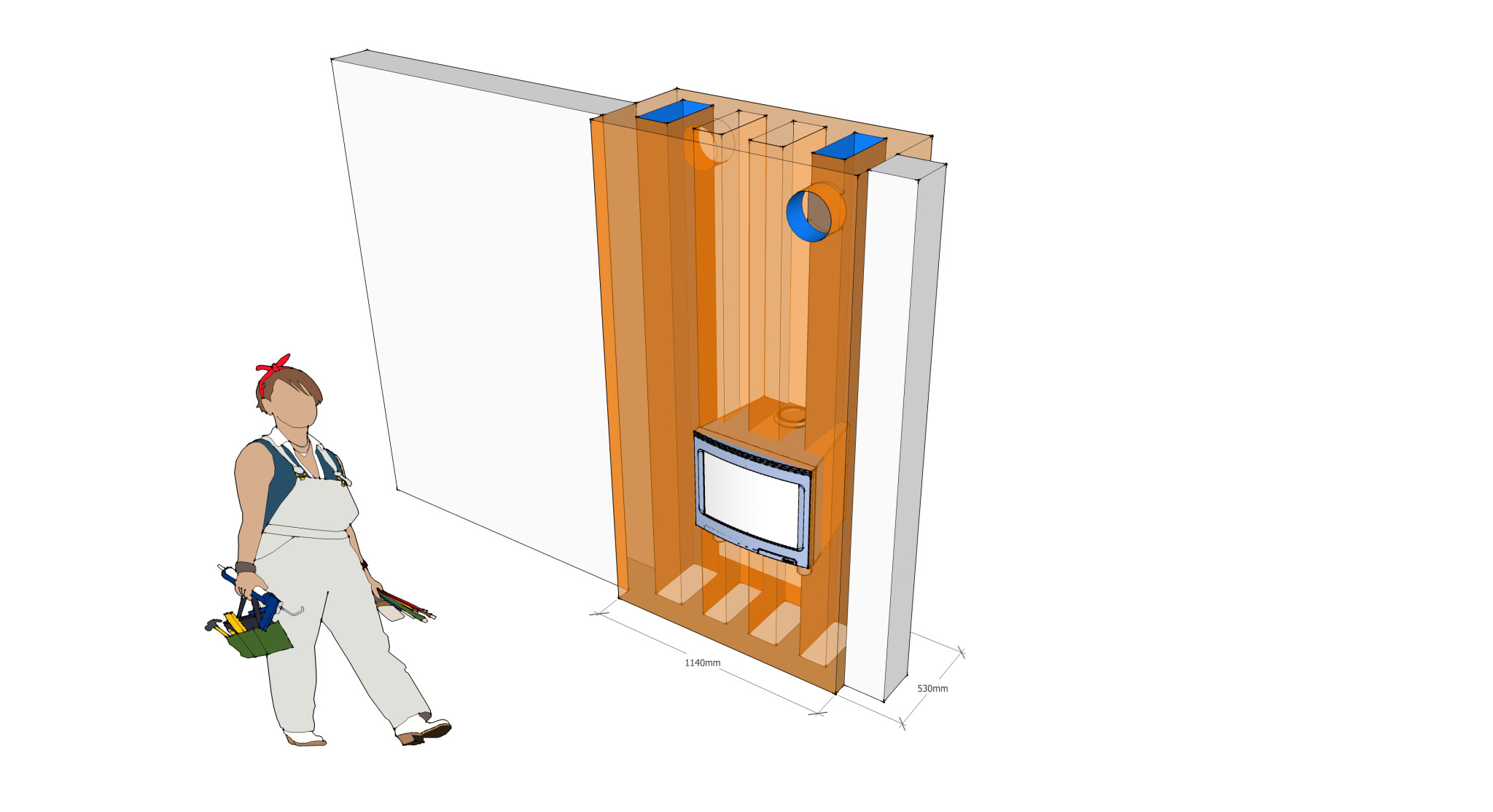
Hi, I'm thinking of installing a stove cassette into our chimney, but before I start tearing down, I want to be sure that this is doable, I'm afraid the chimney might collapse.
When I create the opening, I plan to make it +5 cm larger all around.
Do I need to consider anything when chiseling?
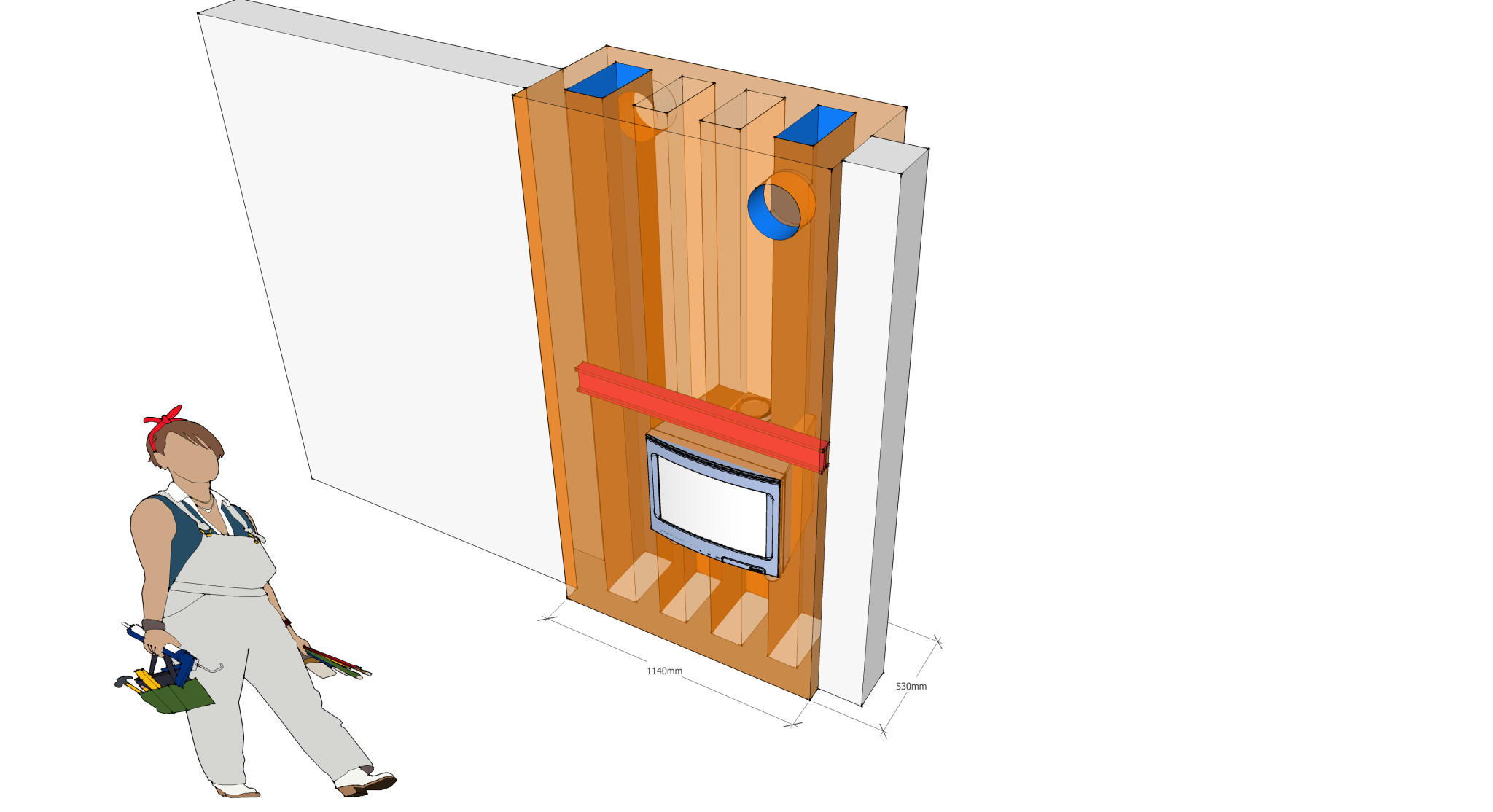
Should I chisel one row higher and reinforce with an I-beam where the opening is largest, and then encase the beam in brick?
I've tried looking for guides but can't find anything. Grateful for all the help I can get.
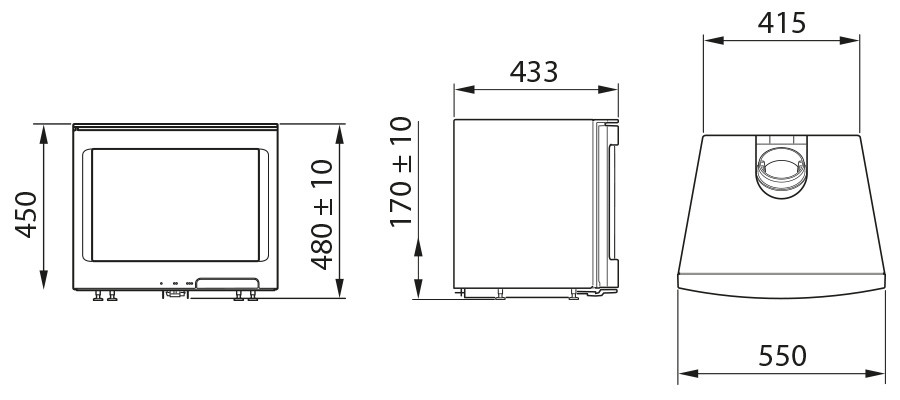
The stove cassette is a Contura i5 with the following dimensions:
The chimney is 53cm thick.
The outer channels are ventilation channels.
The best thing you can do is talk to the chimney sweep, he will have to inspect before you can light a fire, well worth the money, since he knows most about chimneys and can say BU or BÄ
Some kind of steel reinforcement must be built in. The chimney sweep naturally does not have the competence to determine how it should be done, but he has the right to say no. Hopefully, he is aware of similar attempts. I think it seems to be a risky project; much depends on the age and condition of the chimney. It should be easier to place a Contura stove in front of the chimney, which is what I have done.
Naturally, I wish you the best of luck in your endeavors. Few things compare to a modern stove. Some things to consider: the stove's depth is about 43 cm and the chimney's 53. I think the chimney sweep will want at least a full brick (about 25 cm) behind the stove. Contura i5's output is 3-9 kW. Have you checked with the stove seller that it's the right stove size for your small living room? 9 kW is quite a lot for a small room.
The house is 1 1/2 floors with approximately 90m2 of living space, +15-20m2 of extra space due to sloping ceilings. We have an open floor plan, living room, kitchen, hallway, and upper floor are completely open. So 9kw is just right.
It might be enough for the whole house, but it could be too much for the room. Check it, it's important. I'm not sure that an I-beam is the best solution; I believe more in an L-beam in this case. If you use an experienced chimney mason, he knows exactly what to do. But as I said, wait for the chimney sweep's report.
Had the chimney sweep here a little while ago and he came to the same conclusion as you. His recommendation was not to enclose the fireplace cassette (you can extend the chimney about 30 cm) but to replace the fireplace cassette with a wood-burning stove. Now we just have to hope that the company is willing to replace the fireplace cassette with a wood-burning stove.
If you are going to install a wood stove, consider how the flue pipe should go, what's possible , backwards upwards. Backwards will be a short pipe, upwards a long pipe. You have the stove wall completely behind, maybe you can cut in the pipe a little higher up about 80-100 cm, then you get radiant heat from the flue pipe, it can be up to 1.5 KW for free. With the pipe on the backside, you are in good standing with the crows
Now we have our new stove, "unfortunately" the connection will be straight back since the old connection is quite low, about 70cm.
I need to raise the connection to about 75cm and increase the pipe diameter from about 13cm to 15cm.
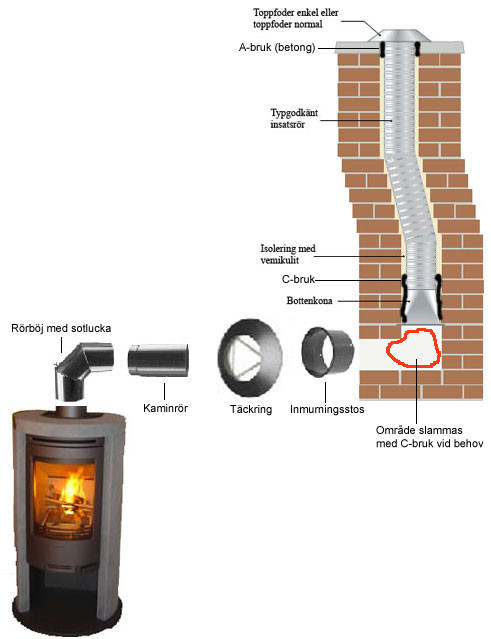
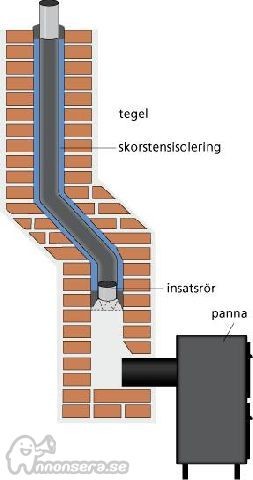
Right now I have a bottom cone that is L-shaped and I'm considering what to do.
Can I cut the bottom cone and smooth it with c-bruk around to seal it?
Our chimney continues down to the basement, I assume there will be a hole down.
Or can I leave it open like in this picture?
There won't be a large gap between the cut bottom cone and the stove connection (1-5 cm between).
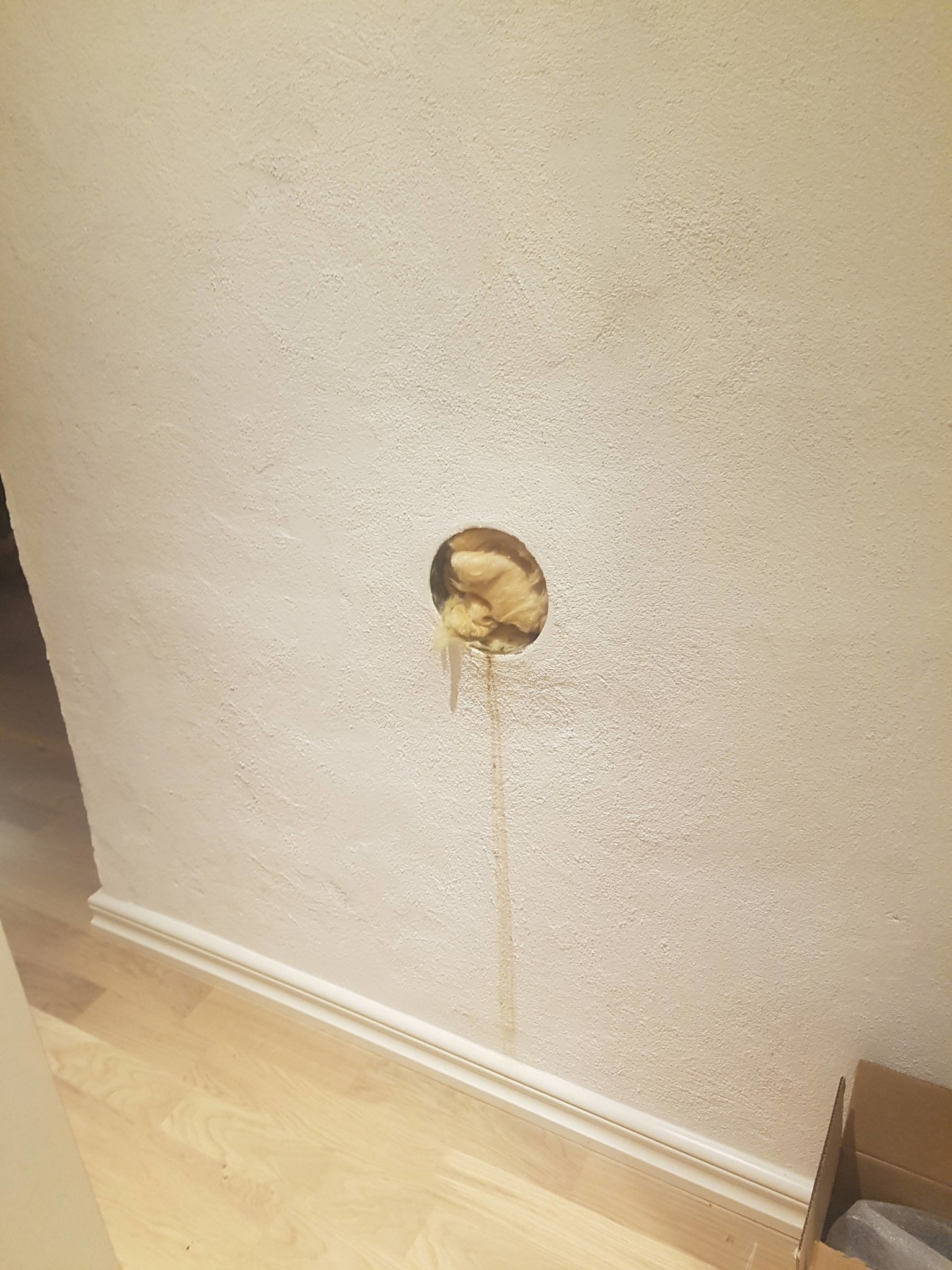
Is it full or half brick from the outside to the flue, you can cut the pipe so it is flush with the inside and brick it in, just make sure it is long enough not to wobble when it's bricked in. About the channel down to the basement, do you have a chimney sweep hatch there? Perfect to have, then you don't need one upstairs, and you can push the soot in the stove pipe straight in, no soot outside the stove and when sweeping it lies down there, just bring it home.
Otherwise, maybe it's easier to start at the right end? What kind of stoves work with the existing conditions? The absolute easiest is to find something that can be connected to the bef hole.
I think it's a half stone for the smoke duct, haven't started breaking up yet. Yes, there's a soot hatch at the bottom of the same channel. Became uncertain because of the pipe bend that is there now if one is required to have it. Do I need to apply c-bruk on the inside of the chimney if it is uneven?
Vi vill skicka notiser för ämnen du bevakar och händelser som berör dig.