Hi!
I'm transforming my living room into a music studio, and I've posted quite a few threads about it in this forum.
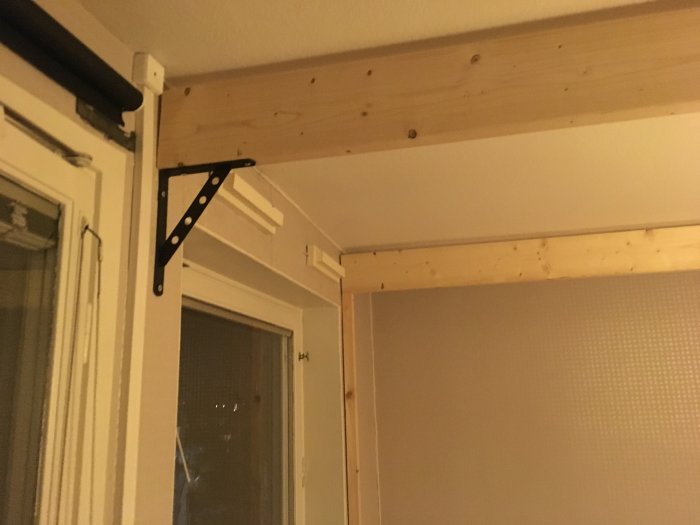
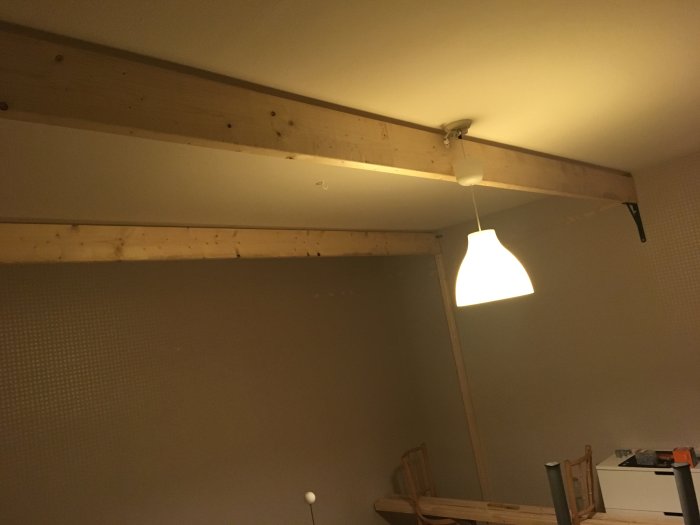
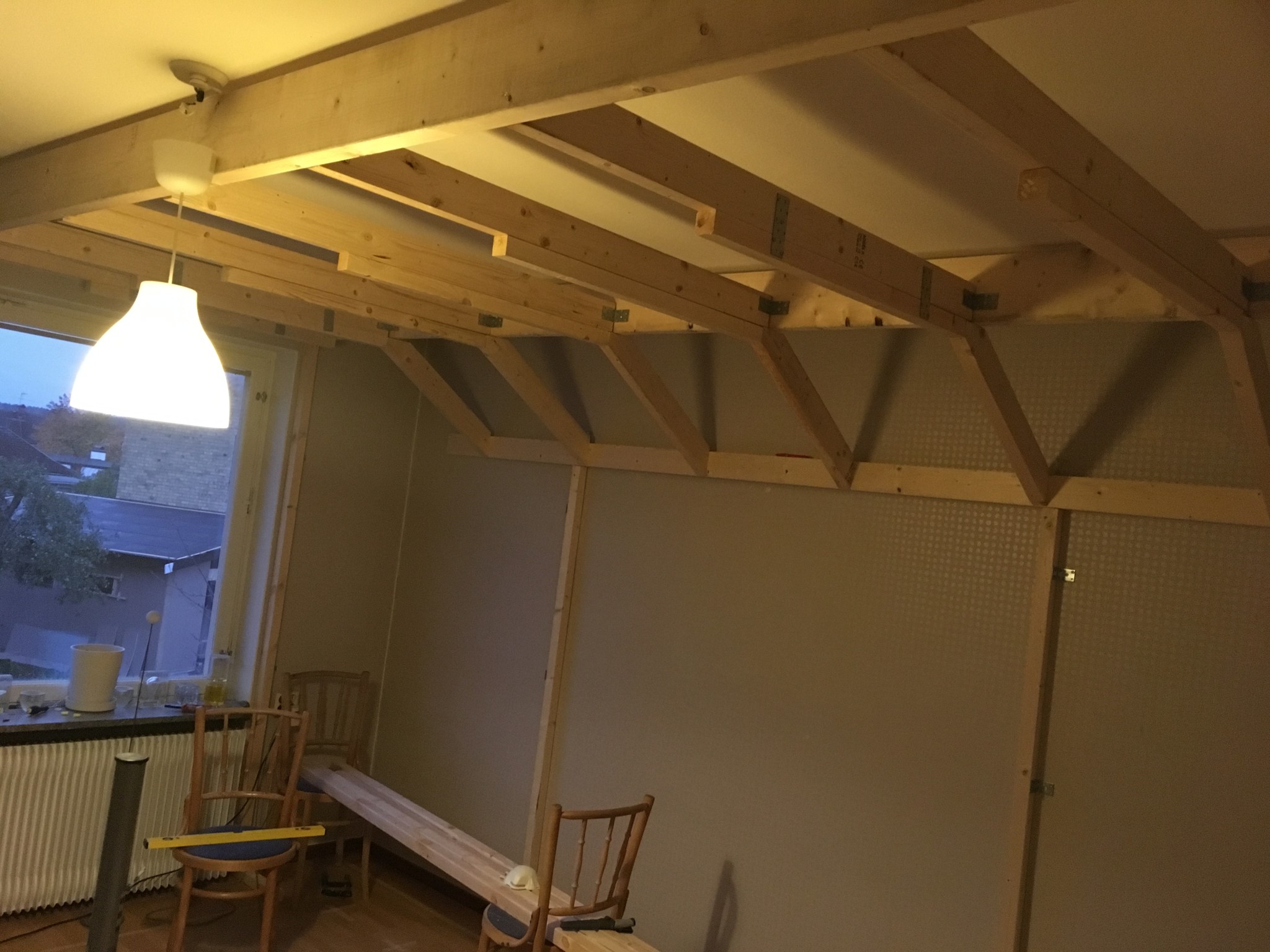
I've installed a ceiling that covers half of the room. One side is supported by brackets.
I realize that I miscalculated the weight the brackets will carry. I initially thought they would carry 26 kg per bracket but now realize they will carry 48 kg per bracket.
The brackets are mounted in the wall with 10 mm lättbetongplugg with a tensile load of 30 kg. Two plugs per bracket so a total of 60 kg. A 12 kg margin, is that enough?
The walls are made of porous lättbetong. I’m using wood screws 6x60 mm.
Should I reinforce the construction?
Some pictures:
One side. Beam 170x45. 4.25 m long.
Other side.
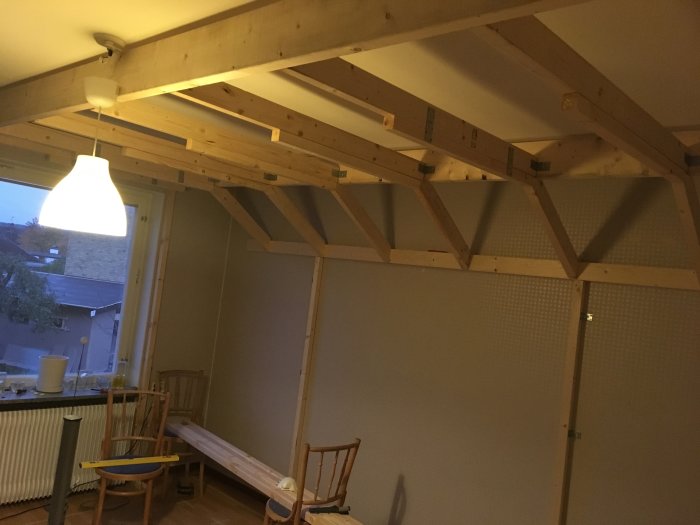
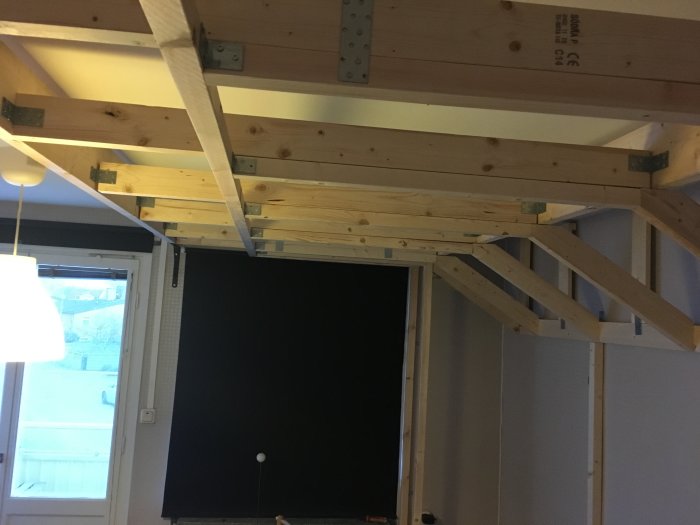
Completed ceiling. Will be filled with mineral wool.
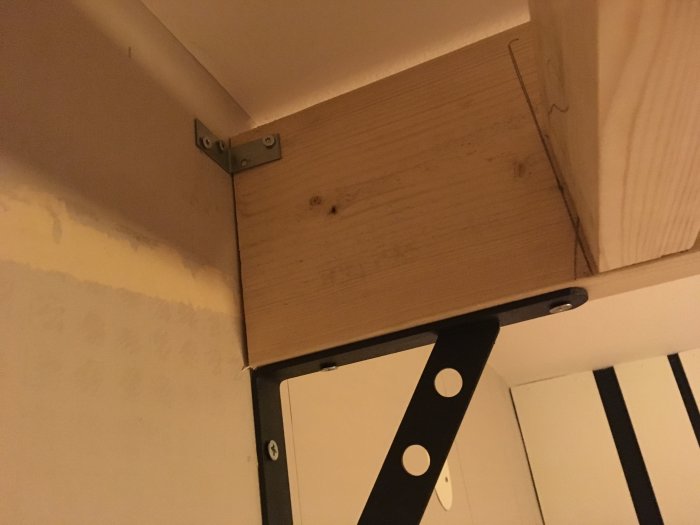
The weight from the roof ends up at the far end of the bracket. The length of the joists means that they rest on the front edge of the brackets. This implies that you get a moment that should be absorbed by the screws in the wall. The load's lever arm is approximately the same as the distance of the screws, which means the tensile load in the upper screw is about as large as the weight on the bracket. So, you were already at the limit before you noticed the weight increase. A simple measure is to split a few smaller nail plates and insert them under the joist at the point closest to the wall on top of the bracket. This way, the load moves closer to the wall, reducing/eliminating the moment and thereby the tensile force in the upper screw. The shear force is handled by the screws without any measure.
Do you mean that the bending of the beam causes it to press on the outer edge of the brackets?
I know I sawed the beam to be as close to the room's width as possible to get the force as far in on the brackets. I don't remember exactly, but the beam was around 1-5 mm shorter than the wall. I can check more precisely later tonight as I won't be in the apartment until then.
Will there still be a bending? Should I have used a thicker beam?
There are no large loads, so the rule is absolutely fine. It is somewhat in the nature that the load ends up far out on the console anyway. To avoid this, one usually has a spacer as I described to be able to control where the load will land.
Awesome! Thanks for the reply!
I thought of another question. If the screws can handle the shear force, what is the risk? What I'm afraid of is that the roof somehow comes down. Can the plug come out? Or does the plug break through the wall downward?
If I put in a post, shouldn't I screw in the outer screw all the way? So that the rule hovers?
/Jens
Or do you mean that the bending of the rule risks pulling out the top plug slightly and that this small extraction reduces the shear force, causing the bracket to suddenly rest on the bottom screw? And that this could lead to the ceiling collapsing? Thinking out loud now.
The console screws handle the vertical compressive force from the beam individually. If you place a shim under the beam as described against the wall, you have eliminated the tensile force on the top screw when the beam bends down, as the underside of the beam, as you say, "floats" above the outer end of the console. An alternative could be to make the console weaker and more compliant to the beam's movements by cutting off the diagonal stiffening plate on the console. In the picture, you can see one of the beams braced by a 45x45 attached to the wall all the way to the floor: that's optimal.
Ok! Thanks for the reply!
Realized that I had reinforced the rule a bit. This was so that it wouldn't move sideways.
Two 6 mm plugs, can't remember the thickness and length of the screw.
Do these help? They take some load off the top screw in the bracket, right?
Or should I go with the nail plate anyway?
If I do that, do I just loosen the screws in the bracket a bit and then lift up the rule and slide in the nail plate? How wide should the nail plate be?
Unfortunately, those screws aren't helping. Go with a nail plate, about 60mm wide, split it in half and stack the pieces on top of each other, right up against the wall
You don't really need the metal bracket because the beam is locked in the construction. What was previously suggested is about shimming up the ends of the beam so that the load is as close to the wall as possible. The shim doesn't need to be wider than the beam. However, from what I can assess from the pictures, I don't think it's necessary.
Here are some thoughts that came up. Is the pulling force really 48 kg on the top screw? Shouldn't the beam's stiffness take some of that? Isn't it true that if you hang 48 kg at the outer edge of the bracket, it corresponds to 48 kg of pull on the top screw? (Just thinking out loud, I have no idea)
For the beam's deflection, it can't be so severe that its entire weight, plus the rest of the roof the brackets have to hold up, ends up at the outermost part of the bracket?
If it were a steel beam, there wouldn't be any deflection, for example. Then there is no pull on the plug. Compared to a rubber beam where extreme deflection occurs. Then it becomes a maximum pull. Shouldn't the beam be in the middle of these? That is, some deflection occurs, which means only a part of the 48 kg ends up at the outer edge of the bracket?
Just thinking out loud now, I have no idea or insight into this. Just something that struck me!
Absolutely, you can use the rule as a backstop with the help of screws that go through the bracket into the rule.
Your example with the rubber beam makes the whole thing very clear. The same principle actually applies to your rules, just that the deflection becomes very small. With an infinitely stiff beam and perfectly horizontal supports, it becomes as you describe.
Absolutely, you can use the rule as a backing with the screws that go through the console into the rule.
Your example with the rubber beam makes it very clear. The same principle really applies to your rules, only the deflection becomes very small. With infinitely stiff beam and perfectly horizontal supports, it is as you describe.
Ok, thanks!
Just want to ask to be sure: Would you be afraid to sit under this roof? That is, as it is now, without nail plates under the rules? Or would you only feel safe once you've put them under? Is there a risk of the roof collapsing? That the top plug pulls out? Or does that apply to heavier constructions?
Is there any reason you chose brackets instead of joist hangers to attach the joists? With joist hangers, you won't have any issues with where the force is applied to the wall, and you get a hidden installation since they don't protrude below the joists.
Vi vill skicka notiser för ämnen du bevakar och händelser som berör dig.