
376,594 views ·
138 replies
377k views
138 replies
Casting a concrete countertop - pictures, questions..
I thought I'd share some experiences and ask a bit about casting concrete countertops. Here is a small description of how it's done. See the attached pdf.
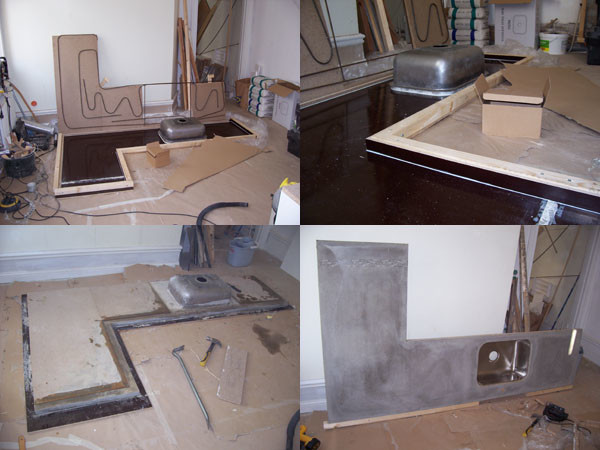
I chose to make the lower half of the slab with chipboard to save some weight and facilitate securing the reinforcement. As you can see in the picture, I attached the reinforcement to the chipboard, which was then placed in the concrete. I believe this was a decent idea, but because I didn't fix the chipboard well enough, it floated up when I vibrated the concrete. This meant I couldn't vibrate as much as I wanted and caused some problems with air bubbles.
I vibrated the mold with a carriage bolt in the chuck of a hammer drill. This worked excellently (except for the chipboard thing, of course).
I chose to make the lower half of the slab with chipboard to save some weight and facilitate securing the reinforcement. As you can see in the picture, I attached the reinforcement to the chipboard, which was then placed in the concrete. I believe this was a decent idea, but because I didn't fix the chipboard well enough, it floated up when I vibrated the concrete. This meant I couldn't vibrate as much as I wanted and caused some problems with air bubbles.
I vibrated the mold with a carriage bolt in the chuck of a hammer drill. This worked excellently (except for the chipboard thing, of course).
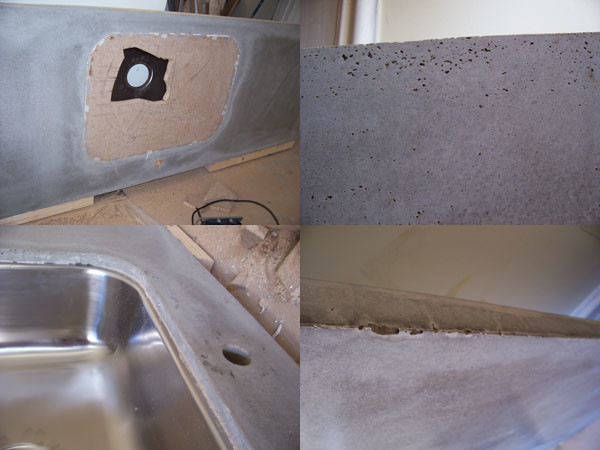
Now the pictures ended up in the wrong order, but you probably understand anyway...
I chose to cast in a 55cm wide disco. I built a mold that was attached to the sink with sealant. This worked brilliantly! Except for some air bubbles...
As you can see in some of the pictures above, there are air bubbles here and there because I couldn't vibrate as much as I wanted. How do I fix them? Should I mix some concrete and try to fill them? This is difficult because the concrete has slightly too large grains to fill the holes. Does household fixative work well?
The surface is to be sanded and then oiled. What type of oil should be used? Does regular wood oil (linseed oil + turpentine) work?
Anyone else who has a concrete countertop that can give some tips on how to best care for it?
I chose to cast in a 55cm wide disco. I built a mold that was attached to the sink with sealant. This worked brilliantly! Except for some air bubbles...
As you can see in some of the pictures above, there are air bubbles here and there because I couldn't vibrate as much as I wanted. How do I fix them? Should I mix some concrete and try to fill them? This is difficult because the concrete has slightly too large grains to fill the holes. Does household fixative work well?
The surface is to be sanded and then oiled. What type of oil should be used? Does regular wood oil (linseed oil + turpentine) work?
Anyone else who has a concrete countertop that can give some tips on how to best care for it?
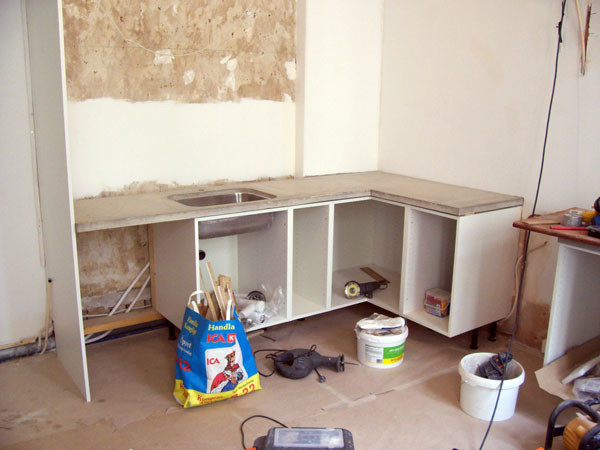

Cool idea. Too bad about the small air bubbles though. I think they might be hard to remove without it showing.  I don't have any tips about oil or repair but there's someone writing about sanding concrete floors in the floor section who might have tips.
I don't have any tips about oil or repair but there's someone writing about sanding concrete floors in the floor section who might have tips.It looks nice!
There is a name of some oil in Finjas description, start searching for it, and you will see..
What concrete did you use when you cast it? What does your slab actually weigh, it looks heavy..
There is a name of some oil in Finjas description, start searching for it, and you will see..
What concrete did you use when you cast it? What does your slab actually weigh, it looks heavy..
Where in the Finja description does it say what the oil is called? Can't find it :-?
The concrete is Gjuta Fin from Byggmax. Perhaps a concrete with a smaller aggregate size should have been used, but we'll see when I grind the slab later...
It's heavy as hell! Two strong guys lifted it into place, and it was a close call. I'd guess it's around 100-150kg ;D
I think I'll fill the bubbles with husfix. It will probably show after grinding, but I don't think it matters much. You probably don't notice such details when you see the whole slab. But I’ll wait a few more days to see if someone else comes up with a better suggestion.
The concrete is Gjuta Fin from Byggmax. Perhaps a concrete with a smaller aggregate size should have been used, but we'll see when I grind the slab later...
It's heavy as hell! Two strong guys lifted it into place, and it was a close call. I'd guess it's around 100-150kg ;D
I think I'll fill the bubbles with husfix. It will probably show after grinding, but I don't think it matters much. You probably don't notice such details when you see the whole slab. But I’ll wait a few more days to see if someone else comes up with a better suggestion.

... or aim to remove the larger "stones" from the same concrete I used and maybe patch with that...

The last option sounds like the wisest. Husfix may not have the same color as the betong you cast with, and it would be unfortunate if you ended up with different colors on the same countertop. So try it
I sifted the concrete with a tea strainer ;D since it was the only fine-mesh thing I had. Then I mixed up a putty-like consistency mortar and filled in the worst holes. It seems to work pretty well. Now I will wait a day and then sand and oil.
Any specific sandpaper recommended? I still don't know what oil to use, but maybe I can experiment... I'll come back with pictures after I've sanded!
Edit: Now I've tried sanding a small corner by hand and it's soooo slow. I need to sand down a few mm to remove a seam that I had to make in the mold. Should I use an orbital sander? I think it will take a week if I do it by hand... But maybe it will go better with good sandpaper?
Any specific sandpaper recommended? I still don't know what oil to use, but maybe I can experiment... I'll come back with pictures after I've sanded!
Edit: Now I've tried sanding a small corner by hand and it's soooo slow. I need to sand down a few mm to remove a seam that I had to make in the mold. Should I use an orbital sander? I think it will take a week if I do it by hand... But maybe it will go better with good sandpaper?
This might be something: http://www.welinoco.com/?mcf=produc...ssion=nestor:282E70B67EEE7F7A57C5DF0C0E670206
Otherwise, I've seen that people who have cast dining tables, etc., have oiled with linolja, so it probably works.
But now it's the sanding that's the next step. In Finja's description, it says to use sandpaper intended for stone. Where can I buy such paper? Classe, Jula, Biltema, and all other places that have their range online don't seem to have it. And regular wet sandpaper is only available with grit 180 at the lowest, and I need 80... :-?
Otherwise, I've seen that people who have cast dining tables, etc., have oiled with linolja, so it probably works.
But now it's the sanding that's the next step. In Finja's description, it says to use sandpaper intended for stone. Where can I buy such paper? Classe, Jula, Biltema, and all other places that have their range online don't seem to have it. And regular wet sandpaper is only available with grit 180 at the lowest, and I need 80... :-?
1 millimeter of concrete takes time, an orbital sander works excellently on concrete. Start with grit 40 or so and sand it down to the right level. It will be a tough job even with grit 40.
Then you can take, for example, 120 and smooth it out to finish the orbital sanding with 240. Then it will almost be like polished.
Then you can take, for example, 120 and smooth it out to finish the orbital sanding with 240. Then it will almost be like polished.
I have concluded that paraffin oil is what you should use anyway.
When it comes to sanding, it's not going so well. I've got an orbital sander and started, but the paper wears out in like 30 seconds! What type of paper should you use? Dry or wet?
For example, Hyreshuset and Hyrcenter have a "concrete hand sander 125mm", what is that?
I wonder what I should do if I can't get the surface right. Not so fun trying to get rid of a 150 kg countertop if you decide to scrap it.
Are there any other types of surface treatment you could consider? If one were to build a said of 5mm, attach a reinforcement mesh, and self-leveling compound on top of the mess maybe.
When it comes to sanding, it's not going so well. I've got an orbital sander and started, but the paper wears out in like 30 seconds! What type of paper should you use? Dry or wet?
For example, Hyreshuset and Hyrcenter have a "concrete hand sander 125mm", what is that?
I wonder what I should do if I can't get the surface right. Not so fun trying to get rid of a 150 kg countertop if you decide to scrap it.
Are there any other types of surface treatment you could consider? If one were to build a said of 5mm, attach a reinforcement mesh, and self-leveling compound on top of the mess maybe.
