Hello,
I don't know if I'm in the right forum category, but I have a classic engineering question that I need help with. I've started building a cable car for material transport in the countryside. The main component is a stainless steel support cable where a basket will be hung.
How much can I load the basket with?
Cable length 50 m
Only attached at the ends
Cable dimension 8 mm (breaking load of just over 3000 kg, which also applies to other components - turnbuckle, shackle, chains at the ends, etc.)
Tolerable "sag" approximately 2 m
Safety factor maybe 2 (?)
Tried to revive old knowledge and started drawing a triangle on paper. Also changed my assumption to a 3-meter sag since the way I've tightened the cable now it hangs maybe a meter without load and another two is okay. So a triangle with one leg of 3 m and one of 25 m gives about a 7-degree angle. When loaded in the middle, 1500 kg pulls in one direction and 1500 kg in the other direction. Both with a 7-degree angle. Sine of 7 degrees times 3000 kg gives about 360 kg. A safety factor of 2 gives a maximum load of about 180 kg. Am I on the right track?
You have 2 different load cases.
1. only the weight of the cable itself.
2. load with cart.
I would calculate with delta = FL/EA to get the extension.
You can then calculate the deflection from that. To be really precise, the cable probably consists of a number of smaller strands.
If you calculate correctly, it probably won't be much that you can load; there should be an addition for dynamic load, etc. If you disregard that (avoid being underneath)
Then you calculate correctly, but I think you can consider 3000 kg in each direction. Compare if the wires were to go straight upwards.
Hello again,
thanks for putting me on the right track. Completely right larsbj that it is 3000 kg and right that I need to look at strain/deflection. I found some additional info at certex.se. They describe three types of elongation as well as tables with the modulus of elasticity for different wires. The modulus of elasticity for the wire that I think is most similar to mine (mine is a 7x19 wire) is approximately 4000 kp/mm². The three types of elongation are these. I assume I can account for phase 1 and disregard it. I should also be able to disregard Phase 3 by initially accounting for it and since it will be used in a fairly narrow temperature range of 20 +/- 5 degrees perhaps.
Phase 1: initial elongation
Phase 2: elastic elongation (strain)
Phase 3: permanent elongation (thermal elongation and contraction, rotation, wear and corrosion)
So Phase 2 gives Delta=F*L/E*A
Trying with deflection as the dimension. Pythagoras gives Sqrt(25*25+3*3)=25.179, i.e. Delta 180 mm per triangle => 360 mm total. Gives F= 4000*50*360/50000 =1440kg And then in the wire's longitudinal direction, i.e., sin 7 degrees * 1440 gives 175 kg in max "basket weight". But okay margin for the breaking limit on the wire. In practice, I think it's good that the cable car limits itself by starting to drag on the ground with too much load.
I also have a cable car project in the works and I'm reviving an old thread because it contained some relevant thought processes.
I'm pondering building a fairly long course and have a pretty good grasp on the trigonometric part of it. However, I'm a bit stuck with the insight that the cable falls freely like a hyperbolic curve which can be approximated as a parabola and is also elastic. It becomes quite advanced mathematics.
What I want to find out is how much slack I can have relative to the theoretical uphill stretch I get at the end, which can also act as a brake.
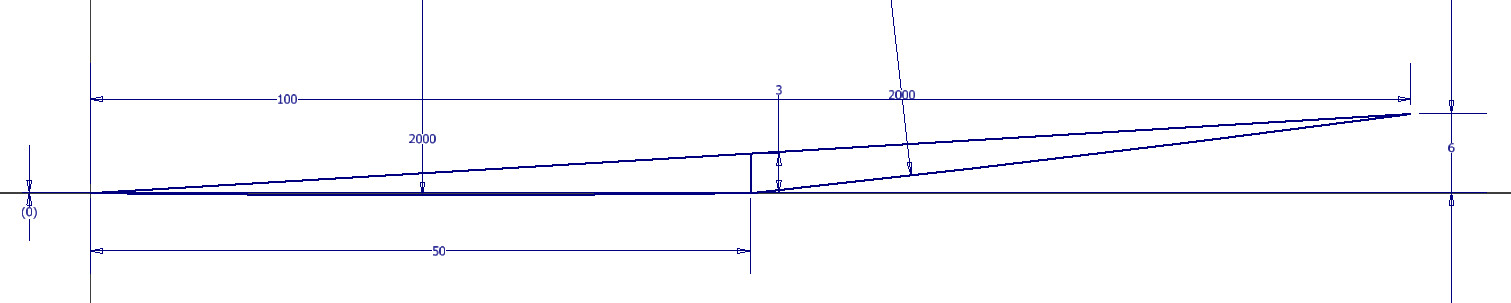
If we play with 100m length and 6m drop, and factor in a 3m sag including its own weight, and tension the cable so that we get a circular radius of 2000 (which we don't, but let's pretend).
Then it looks like the top image, and the cable is actually 100.36 in length.
In example 2, I have a point where I measure 5m before the end of the ride. There I have iterated that a sag of 1.28m instead of 3m will give the same 100.36 in actual cable length assuming the cable length is static.
This provides an uphill angle of 11° incline at this particular point, and assumes 1mm "extra" pole height to avoid touching the ground, compared to a linearly tensioned cable.
But the assumption that the cable length is static is wrong, as it stretches more with the load in the middle. And as mentioned, the curve is hyperbolic, but I don't think it has huge effects on the result.
Is there anyone, even actual zip-line builders, who "properly" calculates this?
The forces get really significant if you tension the cable much more than in the below example.
The diagonal component is 16.7 times the vertical load in the middle and 300kg in total own weight and payload gives 25kN tensile load in each anchorage.
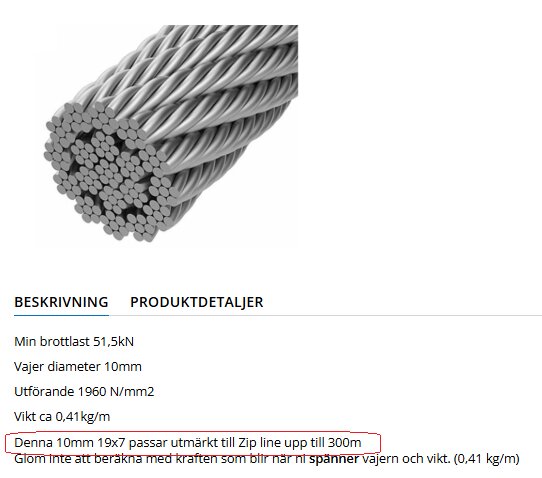
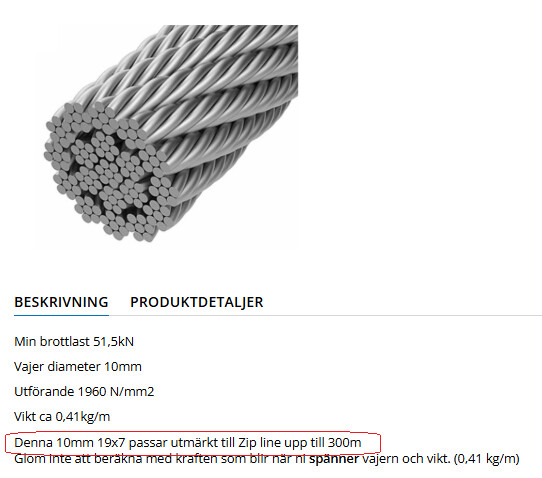
I found the cable below, which seems suitable.
And it should be added that the real project is longer than 100m, and the safety aspect is not insignificant.
Does anyone have any wise input to offer?
//Overanalyzer 😇
Click here to reply
Vi vill skicka notiser för ämnen du bevakar och händelser som berör dig.