
28,557 views ·
32 replies
29k views
32 replies
Byggmax polystyrene adhesive dissolves in the rain today! Need to glue with another adhesive now. Which one?
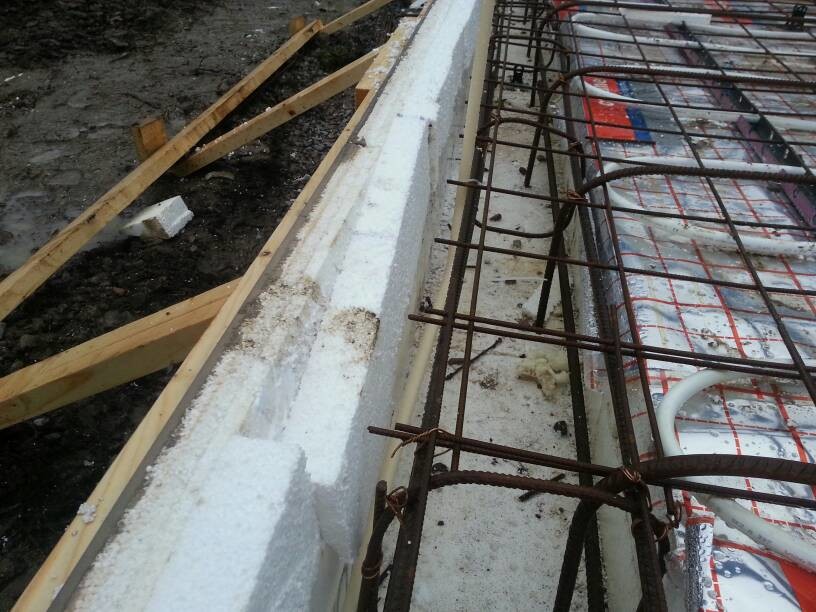
I am going to pour a slab and have built a form with L-shaped edge elements.
On the inner edge of the L-shaped elements where they are beveled, I glued on a little extra foam board because I wanted extra wide insulation here, that is, I glued on a triangle.
I used Byggmax foam adhesive. It worked well and the glue dried and adhered properly. However, the outside temperature was only about 4-5 degrees while the instructions on the glue say at least +10 degrees. It didn't seem to matter because the foam board was very firmly attached after a while. This was a couple of days ago.
It is raining a lot today and now when I inspected the form, it showed that the foam adhesive has become a loose goo, and the glued-on foam board has come off. Sigh!
The casting is probably scheduled for tomorrow, so it's urgent to get this fixed. Which adhesive should I use instead? I need something that is moisture-resistant. I can, in fact, try to protect the edge elements with a tarp while gluing and drying.
So, a warning for Byggmax foam adhesive. The instructions state that it is waterproof after curing, but that isn't true. However, a caveat since I glued at 5 degrees instead of 10 degrees.
Grateful for any tips on which adhesive I should use.
UPDATE 1:
Went to Byggmax's website and it says this: "Do not use Foam Adhesive where objects being glued are constantly exposed to heat or moisture." It doesn't mention this at all on the packaging. BAD BY BYGGMAX!
Now considering if there is any adhesive that can be applied in damp weather on wet foam.
UPDATE 2:
Does PU700 work? It is marketed as a masonry adhesive but is a PU adhesive, which is recommended for foam. http://www.jula.se/konstruktionslim-pu700-500ml-502074
http://www.tremco-illbruck.se/produkt/03805_index.html
On the inner edge of the L-shaped elements where they are beveled, I glued on a little extra foam board because I wanted extra wide insulation here, that is, I glued on a triangle.
I used Byggmax foam adhesive. It worked well and the glue dried and adhered properly. However, the outside temperature was only about 4-5 degrees while the instructions on the glue say at least +10 degrees. It didn't seem to matter because the foam board was very firmly attached after a while. This was a couple of days ago.
It is raining a lot today and now when I inspected the form, it showed that the foam adhesive has become a loose goo, and the glued-on foam board has come off. Sigh!
The casting is probably scheduled for tomorrow, so it's urgent to get this fixed. Which adhesive should I use instead? I need something that is moisture-resistant. I can, in fact, try to protect the edge elements with a tarp while gluing and drying.
So, a warning for Byggmax foam adhesive. The instructions state that it is waterproof after curing, but that isn't true. However, a caveat since I glued at 5 degrees instead of 10 degrees.
Grateful for any tips on which adhesive I should use.
UPDATE 1:
Went to Byggmax's website and it says this: "Do not use Foam Adhesive where objects being glued are constantly exposed to heat or moisture." It doesn't mention this at all on the packaging. BAD BY BYGGMAX!
Now considering if there is any adhesive that can be applied in damp weather on wet foam.
UPDATE 2:
Does PU700 work? It is marketed as a masonry adhesive but is a PU adhesive, which is recommended for foam. http://www.jula.se/konstruktionslim-pu700-500ml-502074
http://www.tremco-illbruck.se/produkt/03805_index.html
Last edited:
The plan is to have horizontal paneling aligned with the baseboard. Windows, standing on the slab, are recessed about 6 cm from the outside of the panel. Since the wall's framework and the windows will be more than 5 cm from the outside of the edge element, this means there will be a small thermal bridge. By adding insulation, the thermal bridge can be eliminated. The studs and windows are deep (thick) enough that they will have ample concrete support.
That's my plan anyway, but I would appreciate concrete problem descriptions if there are issues with this solution. Before pouring, it is easy to remove the Cellplast if there would be a mistake.
That's my plan anyway, but I would appreciate concrete problem descriptions if there are issues with this solution. Before pouring, it is easy to remove the Cellplast if there would be a mistake.
Hello! I have been involved in casting quite a few foundations with the same type of edge elements, and the concrete guys usually use either the plastic insulation nails that you use in the boards, or they just use regular nails, like 4-inch or something, it just needs to hold it in place during the casting, then they'll probably stay anyway.

That just sounds wrong to me.ohlgren said:
Usually, you would let the sill/studs align with the baseboard, and nail battens + paneling outside.
This is to allow the drip from the paneling to fall outside the foundation instead of letting it run/soak into the stud construction, and to create an opening for the air gap.
The only downside is the opening for mice to get in behind the paneling. Solved in some suitable way, e.g., mouse band.
I understand your idea, however, I don't believe that the extra Styrofoam will make any significant difference, the thermal bridge is between the sill and the concrete. The advantage I can see with a little extra insulation there would hypothetically create greater thermal inertia between the cement board of the edge element and the actual edge beam, but I have a hard time seeing that it would bring any noticeable benefits. Also, I don't think aligning the panel with the edge of the slab without having at least some metal flashing between the panel and the battens, down over the edge of the slab, is a particularly good idea.ohlgren said:Will have horizontal paneling that aligns with the baseboard. Windows, standing on the slab, which are recessed about 6 cm from the outside of the panel. Since the wall framework and windows will be more than 5 cm from the outside of the edge element, this means a small thermal bridge will be created. By adding insulation, the thermal bridge is eliminated. The studs and windows are deep (thick) enough that they will comfortably stand on sufficient concrete.
That's my thinking anyway, but I'm grateful for concrete problem descriptions if there are issues with this solution. Before the casting, it's easy to remove the Styrofoam if it's wrong.
The risk with a solution like this is getting water under the sill. I hardly need to state the consequences of that.
I don't mean to sound negative, but some things should not be experimented with.
/M/