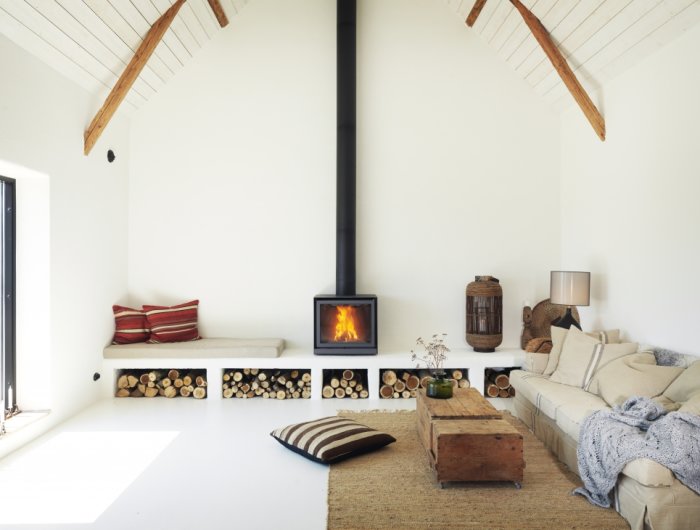
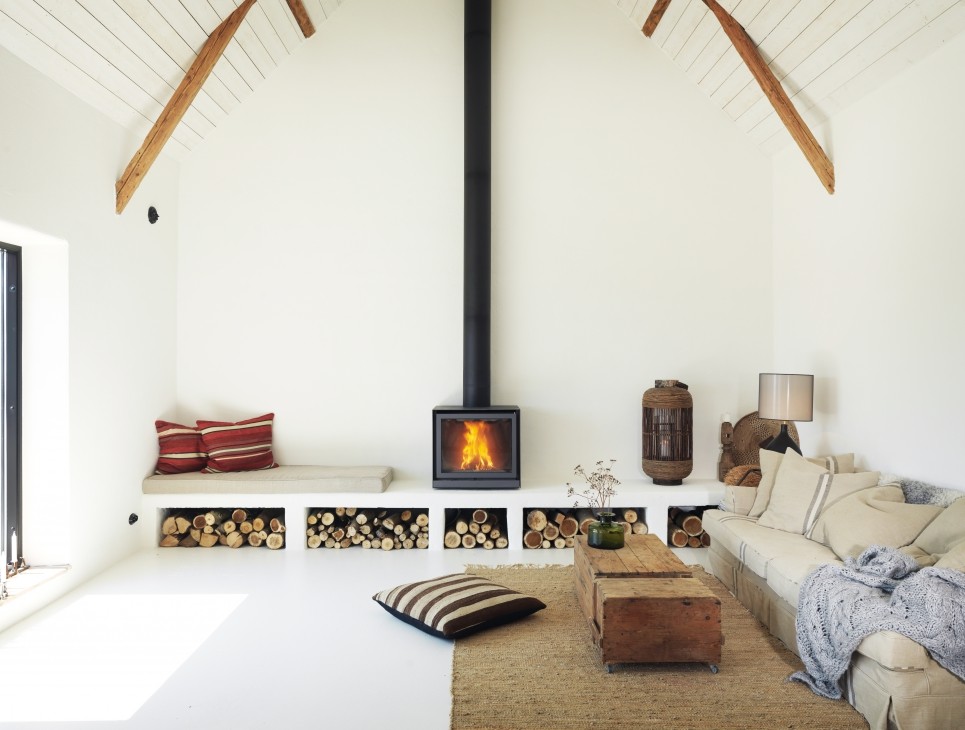
Now it's starting to get cold outside and thoughts of a stove are returning. We've decided on the stove, but the layout of the living room limits our placement options. The solution will be a bench that serves as support for both the stove and as a TV bench with space for all sorts of electronics. See attached image.
So now to the purely technical building part. My first thought is leca that is plastered and painted. A simple construction without frills. But then I encounter problem number 1.
The leca blocks I find are only 60 cm wide. This would mean that the transverse/overlapping leca blocks would limit the wood/electronics compartments to a width of 40 cm (calculated on a 10 cm overlap). According to the attached image, only one compartment is about 40 cm wide. The other compartments look to be about 80-100 cm wide, which is clearly more attractive. How do I solve this easiest? Are there longer leca blocks? Can leca blocks be joined? Laying in reinforcing bars or casting U-blocks?
In summary, how do I build a bench that resembles the one in the image as simply as possible?
Thank you for the quick response! What advantages in construction do I get from brick? Leca undeniably feels easier to work with for someone like me. Flat steel and leca, is that a combo that can work just as well? I'm thinking that the flat steel could then be concealed in the Leca's groove, and in this way be embedded and hidden.
The reason for the narrower compartment in the picture is probably the load from the fireplace.
It is possible to make that compartment wider, but it would need to be significantly reinforced.
I have read that lecablock should not be exposed to high heat because the clinker beads are cement-bound. The cement simply cannot withstand heat and the block crumbles.
Does this apply in practice when placing a stove on lecablock? Does the stove get so hot underneath that the lecablock ages quickly?
No, there's no danger with such a stove. It can stand on a metal sheet on a wooden floor, i.e. the underside will never become warmer than 50-60c normally.
Then you build chimneys with cement mortar, even if they weather a bit, we're talking about 25-30 years between renovations unless water leaks into the chimney?!
I have read that lecablock should not be exposed to high heat because the clinker balls are cement-bound. The cement simply does not tolerate heat and the block crumbles.
Does this apply in practice when you put a stove on lecablock? Does the stove get so hot underneath that the lecablocks age quickly?
Now I can't answer generally. But the stove that is in the picture, as well as the one we chose, has a built-in firewall and is approved to be placed directly on wood.
But an answer as to what generally applies would be appreciated
If you let the stove, like in the picture, rest on lecablock without a joint, and assume that the other compartments should handle a load of about 100 kg (a sitting person).
The steel + mortar/plaster between and around all the blocks might be strong enough?
None of my nearby building suppliers provide flat iron, haven't had the time to check with a sheet metal worker/smith.