
Hello all builders!
I have a question about blåbetong.
I started tearing everything out of the house, a split-level house built in 1970, with a mexisten façade, concrete slabs, and framed wooden floors downstairs in the split-level that have molded and which I have now also torn out.
The partition walls in the split-level are made of blåbetong, no idea how much radon they emit, etc., can vary I understand, but I've decided to tear them down and build new walls with steel profiles, or maybe even build with aerated concrete.
But when I tore down the sauna in one corner of the house, it turned out that the exterior walls in the sauna weren't even plastered, no problem with that, but then I saw something I hadn't seen before, they seem to have placed a layer of blåbetong 7-8cm lying on the topmost row, and the concrete slab rests on this :-/, it might have had its function, maybe they wanted something in between there so the concrete doesn't affect the first row of concrete blocks as it dries, who knows, anyway see the picture and feel free to share thoughts.
Have you seen this before?
What have you done?
Why did they do it this way?
It will remain, I will plaster over it and paint, as mentioned the rest of the partition walls will be torn down.
Thanks in advance!
I have a question about blåbetong.
I started tearing everything out of the house, a split-level house built in 1970, with a mexisten façade, concrete slabs, and framed wooden floors downstairs in the split-level that have molded and which I have now also torn out.
The partition walls in the split-level are made of blåbetong, no idea how much radon they emit, etc., can vary I understand, but I've decided to tear them down and build new walls with steel profiles, or maybe even build with aerated concrete.
But when I tore down the sauna in one corner of the house, it turned out that the exterior walls in the sauna weren't even plastered, no problem with that, but then I saw something I hadn't seen before, they seem to have placed a layer of blåbetong 7-8cm lying on the topmost row, and the concrete slab rests on this :-/, it might have had its function, maybe they wanted something in between there so the concrete doesn't affect the first row of concrete blocks as it dries, who knows, anyway see the picture and feel free to share thoughts.
Have you seen this before?
What have you done?
Why did they do it this way?
It will remain, I will plaster over it and paint, as mentioned the rest of the partition walls will be torn down.
Thanks in advance!
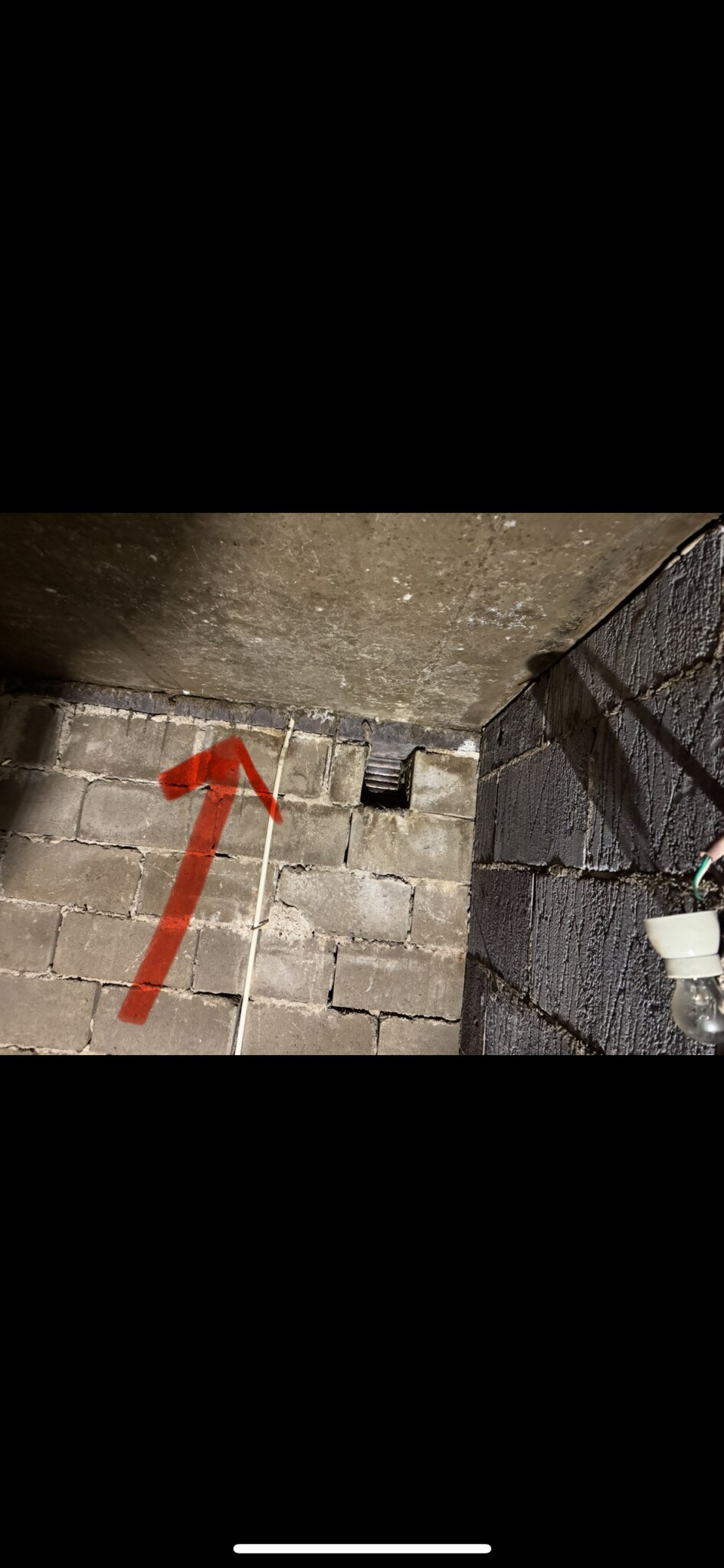
Are you sure that the concrete floor slab rests on aerated concrete and not on a cast beam on concrete hollow block, and that the cavity has then been filled with lightweight concrete? This is to achieve a smooth surface inside and also reduce the thermal bridge created by cast concrete all the way?
It's a bit hard to see in your picture, but if you look in the hole by the vent, can you see if it is aerated concrete all the way out to the outer edge of the basement wall and not just partially?
It's a bit hard to see in your picture, but if you look in the hole by the vent, can you see if it is aerated concrete all the way out to the outer edge of the basement wall and not just partially?
Hi!
Thank you for your response!
I actually didn't think about it, what I thought was that it was on a cast concrete base type just as thick as the hollow core blocks, but here you give me a good tip that I haven't thought of, I'll head out tomorrow right away and check it out?
You get a little nervous working near these blåbetong blocks, but I think it's not a danger as long as you don't cut into them.
Thank you for your response!
I actually didn't think about it, what I thought was that it was on a cast concrete base type just as thick as the hollow core blocks, but here you give me a good tip that I haven't thought of, I'll head out tomorrow right away and check it out?
You get a little nervous working near these blåbetong blocks, but I think it's not a danger as long as you don't cut into them.
What has been "dangerous" with the aerated concrete made with alum shale is radon and not fibers or dust (more than the "usual" risk with mineral dust in lungs) and radon daughters formed during the decay of radon. This results in some particles that can enter the lungs and cause alpha radiation. This is relatively harmless outside the body but not inside the body. Use a mask/respirator when tearing it down, and it's not much of a risk. It is, except when handling the dust from the concrete, something that also increases the risk of lung cancer with long exposure, decades, and especially in combination with smoking:
Read more here for a good understanding of what you should consider: https://www.stralsakerhetsmyndigheten.se/omraden/radon/vad-ar-radon/halsorisker-med-radon/
You can also test the aerated concrete you have to see if it is low or high-radiating.
Read more here for a good understanding of what you should consider: https://www.stralsakerhetsmyndigheten.se/omraden/radon/vad-ar-radon/halsorisker-med-radon/
You can also test the aerated concrete you have to see if it is low or high-radiating.
Thank you for your very good and detailed answers!!T Testarn said:What has been "dangerous" about the aerated concrete made with alum shale is radon and not fibers or dust (other than the "usual" risk of mineral dust in the lungs) and radon daughters formed during radon's decay. These result in particles that can enter the lungs and emit alpha radiation. It is quite harmless outside the body but not inside.
Use a face mask/respirator when demolishing so there's no major danger. Apart from handling the dust from the concrete, it's something that increases the risk of lung cancer with long exposure, decades, and especially in combination with smoking:
Read more here to get a good idea of how to think about it: [link]
You can also test the aerated concrete you have to see if it is low- or high-radiating.
Partition walls made of aerated concrete which are about 7cm thick can never be load-bearing, right? So they are free to demolish. According to the section drawing, only the wall in the middle of the house is load-bearing, and it also has, as seen on the drawing, a cast foundation.
No, a 7 cm inner wall made of aerated concrete is not load-bearing. However, it can have a stabilizing function against the basement wall/exterior wall to withstand earth pressure on a longer wall, so it depends a bit on where it is located and so on. There is a risk that a long wall of concrete hollow blocks might be pushed in by earth pressure if there are no stabilizing transverse walls.
Then you need to tear down and rebuild part by part. But can a wall made of steel profiles replace a 7 cm aerated concrete wall…? Or should one perhaps use brick or light concrete?T Testarn said:No, a 7 cm inner wall made of aerated concrete is not load-bearing. However, it can have a stabilizing function against the basement wall/external wall to withstand soil pressure on a longer wall, so it depends a bit on where it is located and so on.
There is a risk that a long wall made of concrete blocks is pushed in by soil pressure if there are no stabilizing transverse walls.

Two things to consider:
- Not all blue concrete is radioactive. Bring a meter and find out the facts before taking unnecessary actions.
- The amount of radiation is directly proportional to the amount of radioactive concrete. If you only have this row, it's likely still so little that it makes no noticeable difference.

Blue concrete is also used as insulation on the inside of concrete walls.
We have a similar cellar, but with wooden joists. The exterior walls are built with concrete block and a layer of blue concrete on top. All interior walls except for the core wall were blue concrete. The exterior walls in the family room and by the stairs have a layer of blue concrete on the inside.
We have demolished almost all the interior walls of blue concrete, with only a few linear meters left, and have demolished the walls gradually as we have renovated.
We have a similar cellar, but with wooden joists. The exterior walls are built with concrete block and a layer of blue concrete on top. All interior walls except for the core wall were blue concrete. The exterior walls in the family room and by the stairs have a layer of blue concrete on the inside.
We have demolished almost all the interior walls of blue concrete, with only a few linear meters left, and have demolished the walls gradually as we have renovated.
Thank you for your response!Demmpa said:
Blåbetong is also used as insulation on the inside of concrete walls.
We have a similar basement, but with wooden joists.
The exterior walls are built with concrete blocks and a layer of blåbetong at the top. All interior walls except the heart wall were blåbetong.
The exterior walls in the den and by the stairs have a layer of blåbetong on the inside.
We have torn down almost all interior walls made of blåbetong, only a few meters left, have dismantled the walls gradually as we have renovated.
Thanks for your response!Blåbetong is also used as insulation on the inside of concrete walls.
We have a similar basement, but with wooden floor joists.
The exterior walls are built with concrete hollow blocks and a layer of blåbetong on top. All interior walls except the heart wall were blåbetong.
The exterior walls in the recreational room and by the stairs have a layer of blåbetong on the inside.
We have demolished almost all the interior walls of blåbetong, just a few meters left, have demolished the walls gradually as we have remodeled.
Click here to reply
Similar threads
-
Is the blue concrete wall load-bearing?
Building Materials and Construction Technology -
Tear down blue concrete & possibly a load-bearing wall
Building Materials and Construction Technology -
Are 9 cm thick aerated concrete walls load-bearing?
Building Materials and Construction Technology -
Demolish load-bearing blue concrete wall
Building Materials and Construction Technology -
Technique for Replacing Load-bearing Interior Walls in Aerated Concrete
Building Materials and Construction Technology