
43,188 views ·
32 replies
43k views
32 replies
Beam - which material
Page 1 of 3


I am considering which material is most suitable for a beam that will replace a load-bearing wall (and support some roof trusses).
The span is approximately 6 meters. Since the beam must sit below the attic floor (there is no space for it on top this time), it's important that it is "low." Two support points, one at each end.
There are a few different options, glulam beam, Kerto, or steel. Perhaps it's also an option to cast (or buy a pre-cast) beam.
Can one generally say which of these might result in the lowest construction height? Width is less important.
It's also not entirely unimportant that the beam can be mounted reasonably easily. For example, it's not impossible that both steel and concrete might be too heavy to safely get into place...
The span is approximately 6 meters. Since the beam must sit below the attic floor (there is no space for it on top this time), it's important that it is "low." Two support points, one at each end.
There are a few different options, glulam beam, Kerto, or steel. Perhaps it's also an option to cast (or buy a pre-cast) beam.
Can one generally say which of these might result in the lowest construction height? Width is less important.
It's also not entirely unimportant that the beam can be mounted reasonably easily. For example, it's not impossible that both steel and concrete might be too heavy to safely get into place...
Steel is easy with 2 support points if you want to minimize the height. Wood is not suitable with that span. Concrete is not even worth considering since it's the steel that takes the tensile load... I say steel... However, you must fireproof insulate a steel structure. But that only requires about 30 mm... And you might get away with a VKR of around 250x150 somewhere.
Wood is not suitable for shear strength, I would think, although it depends on what the maximum beam height is...
Rambling on...blah...blah...blah...
came to the conclusion of steel
Wood is not suitable for shear strength, I would think, although it depends on what the maximum beam height is...
Rambling on...blah...blah...blah...
came to the conclusion of steel
I have slightly under 250cm in ceiling height so every centimeter is important.
VKR, does that refer to a rectangular profile?
250mm, is there really no way to reduce that measurement a bit?
Should it be a rectangular profile and not an H-profile? The latter would presumably be higher, reasonably.
I should probably talk to someone who can seriously calculate this. Hmm...there was someone here on the forum who did that...
VKR, does that refer to a rectangular profile?
250mm, is there really no way to reduce that measurement a bit?
Should it be a rectangular profile and not an H-profile? The latter would presumably be higher, reasonably.
I should probably talk to someone who can seriously calculate this. Hmm...there was someone here on the forum who did that...
A 200mm HEA or HEB beam should be most suitable. Maybe you can fit it into the attic joists by cutting the sub-frames of the rafters and then joining with perforated bands/flat iron instead. That's how I'll do it in our new build to avoid load-bearing partition walls and enable open-plan rooms.
Hmmmm....yeah, there I got some bad ideas.... more work. But the principle is straightforward:MrMagic said:A 200mm HEA or HEB beam should be most suitable.
Maybe you can fit it into the attic joist by cutting the lower frames of the trusses and then joining them with perforated metal strap/flat iron instead. That's how I'll do it in our new build to avoid load-bearing central walls and allow for through rooms.
*Cut the lower arms where the beam lies, attach the ends of the lower arms to the beam in a suitable way
*Fix the upper arms with the remaining lower arms with, for example, 21mm plywood on each side.
How do you attach the lower arms to the beam?
How do HEA, HEB, and VKR differ in terms of characteristics for hole strength? I'll soon have to dig out my old formula collection in Technology or whatever it was called....
I would probably choose HEB as well. Can't it be placed underneath and encased instead of cutting the rafters? For pure bending, an HE beam and a square tube (VKR) work about equally well. VKR is better for torsion. An I-beam is really mostly intended for pure bending, but it becomes very tall, and that's not what you wanted... If you choose HEB instead, it won't be as tall (but heavier...). HEB-200 has better bending resistance than an I-240.... On the other hand, VKR is available in multiple wall thicknesses, so you can choose a thick one and thus reduce the external dimensions.

Hello!
A 6m long HEB200 weighs 370kg and a HEA200 weighs 254kg. Not so easy to handle such a piece indoors....
If you describe on a drawing or sketch where the beam should be, we can calculate the loads more precisely and provide a suggestion.
6m is long for a slender beam - deflection requirements are difficult to meet. Consider what is most important - a slender beam with a pillar underneath or a large beam with a free span.
(If you have already removed another wall, you might also consider if you have any stabilizing walls left in the house after the next removal....)
/Engineer
A 6m long HEB200 weighs 370kg and a HEA200 weighs 254kg. Not so easy to handle such a piece indoors....
If you describe on a drawing or sketch where the beam should be, we can calculate the loads more precisely and provide a suggestion.
6m is long for a slender beam - deflection requirements are difficult to meet. Consider what is most important - a slender beam with a pillar underneath or a large beam with a free span.
(If you have already removed another wall, you might also consider if you have any stabilizing walls left in the house after the next removal....)
/Engineer
Here are guys with insight, I see - perfect!
I will come back with a sketch + picture of this practical case.
A pole is not an option - it would feel a bit too much like a gogo-dancer... Maybe in the bedroom but not in the middle of the living room....
I will come back with a sketch + picture of this practical case.
A pole is not an option - it would feel a bit too much like a gogo-dancer...
Maybe in the bedroom but not in the middle of the living room....With the deflection due to the span, it's inevitable... There will always be a deflection, even if you're far from the maximum load. Therefore, each truss that will be placed on the beam must be wedged up differently.
As a previous speaker mentioned, I also recommend an HEA or HEB beam. I have a strength table here with different beams and their strength properties. When comparing the ratio of bending resistance[mm^3]/height[mm], we get the following examples:
HEA 200: 2.05 (NOTE: 190mm high!)
HEB 200: 2.85
VKR 200x200x10: 1.87 (200x200x10 has approximately the same bending resistance as HEA/HEB 200.)
Therefore, you get the best bending resistance (=least deflection) per unit height if you choose an HEB. You must, of course, determine what loads may occur and then select a beam based on that.
Hope this helps you a little ;-)
//Magnus, Engineering Student in Mechanical Engineering.
As a previous speaker mentioned, I also recommend an HEA or HEB beam. I have a strength table here with different beams and their strength properties. When comparing the ratio of bending resistance[mm^3]/height[mm], we get the following examples:
HEA 200: 2.05 (NOTE: 190mm high!)
HEB 200: 2.85
VKR 200x200x10: 1.87 (200x200x10 has approximately the same bending resistance as HEA/HEB 200.)
Therefore, you get the best bending resistance (=least deflection) per unit height if you choose an HEB. You must, of course, determine what loads may occur and then select a beam based on that.
Hope this helps you a little ;-)
//Magnus, Engineering Student in Mechanical Engineering.
Ok, here is an attempt to provide additional information:
This is how it looks in reality:
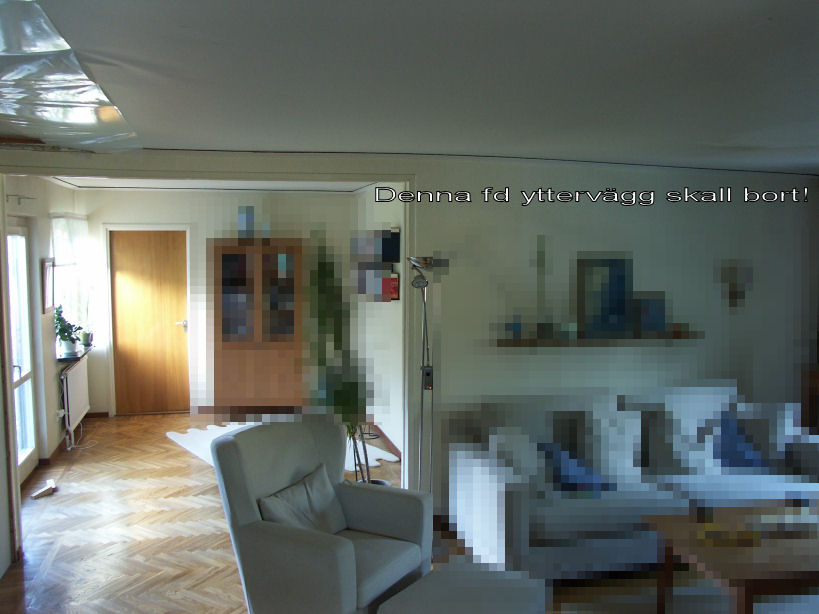
The wall behind the sofa is a former exterior wall (long side!) and it will be completely removed. In the extension beyond the wall, the attic joists are parallel with the former exterior wall. Furthermore, the wall that will be removed rests on the foundation wall, so a proper base for the beam's support points can be easily arranged (e.g., 3 pieces of 45x120 or 45x145 nailed together into a post).
The roof, like the house, is built at an angle, but I propose that the beam be calculated for loads as if the angled roof weren't there. The construction is a bit peculiar....
As observed, an opening has also been made without adequate support.
The drawing found at the link below specifies where the trusses are located. If we can manage with a beam around 200mm high, I would rather avoid installing the beam in the attic joist - underneath is sufficient.... it is likely to be tricky enough anyway..... 3-400kg seems fairly manageable though....
http://www.mugglo.net/mix/PICT2726s.JPG
The house is located in the 08 area.
As for forces and directions, I can't see anything other than exclusively vertical forces?
Is it possible to make some smart calculations on the beam dimensions in this context? Help is gratefully received!
This is how it looks in reality:
The wall behind the sofa is a former exterior wall (long side!) and it will be completely removed. In the extension beyond the wall, the attic joists are parallel with the former exterior wall. Furthermore, the wall that will be removed rests on the foundation wall, so a proper base for the beam's support points can be easily arranged (e.g., 3 pieces of 45x120 or 45x145 nailed together into a post).
The roof, like the house, is built at an angle, but I propose that the beam be calculated for loads as if the angled roof weren't there. The construction is a bit peculiar....
As observed, an opening has also been made without adequate support.
The drawing found at the link below specifies where the trusses are located. If we can manage with a beam around 200mm high, I would rather avoid installing the beam in the attic joist - underneath is sufficient.... it is likely to be tricky enough anyway..... 3-400kg seems fairly manageable though....
http://www.mugglo.net/mix/PICT2726s.JPG
The house is located in the 08 area.
As for forces and directions, I can't see anything other than exclusively vertical forces?
Is it possible to make some smart calculations on the beam dimensions in this context? Help is gratefully received!
We also need information on the size of the roof area that will rest on the beam, as well as a bit about how the roof is constructed.
I cannot take on the task of calculating which beam you should have since I do not have expertise in construction. In principle, the methods are the same, but one needs to know some regulations, etc.
I hope my previous post helped a bit..
I cannot take on the task of calculating which beam you should have since I do not have expertise in construction. In principle, the methods are the same, but one needs to know some regulations, etc.
I hope my previous post helped a bit..

A little tip if you are going to buy a beam. I need a simple reinforcement of a floor beam. I’m going to buy 4.5m flat steel 150mm.
I called a construction steel company and they wanted 3000 kr. Then I called a scrap metal company I found in the yellow pages, and their advertisement also mentioned that they sell "merchant steel" so it's not scrap you buy from them. There it will cost 600 kr.
With the cheaper option, I have to make the screw holes myself.
Edit: In a post a little higher up it said that you need to fireproof the beam. According to our engineer, it is not necessary in a house, only in public premises (and that discussion was about a slightly more advanced beam that we need in the next stage of our construction). However, it may need to be condensation insulated if it partially lies in the cold zone of the house.
I called a construction steel company and they wanted 3000 kr. Then I called a scrap metal company I found in the yellow pages, and their advertisement also mentioned that they sell "merchant steel" so it's not scrap you buy from them. There it will cost 600 kr.
With the cheaper option, I have to make the screw holes myself.
Edit: In a post a little higher up it said that you need to fireproof the beam. According to our engineer, it is not necessary in a house, only in public premises (and that discussion was about a slightly more advanced beam that we need in the next stage of our construction). However, it may need to be condensation insulated if it partially lies in the cold zone of the house.
The roof area can be estimated at about 25sqm.Magnus_Nordmark said:We also need information about the size of the roof area that will rest on the beam, and a bit about how the roof is constructed.
Now I can't commit to calculating which beam you should have as I don't have expertise in construction. In principle, it's the same methods, but you need to know some regulations, etc.
I hope my previous post helped a bit..
Magnus, all input is welcome, your info makes the choice of beam easier for a layperson since it is precisely height vs. deflection that are strongly governing parameters.