Is there any site where you can input "fact information" to find out how much an aluminum L-beam can support?
Aluminum: AW-6082
Length: 840 cm
Height: 10 cm
Thickness: 1 cm
Cannot get an answer from the supplier…. (Not the one below)
[link]
With such a profile, the load capacity also depends on how the load is applied and how the beam is braced. You will need to provide a bit more about the conditions and how it is used to get a relevant answer.
With such a profile, the load capacity also depends on how the load comes in and how the beam is braced. You'll probably need to provide a bit more detail about the conditions and how it's used to get a relevant answer.
Unfortunately, I am completely ignorant about this. But I'll explain as best as I can.
We have built a pool cover in pressure-treated wood over a pool measuring 8*4m. The pool cover rolls on rails under an elevated part of the deck. That function works brilliantly and rolls easily. The pool cover constantly rests on both short sides and the long side that goes under the elevated part of the deck. Motorized.
What unfortunately doesn't work is the long side that goes over the pool as it has no support underneath. The deck sags down maybe 5 cm in the middle of that long side, which means it doesn't come up on the other side and hits the pool edge.
The current framework consists of 195*45 as the frame and double 120*45 every 60 cm, one of which is tensioned to lift the troublesome long side. We have also tensioned 3 flat bars (10*1 cm) to further help lift. In total, our measures have lifted the long side maybe 10 cm but need to lift it at least 5 cm more.
So I am therefore looking for a way to straighten an 840 cm long 195*45 pressure-treated beam. I also tried tensioning a 4 m long flat bar but it did nothing and will be removed.
Due to the plot, I have no other way to move the pool cover. It is not possible to split the pool cover either.
Possibly a truss could contribute but the deck height of 195 mm, the carpenter thinks, makes it less effective. Rather increases the weight. Today, with decking on the pool cover of 120*20 and joists, I estimate the total weight of the pool cover to be about 1 ton.
Since aluminum is strong and shouldn't bend, I have received a tip that this is the solution. I am thinking of buying, for example, an L-profile and mounting it all around and reinforcing the corners with 3m aluminum beams.
I live in Kungsbacka, so we don't have direct snow, but should calculate 140 kg of snow load and perhaps another 200 kg as a possible person load.
But... I don't know how to calculate what, for example, an L-beam in aluminum can withstand.
Very grateful for help.
Attached is a quick video showing how it looks today.
It probably won't help at all. It will be too low. It will be like railway tracks roughly. Floppy like rubber on its own if you lift it.
I believe more in getting stainless steel sheets cut to the same height as the side. A small underbending of about 5cm and then everything welded together to get full length. Then screw it "quite" tightly. Some rows of screws every half meter or so. Maybe through with screws and nuts.
It probably won't help at all. It will be too low. It will be like railway tracks roughly. Flimsy like rubber in itself if you lift it. I believe more in getting stainless steel sheet cut to the same height as the side. A small underlap about 5cm and then everything welded together to get full length. Then screw it "fairly" tight. Some rows of screws every half meter or so. Maybe through with screw and nut.
From what I understand, aluminum doesn't bend like steel. It cracks instead. However, I can increase the height to about 195 mm.
See no reason to use aluminum here possibly except for corrosion resistance. Aluminum is about one-third as heavy as steel and also one-third as stiff. Here, the own weight gets lost somewhat in the overall weight of the pool cover so I would go for stainless steel to maximize stiffness.
If you envision a long profile running along the entire free edge of the pool cover, the goal is to make it as bend-stiff as possible. One part of the equation is the material, and steel is the stiffest we can achieve with reasonable means. The next challenge is which profile. It's essential to choose a cross-section with as much material as possible as far from the center (neutral plane) as possible. This maximizes the profile's moment of inertia. A U-beam where the flanges enclose the pool cover at the top and bottom is much better than just placing a sheet on the side, for example.
It is inevitable that constructions deform to some degree under their own weight (if we stay on Mother Earth). If you want it really straight, you can pre-camber the reinforcement, meaning you shape it so that it curves upwards before installation to compensate for the sagging of the whole side.
From what I understand, aluminum doesn't bend like steel. It breaks instead. However, I can increase the height to about 195 mm.
No, but an 8-meter profile like that is quite flimsy...........If you place such a profile on two chairs, it might hold up fairly straight with just its own weight. But then it needs to be loaded.......
See no reason to use aluminum here except possibly for corrosion resistance. Aluminum is about one-third as heavy as steel and at the same time one-third as stiff. Here, the self-weight is somewhat overshadowed by the entire weight of the pool enclosure, so I would go for stainless steel to maximize stiffness.
If you imagine a long profile running along the entire free edge of the pool enclosure, the goal is to make it as flexurally stiff as possible. One part of the equation is the material, and steel is the stiffest we can achieve with reasonable means. The next point is the profile choice. The key is to choose a cross-section with as much material as possible as far from the center (neutral axis) as possible. This maximizes the profile's moment of inertia. A U-beam, with flanges that encompass the top and bottom of the pool enclosure, is much better than just placing a plate on the side, for example.
You can't escape the fact that constructions deform to some degree due to their own weight (if we stay on Mother Earth). If you want to make it really straight, you can pre-camber the reinforcement, shaping it so that it arches upward before installation to compensate for the sagging of the entire side.
yes, that might be right. So when you say U-beam, what dimensions should it be? Is there a site where you can input the different variables to get the flexural stiffness?
For the mezzanine, we used two 10 cm IPE beams and boxed them with 4 mm Corten steel. Still deflected about 2-3 cm.
Would it work to use, for example, 3mm stainless steel sheet and make a beam in a rectangular box shape all the way?
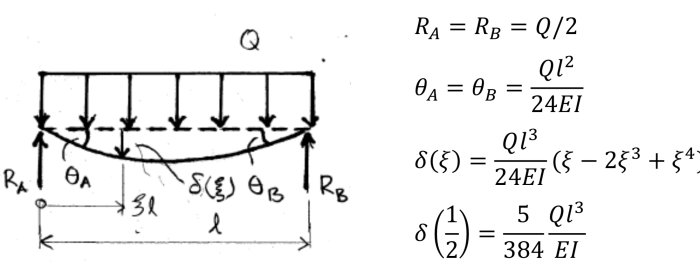
Below you can see the formula for deflection of a beam supported at two ends with distributed load (formula at the bottom).
Q = total load [N]
l (lowercase L) = length [mm]
E = elastic modulus of the material [MPa]
I (uppercase I) = moment of inertia of the cross-section [mm^4]
[image]
With the above units, the deflection is obtained in [mm]
Steel has E = 200,000 MPa and aluminum has E = 70,000 MPa.
You can get help with moment of inertia, for example, on this site:
[link]
Enter dimensions in [mm]. Use I_x.
Example: Box profile of steel with thickness 3 and inner dimensions 45x195 with length 8400 mm and 500 kg distributed load:
deflection = 5/384 x 500 x 9.81 x 8400^3 / (200000 x 6706773) = 28 mm
The simplest solution might be to add an additional wheel track in the middle of the cover and a detachable beam over the center of the pool. Perhaps an aluminum profile for weather resistance/lightweight.
The simplest solution might be to add an extra wheel track in the middle of the cover and a detachable beam across the middle of the pool. Perhaps an aluminum profile for weather resistance/lightweight.
That does sound like the absolute simplest... but perhaps not the most elegant solution.
Before the roof is pulled over, TS lays out a profile (a ramp) for the wheels in the middle to roll on.
The profile should be as stiff as possible, but if a lying U-profile is used, the far support beam will be drawn over the pool edge where it currently touches.
Yes, it is a smart idea and a simpler solution. But it feels like a shame when TS has already made such a big investment to be able to cover the pool with the push of a button. A good plan B!

Huggedugge1 said:
Bernieberg said: