
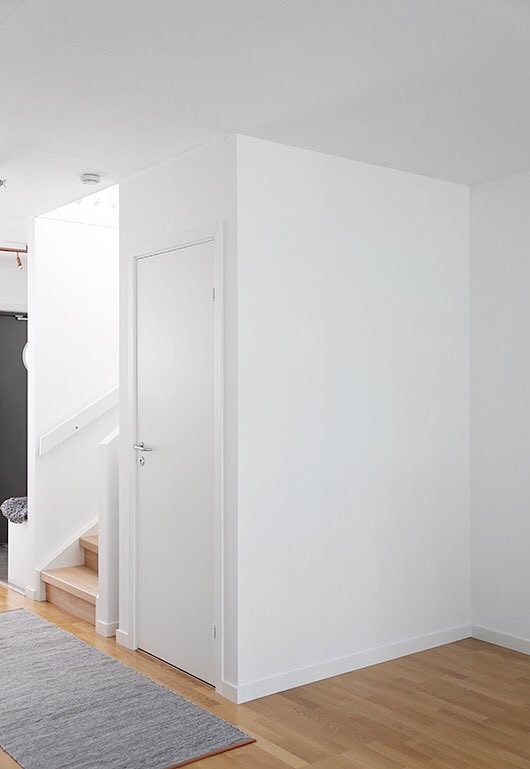
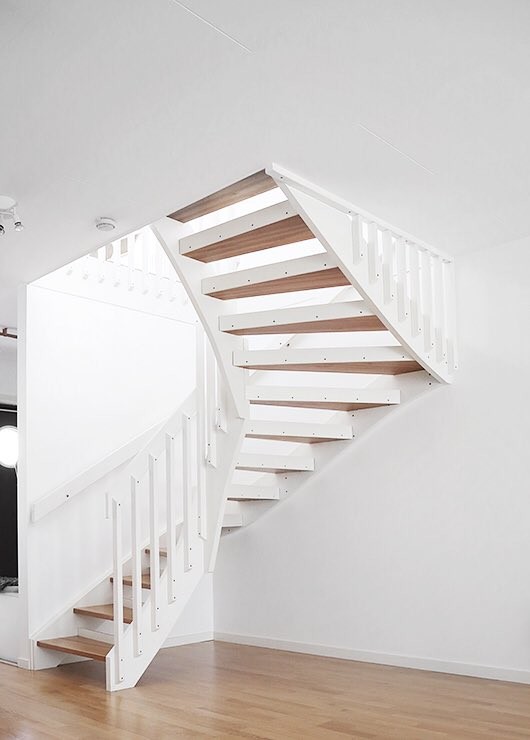
There are plans to enclose the staircase to create a more furniture-friendly area in the living room and, as a bonus, a new, sturdy storage room. We also plan to lay new parquet flooring throughout the ground floor. We imagine something similar to the attached images.
I am considering the attachment of the sill. Should it be done directly into the concrete slab, or can we lay the floor first and attach the sill to the floor instead? I think the latter is good if we decide to take down the wall in the future. Plus, we would like to lay the floor as soon as possible and maybe save the storage project a bit.
It concerns a concrete slab on the ground with underlying insulation and no underfloor heating.
So, three questions:
- Attachment of the sill to the concrete slab or to the floor? Which is preferable, and what are the pros and cons?
- What does a correct attachment look like if done in the concrete slab? Drill, plug, and sill paper between the wooden stud and the slab? Or is it better to use steel studs?
- What does a correct attachment look like if done directly to the floor? Can it be glued or taped to avoid drill holes?
I am considering the attachment of the sill. Should it be done directly into the concrete slab, or can we lay the floor first and attach the sill to the floor instead? I think the latter is good if we decide to take down the wall in the future. Plus, we would like to lay the floor as soon as possible and maybe save the storage project a bit.
It concerns a concrete slab on the ground with underlying insulation and no underfloor heating.
So, three questions:
- Attachment of the sill to the concrete slab or to the floor? Which is preferable, and what are the pros and cons?
- What does a correct attachment look like if done in the concrete slab? Drill, plug, and sill paper between the wooden stud and the slab? Or is it better to use steel studs?
- What does a correct attachment look like if done directly to the floor? Can it be glued or taped to avoid drill holes?
Hello
Option 1 If the wall is placed directly on the slab, the easiest way is to use sheet metal spacers that you attach with screws, concrete screws, or something similar. These spacers also have a finished sill paper, but they are significantly more expensive than wooden studs.
Option 2 If you choose to lay the parquet first, it’s not good to screw the sill down because then the parquet can't move, posing a risk that the floor might lift somewhere. However, there are several systems where you can build walls that are simply pressed against the floor and ceiling to avoid screw holes and locking the parquet. Just Google "wall without screwing into the floor" and a dozen different systems will come up. I haven't tried them myself, so I can't say how good/bad they are.
Option 1 If the wall is placed directly on the slab, the easiest way is to use sheet metal spacers that you attach with screws, concrete screws, or something similar. These spacers also have a finished sill paper, but they are significantly more expensive than wooden studs.
Option 2 If you choose to lay the parquet first, it’s not good to screw the sill down because then the parquet can't move, posing a risk that the floor might lift somewhere. However, there are several systems where you can build walls that are simply pressed against the floor and ceiling to avoid screw holes and locking the parquet. Just Google "wall without screwing into the floor" and a dozen different systems will come up. I haven't tried them myself, so I can't say how good/bad they are.
Thanks for the tips!Visionw1994 said:
Hi
Option 1 If the wall is placed directly on the slab, the easiest way is to use metal brackets that you attach with spix, concrete screws or something similar. These brackets also have a ready-made seal paper, however, they are significantly more expensive than wooden studs.
Option 2 if you choose to lay the parquet first, it is not good to screw the sill as the parquet cannot move and there is a risk that the floor will rise somewhere. But there are several systems where you can build walls by just placing with pressure against the floor and ceiling to avoid screw holes and locking the parquet. Just google for wall without screwing into floor and a dozen different systems will come up. Nothing I've tried myself so can't say how good/bad they are.
I understand that the most correct way is to attach the interior wall directly to the concrete slab. But we would like to lay the floor first and wait with building the storage until later, so we are leaning towards option two. I have looked at a solution where the sill sits loosely against the floor and the wall is clamped using this technique:
https://fixarfarsan.se/2015/02/regla-upp-innervagg-utan-att-skruva-i.html?m=1
It should become extra stable considering it will be an interior wall with an angle.
A third option is to lay the floor first and then cut the floor afterward to be able to attach the wall to the bottom slab after all. I have been searching for a description of how this can practically be done. Can anyone help me with that?
Circular saw set to the correct depth will handle most of the work. And then the final part with, for example, a multitool.N Nossungam said:

Click here to reply
Similar threads
-
What type of fastening for this interior wall?
Building Materials and Construction Technology -
Risk with water pipe new interior wall
Building Materials and Construction Technology -
Building a new interior wall on a concrete floor with heating coils
Building Materials and Construction Technology -
Hur snyggar jag till efter rivning av innervägg och tak?
Färg, Måla & Tapetsera -
Ta ner innerväggar (trätex) och sätta upp nya eller lappa och laga
Badrum