
13,178 views ·
14 replies
13k views
14 replies
Attaching floor joists to sill
Hello
I'm asking you experts if it is OK to notch the floor joists 20mm and place them on the sill?
I have replaced the sill and cast the foundation wall a few cm to level it.
I am now thinking of placing a 195x45 sill. The floor joists have dimensions of 170x45.
To achieve the desired floor height, I need to notch the floor joists 20 mm before placing them on the sill. Is such an adjustment OK to make?
Is there perhaps another smarter way to attach the floor joists?
Maybe there are some types of joist hangers that work in such a case?
Thanks in advance
/beppe
PS.
I am attaching a picture showing how the floor joists meet the sill and foundation wall.
DS
I'm asking you experts if it is OK to notch the floor joists 20mm and place them on the sill?
I have replaced the sill and cast the foundation wall a few cm to level it.
I am now thinking of placing a 195x45 sill. The floor joists have dimensions of 170x45.
To achieve the desired floor height, I need to notch the floor joists 20 mm before placing them on the sill. Is such an adjustment OK to make?
Is there perhaps another smarter way to attach the floor joists?
Maybe there are some types of joist hangers that work in such a case?
Thanks in advance
/beppe
PS.
I am attaching a picture showing how the floor joists meet the sill and foundation wall.
DS
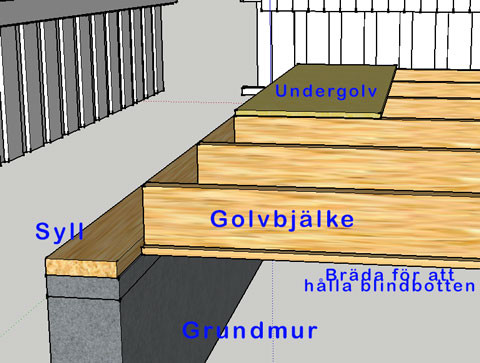
Last edited:


No, it is not appropriate to notch the beams on the underside of the ends, without other measures, as it weakens the wood. However, if you can place a ledger at 90 degrees against the sill, or some form of joist hanger, that the underside of the floor beam can rest against, it is OK.
A notch as small as 20 mm is no problem in a regular floor joist; a calculation of shear capacity suggests that approximately 70 mm is okay for a typical house floor joist with a span of 3.8 m.J justusandersson said:
If you only look at shear forces and torques (which are zero at the support), there are no problems. However, wood is not a homogeneous material. A notch on the underside constitutes a weakening and a potential crack initiation that should be avoided. On the other hand, it's fine to notch at the top side, but it's rarely a preference.
20mm is okay. But as mentioned, it constitutes a crack indication but not to the extent that it would cause any problems.
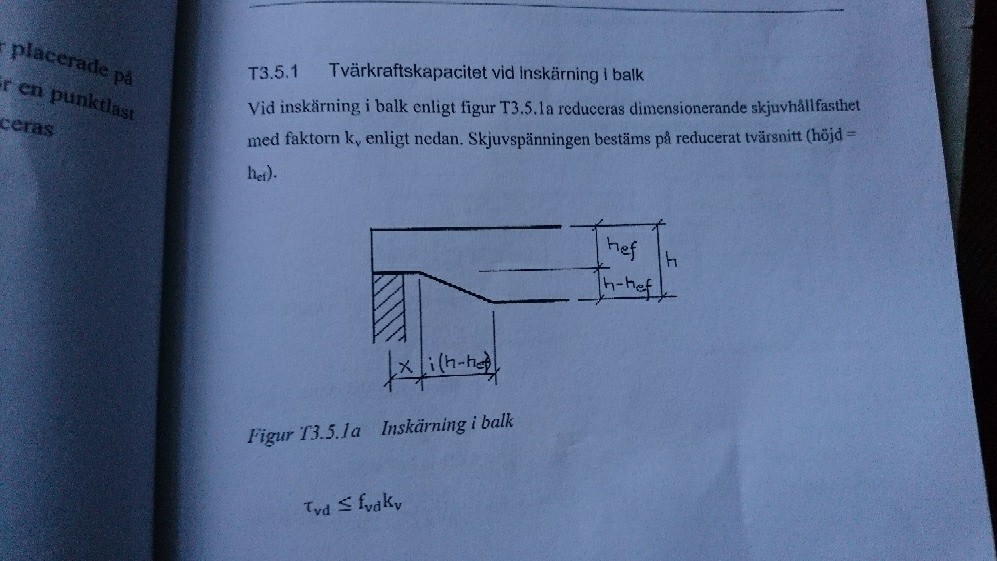
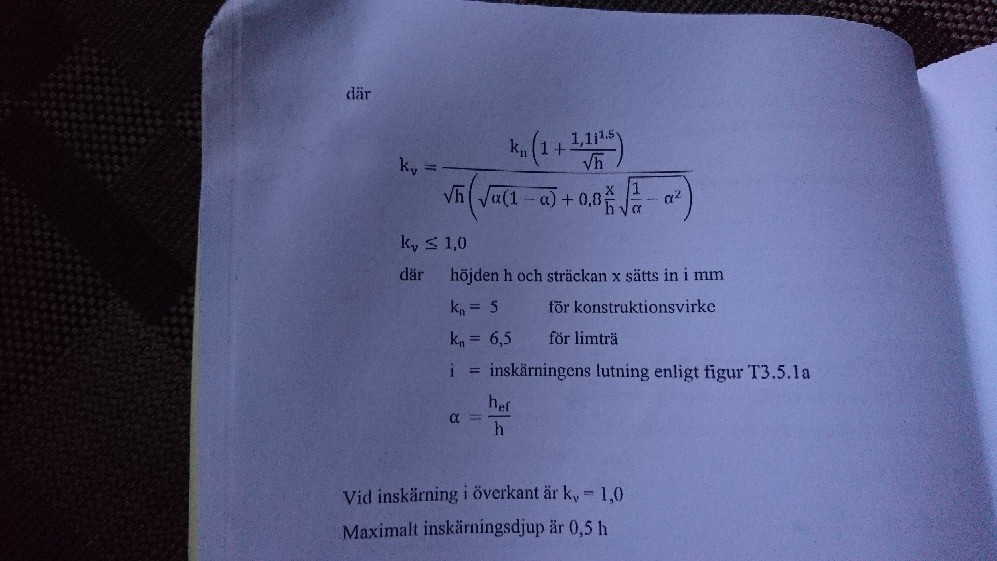
I don't think it's a sustainable approach. If you don't have access to the eurokoderna, can't calculate the shear force, don't know what shear stress is, then it's a better rule of thumb to never notch the underside. Especially since it's always possible to arrange a proper support. The advice given on Byggahus must be simple and understandable.
No, TS does not get a real answer. A direct connection, as TS wishes to do, is not the same as the one described in the Eurocode. Additionally, we do not know the span, the load, and therefore whether 45x170 is a reasonable choice.
I am very grateful for all the input!
The room in question is 4.5 x 3.2 meters, so the span is not large, the entire beam will be 4.5 meters with a supporting beam at 2250 mm.
It doesn't feel like there should be any danger of structural integrity or that the construction will collapse, but it doesn't hurt to ask.
The room in question is 4.5 x 3.2 meters, so the span is not large, the entire beam will be 4.5 meters with a supporting beam at 2250 mm.
It doesn't feel like there should be any danger of structural integrity or that the construction will collapse, but it doesn't hurt to ask.
"i=1" for 90-degree urjack, also exists in eurocode
The latest data changes a lot. With an actual span of 2.25 m, 45x170 (if it is C 24) is an over-dimensioning. It's fine to notch 20 mm at 90 degrees because even 45x150 would handle the job.
then many of our older houses should be ready for demolitionJ justusandersson said:If you only look at shear forces and torque (which are zero at the support), there are no problems. But wood is not a homogeneous material. A notch on the underside constitutes a weakening and a potential fracture indication that should be avoided. However, it is fine to notch on the top side, but that is rarely desirable.
Click here to reply