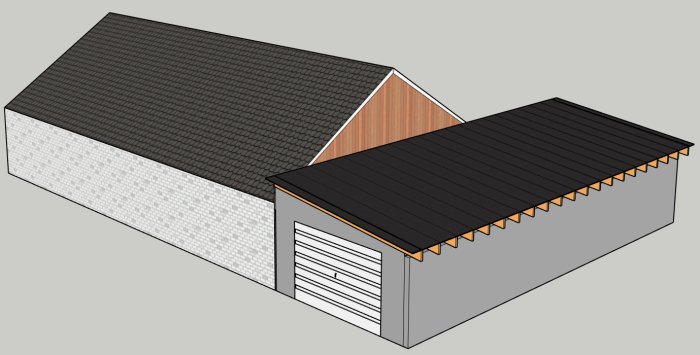
I am currently in the process of connecting the garage to the house.
The house is a brick veneer house with a wooden frame from 1970.
Since one of the short sides of the house will now become part of the garage, this exterior wall will now become an interior wall, and I am wondering what to do with the air gap behind the brick (30 mm air gap according to the construction drawings).
The entire short side of the brick veneer wall will end up inside the garage, so to speak.
I have looked and shone a light as best as I could behind the brick, and from what I can see, the air gap does not run unbroken around the entire house, like a border. It seems that it is sealed at the outer edges (so that there is an air gap compartment for each wall).
Had the air gap been unbroken around the entire house, I assume it would have been necessary to remove the brick at the outer ends to seal the gap with foam or the like, but I assume that in my case, I don't need to bother?
At most, you might consider placing a vent at the bottom in each corner for ventilation?
The plan is to install an air/air heat pump when the roof and walls are insulated, sealed, and plastered to maintain, say, 18 degrees year-round in the garage.
Bonus question;
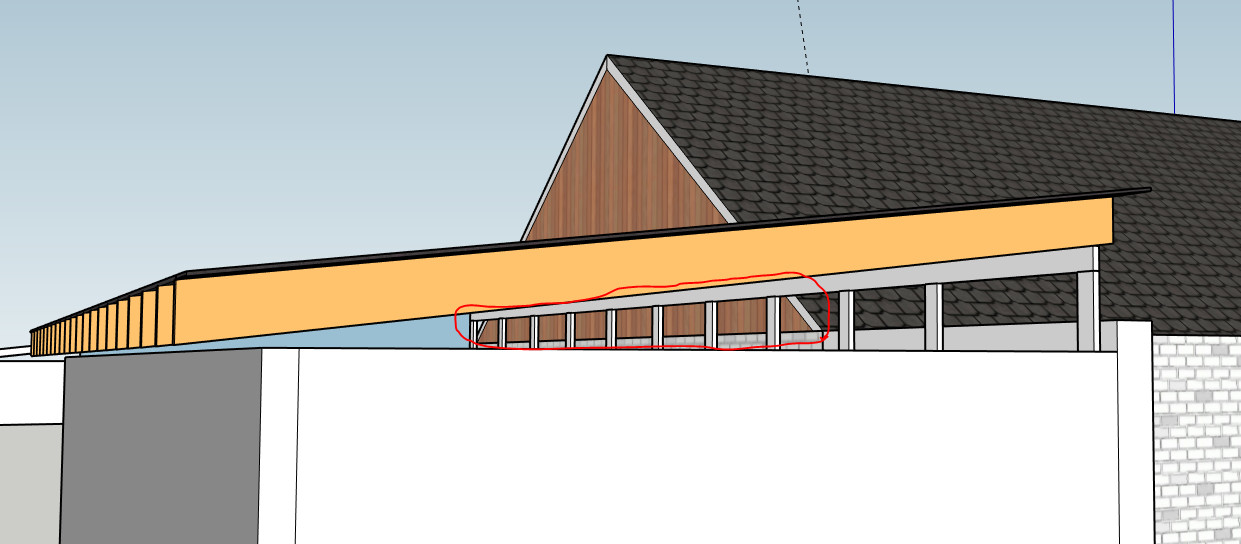
The trusses on the garage's pitched roof go up and into the attic a little bit where they are anchored. I strongly suspect that the entire wall facing the living area should *not* have a vapor barrier. Correct?
Spontaneously, without having thought too much about your first question, there shouldn't be any risk since it's one "compartment" per wall. The risk is otherwise that you might get warm humid air in the air gap which can condense. Possibly it could be a problem at the corners of the house but that's a bit far-fetched. Where in the country is the house?
Interested in the question as we hopefully, at some point, can build something similar.
Spontaneously, without having thought much about your first question, it shouldn't be a problem as it's a "compartment" per wall. The risk is otherwise that you could get warm humid air in the air gap that condenses. Possibly it could be a problem in the corners of the house but that's a bit far-fetched. Where in the country is the house?
Interested in the issue as hopefully, sometime, we can build something similar.
No, that's kind of what I'm thinking too. However, I can't guarantee that it is actually one compartment per wall because I can't access enough to see properly, and it's not clear from the drawings I have either.
The house is located in southern Halland.
The question is whether it's a sensible idea to seal the ventilation holes in the lower brick course if it is open between the long sides and the gable in order to avoid the risk of letting in warm moist air?
There are USB inspection cameras with a long cable at Biltema for a reasonable price that might work?
The question is whether it's a sensible idea to seal the ventilation holes in the lower brick course if it's open between the long sides and the gable, to avoid the risk of letting in warm humid air?
There are USB inspection cameras with long cords at Biltema for a reasonable price that might work?
Then I can tell you that there isn't a single ventilation hole anywhere on the facade
But I'll take your idea with a small inspection camera to heart!
However, I don't know if I should install a couple of ventilation grilles in the brick just for the sake of it.
Normally, ventilation is done by not having mortar between every 4-5 bricks in the bottom layer, so no vent grilles are needed. But you don't have that either, then?
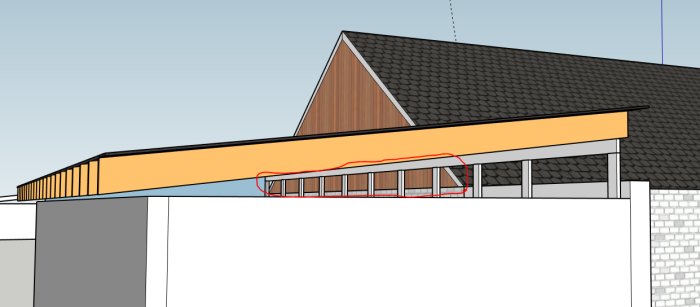
What is the general opinion regarding applying plastic where the roof trusses go up into the attic?
Of course, I won't be applying plastic to the actual mexitegel wall as it already has plastic on the inside.
I assume one would preferably want to apply plastic to prevent warm, humid air from condensing in the attic insulation?
Attached is a picture with a red marking on the area;
Hello, I have the same question. I am going to build a garage against a mexitegel wall. However, it will probably be completely freestanding, but I plan to keep the mexitegel wall as part of it since otherwise it would be too much work to tear down the brick. But what should be considered and how do you handle ventilation and drainage in the wall when it becomes warm?
Click here to reply
Vi vill skicka notiser för ämnen du bevakar och händelser som berör dig.



mexitegel said:
Spontaneously, without having thought much about your first question, it shouldn't be a problem as it's a "compartment" per wall. The risk is otherwise that you could get warm humid air in the air gap that condenses. Possibly it could be a problem in the corners of the house but that's a bit far-fetched. Where in the country is the house?