
21,529 views ·
17 replies
22k views
17 replies
Asbestos in mortar from the 1920s?
Hey, I'm a bit paranoid about asbestos when we're tearing down our house from '23. There are some later added eternit panels out on the balcony, but otherwise, we don’t know much.
For those who know, how common was eternit in building materials in '22?
There is some kind of tar paper under the panel.
I'm wondering if it could be in the foundation and chimney?
And is there any way to find out?
Best regards/
For those who know, how common was eternit in building materials in '22?
There is some kind of tar paper under the panel.
I'm wondering if it could be in the foundation and chimney?
And is there any way to find out?
Best regards/

In 1922, asbestos existed as a material, but as far as I know, it hadn't begun to be used so extensively as a building material. The significantly increased use occurred after World War II.
So for these specific reasons, the risk isn't that great that you have asbestos in those oldest parts. But still no guarantee.
Have you seen the fact thread here about asbestos?
So for these specific reasons, the risk isn't that great that you have asbestos in those oldest parts. But still no guarantee.
Have you seen the fact thread here about asbestos?
Even if there is asbestos in the house, it is hardly economically justifiable to hire a specialized firm every time you want to do some work. Work with a proper protective mask, vacuum with a HEPA filter when the dust settles, and wash your clothes after completing the job. If you do this, you probably won't need to worry about your health (for that reason, at least).
Asbestos began to be used in building materials in the 1920s, including in Sweden. During World War II, it was difficult to access due to the war, but after the war, asbestos in building materials was resumed.
The previous recommendation should not be followed. It’s one thing to protect yourself while working with a mask, but if the workspace has not been properly isolated from the rest of the house when processing the material, asbestos dust will spread to other areas of the house through ventilation and non-sealed surfaces in doors, ceilings, and walls, as well as your clothes when you need to leave the area for a break. Consider this if you intend to live with family, etc., in the same house. You should regard most things as potentially asbestos-containing, i.e., typically suspect materials such as mortar, tile adhesive/grout, glue (floor/wet wallpaper), vinyl materials, pipe insulation, attic and wall insulation, fireplace insulation, stove insulation, etc. Send samples for analysis before tearing into anything. "Once is not so dangerous" does not apply to asbestos. All exposure should be avoided; there is no threshold value below which it is not dangerous.
Any processing resulting in airborne asbestos particles should be done professionally and properly. You can do it yourself, but in that case, follow the procedures properly.
The previous recommendation should not be followed. It’s one thing to protect yourself while working with a mask, but if the workspace has not been properly isolated from the rest of the house when processing the material, asbestos dust will spread to other areas of the house through ventilation and non-sealed surfaces in doors, ceilings, and walls, as well as your clothes when you need to leave the area for a break. Consider this if you intend to live with family, etc., in the same house. You should regard most things as potentially asbestos-containing, i.e., typically suspect materials such as mortar, tile adhesive/grout, glue (floor/wet wallpaper), vinyl materials, pipe insulation, attic and wall insulation, fireplace insulation, stove insulation, etc. Send samples for analysis before tearing into anything. "Once is not so dangerous" does not apply to asbestos. All exposure should be avoided; there is no threshold value below which it is not dangerous.
Any processing resulting in airborne asbestos particles should be done professionally and properly. You can do it yourself, but in that case, follow the procedures properly.
Last edited:
Wow, that's going to be expensive. So, you're supposed to start by sending all suspected building materials for analysis if you're going to demolish a house built between 1920 and (approximately) 1980?
I don't mean to downplay your knowledge in the area, but I think you're overdramatizing. There are no indications that there would be more asbestos in this house than in any other. You have to make a sober assessment of risk versus cost.
I don't mean to downplay your knowledge in the area, but I think you're overdramatizing. There are no indications that there would be more asbestos in this house than in any other. You have to make a sober assessment of risk versus cost.



I agree that it sounds unreasonable to have asbestos in the chimney and foundation from 1923. It was common for chimneys to be built with bricks and lime mortar. Foundations were also built and often used natural stone bonded with lime mortar. Concrete became popular around this time, so the foundation might also be cast, typically with large amounts of natural stone to save on concrete. In general, unlike today, labor was cheap, and materials were expensive. You wouldn't buy building materials unless absolutely necessary.
I have a house from 1920, and the asbestos materials present were added later, likely mostly after the war: Eternit panels, ventilation ducts in Eternit, and Eternit plate in cast iron vent.
I have a house from 1920, and the asbestos materials present were added later, likely mostly after the war: Eternit panels, ventilation ducts in Eternit, and Eternit plate in cast iron vent.
Yes new and new, well. Asbestos had been "in the service of mankind" long before. Yes, a few thousand years according to English Wikipediathomas33 said:
https://en.wikipedia.org/wiki/Asbestos
In Sweden, Eternit and asbestos cement began to be manufactured under license in 1906-1907
https://sv.wikipedia.org/wiki/Asbestcement
So asbestos was present to some extent in building products in 1922.
Personally, I wouldn't suspect the mortar in a building from 1922 to contain asbestos. But it probably cannot be completely 100% ruled out.


Looking at the original question from TS, namely tar paper, mortar in the foundation and chimney, I see it as almost entirely unlikely that asbestos would have been used as a deliberate active component at that time. Claes explains well how frugality was often necessary even in the relatively recent past, perhaps it's time to dust that off going forward so there's no need to be ashamed of the use of the word economy.
And academia has provided many good contributions in the asbestos threads, but it doesn't need to go to extremes when many threads here may be based on fears founded in something else, and not always related to asbestos in the actual case.
And academia has provided many good contributions in the asbestos threads, but it doesn't need to go to extremes when many threads here may be based on fears founded in something else, and not always related to asbestos in the actual case.
And it should probably also be pointed out that the word asbestos cement here refers to the cement mixture used for manufacturing the Eternit panels.Mikael_L said:
If I haven't misunderstood something now, the asbestos cement was not sold in general form in bags at hardware stores, but was only used within the Eternit factory.
You do get a bit paranoid undeniably. At the same time, you have to think about how much dust the average carpenter/plumber/electrician has been exposed to over the years without being affected to a significant extent.
Does anyone know if asbestos was used in porous plates?
I saw some text on a plate that said something like xxxnit xnxx shot
Xxx are unclear letters... unfortunately, I've torn quite a bit of those without protection...
Just as it's written, it's the children you're worried about.
Thanks for all the input anyway.
Best regards/
Does anyone know if asbestos was used in porous plates?
I saw some text on a plate that said something like xxxnit xnxx shot
Xxx are unclear letters... unfortunately, I've torn quite a bit of those without protection...
Just as it's written, it's the children you're worried about.
Thanks for all the input anyway.
Best regards/
I did not mean that there would be more asbestos in this house than in any other. Nor that you have to send everything for analysis. However, such material should be considered potentially asbestos-containing, rather than taking a chance and hoping it is not.tacho said:Jeez, that is going to be expensive. You're supposed to start by sending all suspected building materials for analysis if you are going to demolish a house built between 1920 and (about) 1980?
I don't mean to belittle your knowledge in the area, but I think you are overdramatizing. There are no indications that there would be more asbestos in this house than in any other. One must make a sober assessment of risk versus cost.
The point was more to adapt one's work with such material, so as not to spread dust. That is, work according to all the rules of the art, no matter how tiresome it may be. A protective mask and a bit of HEPA vacuuming afterwards are usually far from sufficient if it involves activities where you create airborne asbestos fibers.
Asbestos can occur in porous boards. What do the boards look like?Kapten_Haddock said:You do become a bit paranoid, undoubtedly. At the same time, you have to consider how much the average carpenter/plumber/electrician has been exposed to dust over the years without being significantly affected.
Anyone know if asbestos was used in porous boards?
I saw some text on a board where it said something like xxxnit xnxx shot
Xxx are unclear letters.. unfortunately, I've torn quite a bit of such without protection...
Just like it's written, it's the children you're worried about.
Thanks for all the input anyway.
Regards/
Internit was already present in the 20s, for use inside facades and interior walls, etc. But I can't comment on how "porous" internit is. https://s1.whbo.nl/uploads/order/406/793ad6d855edbe49238031b04ec16523f3956bab.jpg
It's like a slightly structured waffle pattern. Looks like regular porous boards, slightly lighter than masonite-colored. They are found both inside the walls and outside. However, I'm not going to tear into it any more, but one should be careful if it happens. It's undeniably a pretty big mistake that was made when it was mixed into materials.
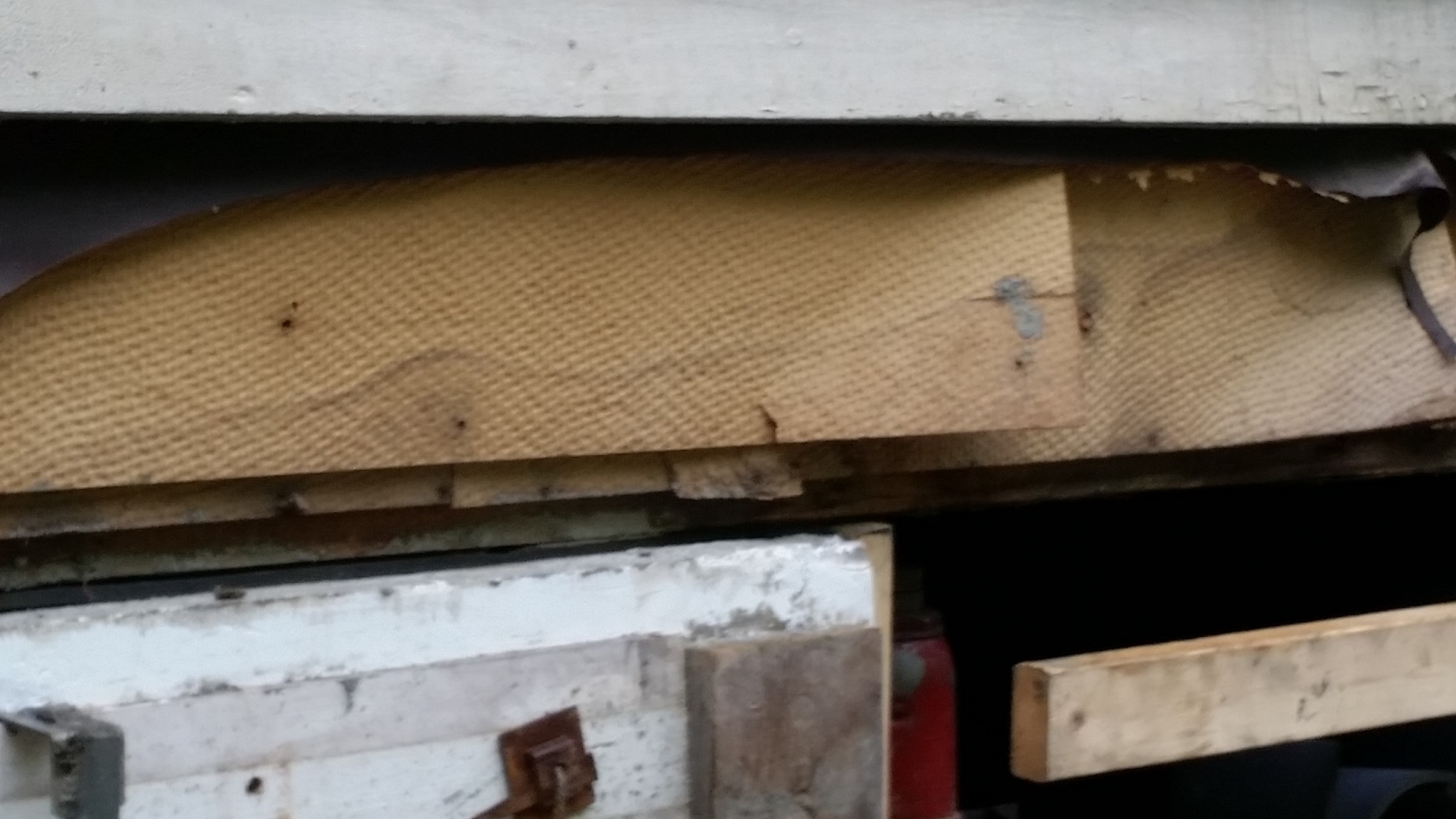
This is what they look like.