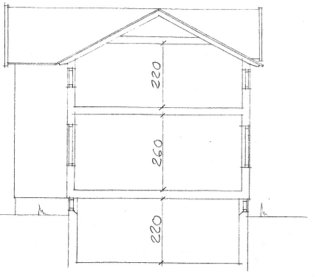
Hi! I'm thinking about doing some renovations on the upper floor of our old house. The house was probably built sometime in the 1920s, with the entire ground floor made of logs and the upper floor constructed as a "spånlåda." The house was likely raised sometime in the 1940s or 1950s. The house measures approximately 6x12 meters.
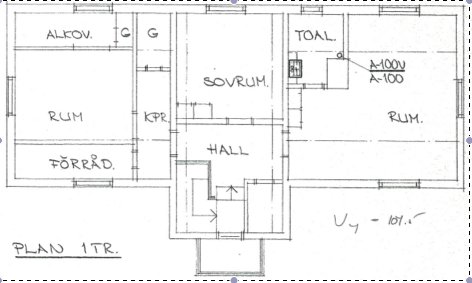
The room I want to renovate is the one on the left on the upper floor. The plan is to remove the wall between the room and the alcove, and move the wall between the room and the storage towards the window on the gable, thereby creating a larger room out of the storage area. The large room to the right is completely open, and as far as I can see, the trusses on that side are the same as on the left side.
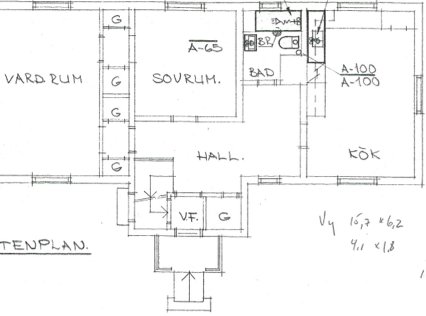
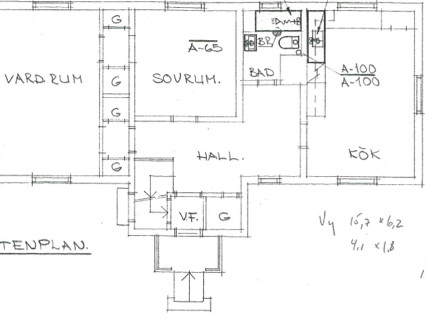
Below the rooms I want to change is a single large living room without any walls supporting the upper floor walls.
Spontaneously, it feels like moving the wall towards the storage shouldn't affect the load-bearing capacity at all, since the new wall should support about the same amount?
Regarding the wall to the alcove, it feels a bit trickier, but it seems to work on the other side of the house?
The walls against the alcove and storage are likely part of the truss construction. In that case, you need to let a structural engineer look at it.
Edit: I didn't see the part about the trusses looking the same on the right side. But I maintain that you should consult a structural engineer. It's entirely possible that the right side has also been modified incorrectly at some point, but has never been subjected to maximum load. Or there might be reinforcements that you don't see.
I am currently renovating the large room now, and there are no traces of previous walls, neither on the subfloor, ceiling paper, nor the raw board above the ceiling paper, so I believe that layout is original.
I can add that the walls of the storage room and alcove consist of horizontal studs and horizontal raw board, and in total they are just over 1 dm thick. The wall between the room and the kpr definitely does not seem to have any load-bearing function, as it mostly consists of tretex.
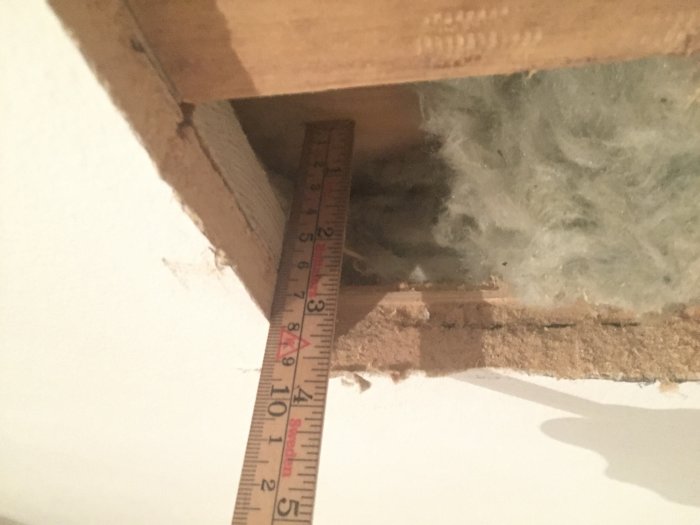
Reviving this thread as the project has become relevant again. Made a pilot hole in the wall between the storage and room today:
The wall consists of 15mm tretex, 20mm raw wood, 43mm studs, 20mm raw wood.
My goal is to move the wall about 50 cm closer to the center, so that it ends just before the window on the gable wall. The floor joists that the wall rests on run along the gable of the house.
I plan to leave the wall between the room and alcove as it is.
I can add that the trusses on the other side are identical, and when I renovated that room I found nothing to suggest that it had been remodeled or any wall had been demolished.
The house previously had a tile roof, but now it is sheet metal.
No one? I can further add that I plan to build the new wall with 45mm studs and OSB glue-screwed on both sides, then plasterboard on top of that.
Since the other room with the same trusses has 6 meters without wall support, these mere four meters should manage excellently even if I move the existing wall about half a meter.